


Quercus lyrata, overcup oak
Sullivan, Janet. Quercus lyrata, overcup oak. 1993. In: Fire Effects Information System, [Online]. U.S. Department of Agriculture, Forest Service, Rocky Mountain Research Station, Fire Sciences Laboratory (Producer). Available: https://research.fs.usda.gov/feis/species-reviews/quelyr
| Abbreviation | Common Name | Scientific Name | Classification | Status |
|---|---|---|---|---|
| Plants | ||||
| QUELYR | overcup oak | Quercus lyrata | Life Form: Plants/Tree Kingdom: Plantae Class: Dicot Order: Fagales Family: Fagaceae Genus: Quercus | Fed. Protected: No Nativity: Native Invasiveness: Noninvasive |

Taxonomy
The currently accepted scientific name of overcup oak is Quercus lyrata Walt. [18,28]. Two accepted forms are differentiated [7]:
- Q. l. forma lyrata, with hairy undersurfaces,
- Q. l. forma viridis Trel., with scattered hairs on leaf undersurfaces.
Overcup oak hybridizes with many other oaks in the white oak subgenus (Quercus) including white oak (Q. alba), swamp white oak (Q. bicolor), Durand oak (Q. durandii), bur oak (Q. macrocarpa), swamp chestnut oak (Q. michauxii), post oak (Q. stellata), and live oak (Q. virginiana) [28]. Overcup oak is genetically most similar to post oak, based on electrophoretic evidence [14].
Synonyms
- No entry
Other Common Names
swamp post oak, swamp white oak, water white oak
General Distribution
Overcup oak occurs on the Coastal Plain from southern Virginia south to Georgia and northwestern Florida; west to eastern Texas; north in the Mississippi Valley to extreme southeastern Oklahoma, southern Illinois, southwestern Indiana, and western Kentucky. Disjunct populations occur in Delaware, Maryland, central Tennessee, and northern Alabama [27,28].
States
- United States: AL AR DE FL GA IL IN KY LA MS MO NC OK SC TN TX VA WV
Site Characteristics

Overcup oak, Bowie County, Texas. (CC BY-NC 4.0)
Overcup oak occurs on low, wet soils in floodplain forests, bottomlands, streambanks, and bayous, and sometimes on adjacent lower slopes [7,12]. It occurs most often on soils with a moderate water table depth. Sites are commonly flooded for 29 to 40 percent of the growing season [15,16,39].
Plant Communities
Overcup oak is dominant in only one described cover type, overcup oak/water hickory (Carya aquatica) [8]. This cover type extended over 1,241,250 acres (496,500 ha) of the lower Mississippi Valley in 1990. It was the most floristically diverse of the wet-site cover types, with five species making up 60 percent of the basal area [30].
Tree associates not mentioned previously include laurel oak (Q. laurifolia), American elm (Ulmus americana), cedar elm (U. crassifolia), water locust (Gleditsia aquatica), common persimmon (Diospyros virginiana), hawthorn (Crataegus spp.), planer-tree (Planera aquatica), and red maple (Acer rubrum). Shrub associates include swamp-privet (Forestiera acuminata), roughleaf dogwood (Cornus drummondii), swamp dogwood (C. stricta), and common buttonbush (Cephalanthus occidentalis) [12,39].
Botanical Description

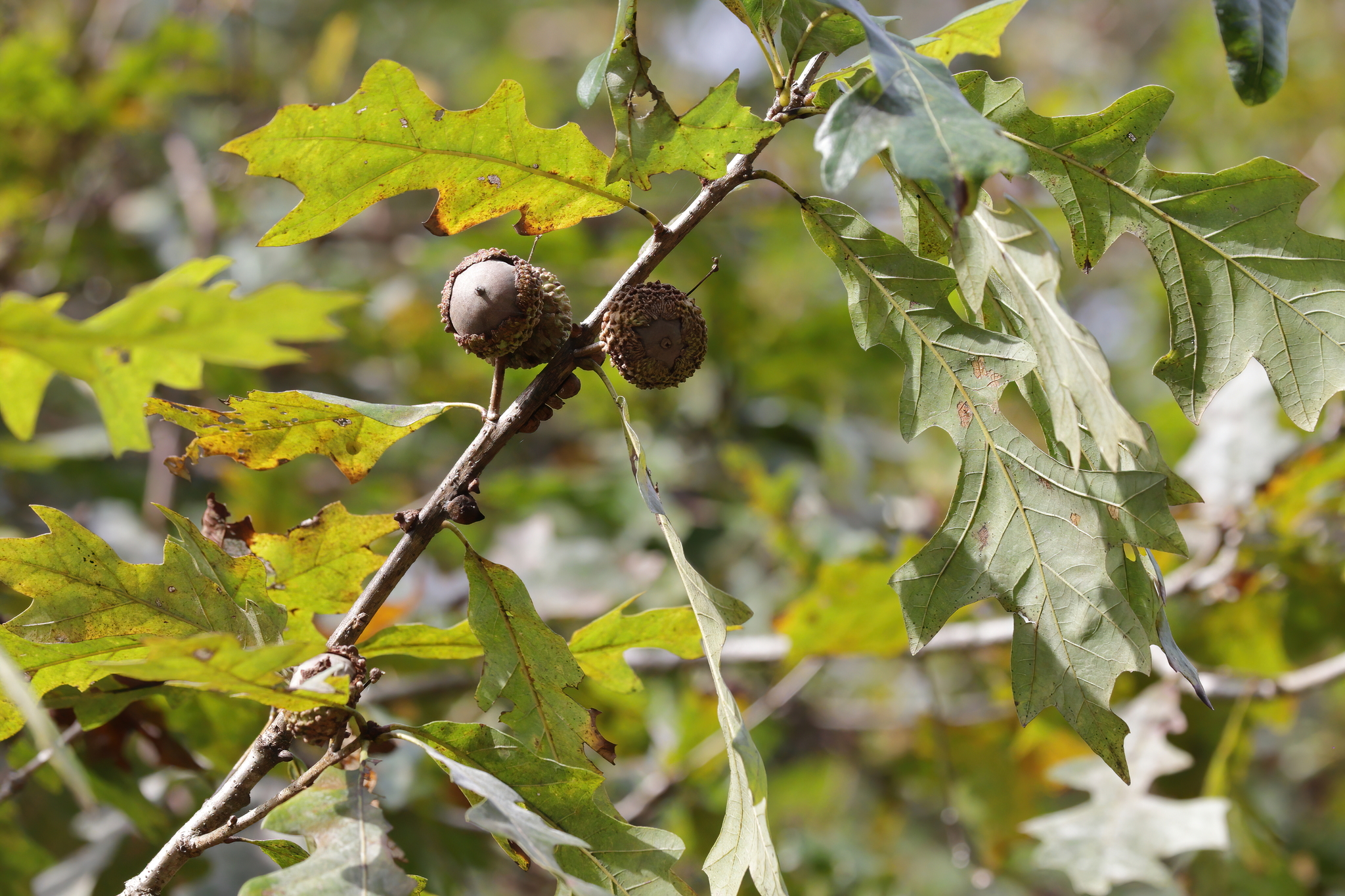
Overcup oak acorns, Jackson County, Mississippi. (CC BY- 4.0)
Overcup oak is a deciduous, native tree [12]. Mature trees usually range from 60 to 90 feet (18-27 m), and 24 to 30 inches (61-76 cm) d.b.h. Maximum height is rarely over 100 feet (30 m) [34,39]. The bark has thick, irregular plates or ridges covered with inner scales. The root system is usually shallow and saucer shaped. Seedling taproots are usually replaced by a lateral root system [39]. Mature crown leaves range from 5 to 8.5 inches (13-21.5 cm) in length and are usually five- to nine-lobed [12]. The acorns range from 0.48 to 1 inch (12-25 mm) in length, and are nearly globose to broadly ovoid. The acorn cup covers two-thirds to nearly all of the acorn, with acute scales [7].
Oaks usually grow slowly for the first 10 to 15 years; growth rates become more rapid thereafter [21]. The national champion overcup oak for 1976 was in South Carolina; it measured 22 feet (6.7 m) in circumference, was 123 feet (37 m) tall, and had a 48-foot (14.6-m) crown spread [12]. The largest overcup oak (ranked by point system in 1990) was found in Texas. It was 51.1 inches (129.8 cm) in diameter, 160.53 inches (13.37 m) in circumference, and 114 feet tall (34.7 m) [29]. Overcup oaks can live to 400 years of age [39].
Raunkiaer Life Form (Raunkiaer 1934)
- Phanerophyte
Seasonal Development
Overcup oak is late to leaf out in the spring, sometimes as long as a month behind sympatric species. This late emergence probably contributes to its flood tolerance [36,39]. Overcup oak flowers from March to May as its new leaves appear [7,39]. Acorns ripen the same year, from September to October, and are disseminated shortly thereafter [1].
Regeneration Processes
Overcup oak becomes sexually mature around 25 to 30 years of age. Good seed crops are produced approximately every 3 or 4 years, although yield is relatively low compared to other oaks [39,43]. Overcup oak acorns have a unique spongy shell that renders them buoyant [26]. They are disseminated by water and, to a lesser extent, animals [39]. Acorns can be carried long distances by streams. Overcup oak acorns have been found on the beach of a northwestern Florida island, miles from any apparent seed source [4]. Overcup oak acorns are dormant only over the winter and germinate in the spring after flood waters recede [39]. One study reported that submergence reduces germination [16]. Another study, however, found soaking overcup oak acorns strongly retarded germination, but did not appreciably reduce germination rates. The first-mentioned study may be based on shorter test times, and not have allowed for the ability of overcup oak to germinate after a long period. Delayed germination may be an adaptive trait that increases the likelihood that young seedlings will germinate after spring floods recede. Partial shade is beneficial for oak germination [34]. Good germination occurs on moist surface soils when acorns are covered by leaves [21].
Natural reproduction is usually prolific, but mortality rates are high, probably due to flooding. Successful regeneration is dependent on the an adequate seed source and complete absence of fire [39].
Stumps of small trees sprout vigorously but not consistently [39].
Successional Status
Facultative Seral Species
Overcup oak forms climax stands on low, backwater flats and is usually subclimax on better sites. It is relatively intolerant of shade [39]. It usually succeeds black willow during very slow succession on shallow swamps or on slough margins [36]. Disturbance results in a strong release response from suppressed overcup oaks [38].
Immediate Fire Effects
DeSelm and Clebsch [5] reported that mature overcup oak trees are somewhat resistant to direct mortality from fire, but barely survived two to five prescribed fires between 1964 and 1988 [5].
In overcup oak, even minor injuries from fire can create avenues of infection for heart rots, which can cause decadence and/or mortality years later [39,41].
Postfire Regeneration Strategy (Stickney 1989)
- Tree with adventitious-bud root crown/soboliferous species root sucker
- Secondary colonizer - off-site seed
Fire Adaptations
No information is available about specific fire adaptations in overcup oak.
Plant Response to Fire
Young overcup oak trees may sprout after top-kill by fire.
Fire Regimes
Fires may be severe during prolonged drought in the swamps in which overcup oak occurs. Fires in these bottomlands are usually surface fires which destroy young seedlings and saplings of all species, and scorch the bark of larger trees, including overcup oaks [35].
For fire regime information, search FEIS for this species by entering the species name on the Advanced Search page and selecting “Fire Regime” as the publication type.
Fire Management Considerations
The usual fire season for bottomland hardwoods is fall, especially in years when summer drought extends to fall and winter [36].
Federal Status
None
Other Status
No entry.
Importance to Wildlife and Livestock
Ducks, wild turkeys, squirrels, and white-tailed deer eat overcup oak acorns [18]. The large size of overcup oak acorns renders them less suitable for duck food than other acorns [6].
Overcup oaks are planted to improve wildlife habitat [39].
Palatability and Nutritional Value
Overcup oak acorns are low in palatability to fox squirrels when compared to other acorns [33].
Cover Value
No entry.
Value for Rehabilitation or Restoration of Disturbed Sites
No entry.
Other Uses
Overcup oak is planted as an ornamental [39].
Acorns of most oak species have been used as food by humans. The bark of oak trees has been used to make dyes, and for tannin extraction [23].
Overcup oak wood is used for lumber and cooperage. It is of low quality when compared to the wood of other white oaks [39].
Other Management Considerations
Overcup oak is susceptible to heart rots after injuries, particularly by fire [39].
Overcup oak is favored by clearcutting or group cutting on poorly drained soils; it may be the only commercial species that grows well on wet bottomland sites [11]. In Missouri, the removal of more desirable species such as pin oak (Quercus palustris) may increase the proportion of overcup oak. High early summer temperatures significantly reduce overcup oak growth. Soil moisture is not a limiting factor on floodplain sites; soil is apparently moist enough for growth even in dry years [38]. Flooding from February to July is beneficial to timber-sized overcup oak trees, but not other size classes [16].
Natural reforestation of bottomland oldfields now favors tree species that tolerate dry soils because a large proportion of formerly wet sites are subject to flood control. Since overcup oak is dependent on overflow or floodwaters for seed dispersal, it has to be planted on these sites if its presence is desired [32].
Post harvest site preparation for regeneration of overcup oak/water hickory stands on low, flat sites or sloughs resulted in good numbers of new overcup oak seedlings, regardless of treatment. The treatments included 1) injecting all residual stems with herbicides, 2) leaving residual basal area of desirables uninjected and injecting the remainder with herbicide, or 3) shearing the entire site with a "V"-blade tractor [20].
Nuttall oak (Q. nuttallii) is often used to replace overcup oak on sites that have reduced flooding or stream flows [22]. Stream channelization projects result in sites of varying stability over time. Overcup oak is only associated with channelized sites that are relatively stable [19].
The inconsistency of stump sprouting makes this an unreliable source of new stems for stand regeneration [39].
Table A1— Forest and range ecosystems, Bureau of Land Management (BLM) physiographic regions, Kuchler plant associations, Society for American Foresters (SAF) forest cover types, and Society for Rangeland Management (SRM) rangeland cover types in which this species occurs.
Forest and Range Ecosystems (Garrison et al. 1977)
- FRES12 Longleaf - slash pine
- FRES13 Loblolly - shortleaf pine
- FRES14 Oak - pine
- FRES15 Oak - hickory
- FRES16 Oak - gum - cypress
- FRES17 Elm - ash - cottonwood
BLM Physiographic Regions (Bernard and Brown 1977)
- No entry.
Kuchler Plant Associations (Kuchler 1964)
- K100 Oak - hickory forest
- K113 Southern floodplain forest
SAF Cover Types (Eyre 1980)
- 14 Northern pin oak
- 61 River birch - sycamore
- 62 Silver maple - American elm
- 63 Cottonwood
- 65 Pin oak - sweetgum
- 87 Sweet gum - yellow-poplar
- 88 Willow oak - water oak - diamondleaf oak
- 91 Swamp chestnut oak - cherrybark oak
- 92 Sweetgum - willow oak
- 93 Sugarberry - American elm - green ash
- 94 Sycamore - sweetgum - American elm
- 95 Black willow
- 96 Overcup oak - water hickory
- 101 Baldcypress
- 102 Baldcypress - tupelo
- 103 Water tupelo - swamp tupelo
- 104 Sweetbay - swamp tupelo - redbay
SRM Rangeland Cover Types (Shiflet 1994)
- No entry
1. Allen, James A.; Kennedy, Harvey E., Jr. 1989. Bottomland hardwood reforestation in the lower Mississippi Valley. Slidell, LA: U.S. Department of the Interior, Fish and Wildlife Service, National Wetlands Research Center; Stoneville, MS: U.S. Department of Agriculture, Forest Service, Southern Forest Experimental Station. 28 p. [15293]
2. Aust, W. Michael; Hodges, John D.; Johnson, Robert L. 1985. The origin, growth and development of natural, pure, even-aged stands of bottomland oak. In: Shoulders, Eugene, ed. Proceedings of the third biennial Southern silvicultural research conference; 1984 November 7-8; Atlanta, GA. Gen. Tech. Rep. SO-54. New Orleans, LA: U.S. Department of Agriculture, Forest Service, Southern Forest Experiment Station: 163-170. [7388]
3. Bernard, Stephen R.; Brown, Kenneth F. 1977. Distribution of mammals, reptiles, and amphibians by BLM physiographic regions and A.W. Kuchler's associations for the eleven western states. Tech. Note 301. Denver, CO: U.S. Department of the Interior, Bureau of Land Management. 169 p. [434]
4. Burkhalter, James R.; Wright, John C. 1989. Fourteen additions to the known stranded seeds and fruits of northwest Florida beaches. SIDA. 13(3): 345-349. [8583]
5. DeSelm, H. R.; Clebsch, E. E. C. 1991. Response types to prescribed fire in oak forest understory. In: Nodvin, Stephen C.; Waldrop, Thomas A., eds. Fire and the environment: ecological and cultural perspectives: Proceedings of an international symposium; 1990 March 20-24; Knoxville, TN. Gen. Tech. Rep. SE-69. Asheville, NC: U.S. Department of Agriculture, Forest Service, Southeastern Forest Experiment Station: 22-33. [16630]
6. Dugger, Katie M.; Fredrickson, Leigh H. 1992. Life history and habitat needs of the wood duck. Fish and Wildlife Leaflet 13.1.6. Waterfowl Management Handbook. Washington, DC: U.S. Department of the Interior, Fish and Wildlife Service. 8 p. [20789]
7. Duncan, Wilbur H.; Duncan, Marion B. 1988. Trees of the southeastern United States. Athens, GA: The University of Georgia Press. 322 p. [12764]
8. Eyre, F. H., ed. 1980. Forest cover types of the United States and Canada. Washington, DC: Society of American Foresters. 148 p. [905]
9. Fitzgerald, Charles H.; Belanger, Roger P.; Lester, William W. 1975. Characteristics and growth of natural green ash stands. Journal of Forestry. 73: 486-488. [5122]
10. Garrison, George A.; Bjugstad, Ardell J.; Duncan, Don A.; [and others]. 1977. Vegetation and environmental features of forest and range ecosystems. Agric. Handb. 475. Washington, DC: U.S. Department of Agriculture, Forest Service. 68 p. [998]
11. Georgia Chapter, Society of American Foresters. 1979. Silvicultural guidelines for forest owners in Georgia. Georgia Forest Research Paper 6. [Place of publication unknown]: Georgia Forestry Commission, Research Division. 35 p. [15405]
12. Godfrey, Robert K. 1988. Trees, shrubs, and woody vines of northern Florida and adjacent Georgia and Alabama. Athens, GA: The University of Georgia Press. 734 p. [10239]
13. Golden, Michael S.; Loewenstein, Edward F. 1991. Regeneration of tree species 7 years after clearcutting in a river bottom in central Alabama. In: Coleman, Sandra S.; Neary, Daniel G., compilers. Proceedings, 6th biennial southern silvicultural research conference: Volume I; 1990 October 30 - November 1; Memphis, TN. Gen. Tech. Rep. SE-70. Asheville, NC: U.S. Department of Agriculture, Forest Service, Southeastern Forest Experiment Station: 76-83. [17464]
14. Guttman, Sheldon I.; Weigt, Lee A. 1989. Electrophoretic evidence of relationships among Quercus (oaks) of eastern North America. Canadian Journal of Botany. 67(2): 339-351. [10401]
15. Hodges, John D.; Switzer, George L. 1979. Some aspects of the ecology of southern bottomland hardwoods. In: North America's forests: gateway to opportunity: Proceedings, 1978 joint convention of the Society of American Foresters and the Canadian Institute of Forestry. Washington, DC: Society of American Foresters: 360-365. [10028]
16. Hook, D. D. 1984. Waterlogging tolerance of lowland tree species of the South. Southern Journal of Applied Forestry. 8: 136-149. [19808]
17. Howard, Rebecca J.; Allen, James A. 1989. Streamside habitats in southern forested wetlands: their role and implications for management. In: Hook, Donal D.; Lea, Russ, eds. Proceedings of the symposium: The forested wetlands of the Southern United States; 1988 July 12-14; Orlando, FL. Gen. Tech. Rep. SE-50. Asheville, NC: U.S. Department of Agriculture, Forest Service, Southeastern Forest Experiment Station: 97-106. [9231]
18. Hunter, Carl G. 1989. Trees, shrubs, and vines of Arkansas. Little Rock, AR: The Ozark Society Foundation. 207 p. [21266]
19. Hupp, Cliff R. 1992. Riparian vegetation recovery patterns following stream channelization: a geomorphic perspective. Ecology. 73(4): 1209-1226. [19499]
20. Hurst, George A.; Bourland, Thomas R. 1980. Hardwood density and species composition in bottomland areas treated for regeneration. Southern Journal of Applied Forestry. 4(3): 122-127. [7839]
21. Johnson, R. L.; Shropshire, F. W. 1983. Bottomland hardwoods. In: Burns, Russell M., tech. comp. Silvicultural systems for the major forest types of the United States. Agric. Handb. 445. Washington, DC: U.S. Department of Agriculture, Forest Service: 175-179. [18953]
22. Kennedy, Harvey E., Jr. 1988. Effects of seedbed density and row spacing on growth and nutrient concentrations of Nuttall oak and green ash seedlings. SO-349. New Orleans, LA: U.S. Department of Agriculture, Forest Service, Southern Forest Experiment Station. 5 p. [6585]
23. Krochmal, Arnold; Krochmal, Connie. 1982. Uncultivated nuts of the United States. Agriculture Information Bulletin 450. Washington, DC: U.S. Department of Agriculture, Forest Service. 89 p. [1377]
24. Kuchler, A. W. 1964. Manual to accompany the map of potential vegetation of the conterminous United States. Special Publication No. 36. New York: American Geographical Society. 77 p. [1384]
25. Kudish, Michael. 1992. Adirondack upland flora: an ecological perspective. Saranac, NY: The Chauncy Press. 320 p. [19376]
26. Larsen, Harry S. 1963. Effects of soaking in water on acorn germination of four southern oaks. Forest Science. 9(2): 236-241. [18903]
27. Little, Elbert L., Jr. 1971. Atlas of the United States trees. Volume 1. Conifers and important hardwoods. Misc. Publ. 1146. Washington, DC: U.S. Department of Agriculture, Forest Service. 320 p. [1462]
28. Little, Elbert L., Jr. 1979. Checklist of United States trees (native and naturalized). Agric. Handb. 541. Washington, DC: U.S. Department of Agriculture, Forest Service. 375 p. [2952]
29. May, Dennis M. 1990. Big trees of the midsouth forest survey. Res. Note SO-359. New Orleans, LA: U.S. Department of Agriculture, Forest Service, Southern Forest Experiment Station. 17 p. [10556]
30. McWilliams, William H.; Rosson, James R., Jr. 1990. Composition and vulnerability of bottomland hardwood forests of the Coastal Plain Province in the south central United States. Forest Ecology and Management. 33/34: 485-501. [11814]
31. Moorhead, David J.; Hodges, John D.; Reinecke, Kenneth J. 1991. Silvicultural options for waterfowl management in bottomland hardwood stands and greentree reservoirs. In: Coleman, Sandra S.; Neary, Daniel G., compilers. Proceedings, 6th biennial southern silvicultural research conference: Volume 2; 1990 October 30 - November 1; Memphis, TN. Gen. Tech. Rep. SE-70. Asheville, NC: U.S. Department of Agriculture, Forest Service, Southeastern Forest Experiment Station: 710-721. [17507]
32. Newling, Charles J. 1990. Restoration of bottomland hardwood forests in the lower Mississippi Valley. Restoration & Management Notes. 8(1): 23-28. [14611]
33. Ofcarcik, R. P.; Burns, E. E.; Teer, J. G. 1973. Acceptance of selected acorns by captive fox squirrels. Southwestern Naturalist. 17(4): 349-355. [11365]
34. Olson, David F., Jr. 1974. Quercus L. oak. In: Schopmeyer, C. S., ed. Seeds of woody plants in the United States. Agric. Handb. 450. Washington, DC: U.S. Department of Agriculture, Forest Service: 692-703. [7737]
35. Penfound, William T. 1952. Southern swamps and marshes. The Botanical Review. 18: 413-446. [11477]
36. Putnam, John A.; Furnival, George M.; McKnight, J. S. 1960. Management and inventory of southern hardwoods. Agriculture Handbook No. 181. Washington, DC: U.S. Department of Agriculture, Forest Service. 102 p. [24970]
37. Raunkiaer, C. 1934. The life forms of plants and statistical plant geography. Oxford: Clarendon Press. 632 p. [2843]
38. Robertson, Philip A. 1992. Factors affecting tree growth on three lowland sites in southern Illinois. American Midland Naturalist. 128(2): 218-236. [19719]
39. Solomon, J. D. 1990. Quercus lyrata Walt. overcup oak. In: Burns, Russell M.; Honkala, Barbara H., technical coordinators. Silvics of North America. Volume 2. Hardwoods. Agric. Handb. 654. Washington, DC: U.S. Department of Agriculture, Forest Service: 681-685. [21822]
40. Stickney, Peter F. 1989. Seral origin of species originating in northern Rocky Mountain forests. Unpublished draft on file at: U.S. Department of Agriculture, Forest Service, Intermountain Research Station, Fire Sciences Laboratory, Missoula, MT; RWU 4403 files. 7 p. [20090]
41. Toole, E. Richard. 1965. Fire damage to commercial hardwoods in southern bottom lands. In: Proceedings, 4th annual Tall Timbers fire ecology conference; 1965 March 18-19; Tallahassee, FL. Tallahassee, FL: Tall Timbers Research Station: 144-151. [8715]
42. U.S. Department of Agriculture, Soil Conservation Service. 1982. National list of scientific plant names. Vol. 1. List of plant names. SCS-TP-159. Washington, DC. 416 p. [11573]
43. Wright, Jonathan W. 1953. Notes on flowering and fruiting of northeastern trees. Station Paper No. 60. Upper Darby, PA: U.S. Department of Agriculture, Forest Service, Northeastern Forest Experiment Station. 38 p. [5009]