


Rhododendron macrophyllum, Pacific rhododendron
Duchac, Leila. 2021. Rhododendron macrophyllum, Pacific rhododendron. In: Fire Effects Information System, [Online]. U.S. Department of Agriculture, Forest Service, Rocky Mountain Research Station, Missoula Fire Sciences Laboratory (Producer). Available: https://research.fs.usda.gov/feis/species-reviews/rhomac
| Abbreviation | Common Name | Scientific Name | Classification | Status |
|---|---|---|---|---|
| Plants | ||||
| RHOMAC | Pacific rhododendron | Rhododendron macrophyllum | Life Form: Plants/Shrub, Plants/Tree Kingdom: Plantae Class: Dicot Order: Ericales Family: Ericaceae Genus: Rhododendron | Fed. Protected: No Nativity: Native Invasiveness: Noninvasive |
This review summarizes information that was available in the scientific literature as of 2021 on the biology, ecology, and effects of fire on Pacific rhododendron in North America.
Pacific rhododendron is an evergreen shrub or small tree common in coastal and montane conifer forests in northwestern United States and southwestern British Columbia. It typically occurs on well-drained, often nutrient-poor soils and is an understory dominant in several ecosystems from coastal dune forests to subalpine forests. Pacific rhododendron can form thickets of compact shrubs in forest openings, edges, and ridgetops, or take a more open, tree-like form in shaded forests.
Pacific rhododendron mainly regenerates by seed. Seeds are small and are likely dispersed by gravity or wind. They lack dormancy and germinate readily in greenhouse settings. Pacific rhododendron seeds do not form a persistent seed bank. Seeds are not heat-tolerant and are likely killed by fire of any severity.
Pacific rhododendron is easily top-killed by fire of all severities, and its cover is greatly reduced immediately after fire. However, it typically sprouts from the root crown within the first growing season after fire. Postfire sprouting has been described as “vigorous”. Sprouting plants can grow quickly and form dense thickets, especially in open postfire environments or after clearcuts.
Pacific rhododendron is shade tolerant and is an important component in forests throughout succession. Its cover generally increases with time since disturbance, and it may take 100 years or more for cover to return to pre-disturbance levels.
While some studies describe Pacific rhododendron’s response to wildfire, most postfire literature about Pacific rhododendron describes its response after clearcut logging and slash burning and subsequent conifer planting. Because sprouting Pacific rhododendron may hinder conifer seedling establishment and growth, various treatments have been studied as control methods for Pacific rhododendron.
Historical fire regimes within the distribution of Pacific rhododendron range from frequent, low-severity fires to very infrequent mixed- or stand-replacing fires. However, over a century of logging and fire exclusion practices have created novel conditions that may result in larger, more severe fires in some areas. Climate change models for the Pacific Northwest project that fires may become larger and more frequent in dry forests, and some dry conifer forests may become hardwood-dominated, and possibly less likely to support Pacific rhododendron. Wet coastal forests may be less likely to transition to drier forest types and may continue to support Pacific rhododendron, especially in shaded forest interiors.




Taxonomy

Pacific rhododendron in bloom in southwestern British Columbia (CC-BY-NC 4.0).
The scientific name for Pacific rhododendron is Rhododendron macrophyllum D. Don ex G. Don [4,16,19,25,41,50,55] (Ericaceae). There are no subspecies of Pacific rhododendron.
The range of Pacific rhododendron overlaps with two other species in the genus, Cascade azalea and western azalea. The leaves of both of these species are deciduous and smaller than those of Pacific rhododendron (see Botanical Description). Cascade azalea is generally a smaller shrub (to 2m, [25]) and can be distinguished by its small, pendulous white flowers. Western azalea is of similar size and shape to Pacific rhododendron (to 8m, [25]) but differs in flower size and shape.
Rhododendron hybrids are cultivated [61], but there is no record of Pacific rhododendron hybridizing in the wild.
Common names are used throughout this review. For scientific names of plants and animals, see Appendix.
Synonyms
- None
Other Common Names
California rhododendron, coast rhododendron
General Distribution
Pacific Rhododendron occurs in coastal and montane areas from northern California to southern British Columbia (fig. 1) [41,76]. It is most common in Oregon and California in the Coast and Cascade Ranges, west of the Cascade crest [4,41,50], but it also occurs east of the crest [84]. Occurrences are more scattered in Washington; it is mainly found on Mount Rainier and the eastern Olympic Peninsula [41,89], (fig. 2). In British Columbia, it only occurs in isolated populations on Vancouver Island and southwestern British Columbia [18,19,76].

Figure 1—Distribution of Pacific rhododendron (left panel) and its relative location in the United States (right panel).

Figure 2—Distribution of Pacific rhododendron from Forest Inventory and Analysis (FIA) plots (n = 764) in Oregon and Washington. Blue dots represent observations of Pacific rhododendron [89].
States and Provinces
- United States: CA, OR, WA [93]
- Canada: BC [93]
Site Characteristics
Pacific rhododendron is most common on coastal and montane slopes in low- to middle-elevation coniferous forests, occurring from sea level to 1,600 m [25] (table 1). It is often abundant on ridges [92] and moderate to steep slopes where soils are shallow (30-76 cm) [74] and rocky, rather than on valley floors where soils are typically deeper, finer, and more productive [42]. It is an understory dominant or codominant in multiple forest types [74], and it tends to grow in dense stands in forest openings and edges and less densely in shaded forest interiors [3,92,98].
Pacific rhododendron grows in areas that have a temperate, maritime climate in the Pacific Northwest. It grows well in locations with seasonal low moisture and tolerates drought, unlike some other rhododendron species [8,42]. Annual precipitation ranges from ~800 to 5,000 mm over its distribution. The lowest precipitation occurs on eastern slopes of the Klamath mountains, and the highest on western slopes of the Oregon Coast Range [42,46,74,98,101]. Pacific rhododendron survives temperatures as low as -20 °C but is less cold-hardy than some other rhododendron species [82].
Pacific rhododendron occurs in areas with a range of soil types, but it is most common in relatively shallow, well-drained soils [41,74]. Soil textures also vary widely, from rocky, coarse-grained soils to sandy soils [3,74]. Less commonly, it may grow in deep, loamy to silty soils, as in some Port-Orford-cedar – western hemlock forests in the Klamath mountains in southwestern Oregon [74]. On some marine terraces where Pacific rhododendron occurs, forests are flooded for several months of the year, stunting vegetation growth. In these forests, soils are extremely shallow and nutrient-poor, and a thick iron hardpan occurs at 30 to 76 cm below the surface, resulting in an elevated water table and poor drainage [74].
Pacific rhododendron occurs in soils that tend to be slightly acidic (pH 5.5) to neutral [81]. It also grows well in low-nutrient soils and nitrogen-poor areas [8,26,41,45], including ultramafic sites with serpentine soil [27,97]. This ability to thrive in nutrient-poor sites is likely due to relationships with ectomycorrhizae [59,86]. In parts of the Oregon Coast Range, Pacific rhododendron grows in dense thickets on ridges of nephaline syenite, a rare type of igneous rock [10,76].
| Area | Elevation range (m) |
|---|---|
| CA | 0–1,515 [4] |
| CA, OR: northwestern CA and southwestern OR, Port-Orford-cedar forest | 450–980 [74] |
| CA, OR: northwestern CA and southwestern OR, redwoods | <900 in CA, <500 in OR [74] |
| OR: coastal mountains (and possibly northern CA) | 540–1,115 [74] |
| OR: southern Cascades | <915 [74] |
| OR: southwestern, shore pine | 40 [74] |
| WA: Puget Lowlands including Olympic Peninsula | 0–460 [74] |
Plant Communities
Plant community descriptions below are based on information from Natureserve [72,74] unless otherwise cited. Bold font indicates Natureserve Terrestrial Ecological System [72] and Landfire Biophysical Setting (BpS) names and codes.
Pacific rhododendron is a common understory shrub in mixed-conifer forests of northwestern California, western Oregon and Washington, and isolated locations in southern British Columbia. It occurs in very wet to dry forests, and ecosystems from low coastal dunes to mid-elevation forests to high subalpine environments. In wet coastal forests, Pacific rhododendron tends to occur in relatively warmer, drier areas, while in dry forests it tends to occur in relatively moist areas. See table 2 for vegetation classifications that include Pacific rhododendron as an important, indicator, or dominant species. See table 4 for biophysical settings and associated modeled fire regime characteristics for communities where Pacific rhododendron is common in the understory.
Pacific rhododendron is common in low- to mid-elevation forests in the Coast Range and Cascade Ranges. It grows in the understory of mixed conifer coast Douglas-fir, western hemlock, and Pacific silver fir forests (Maritime Douglas-fir-Western Hemlock Forest (10370, 10390) and Silver Fir-Western Hemlock-Douglas-fir Forest (11740)). Pacific rhododendron often codominates with other broad-leaved evergreen shrubs including salal, huckleberries, Cascade barberry, and western Cordilleran bunchberry. These forests range from wet to dry-mesic but typically experience summer drought and high winter moisture that mostly falls as rain. Nearer to the coast, Pacific rhododendron grows in wetter forests under Sitka spruce and western hemlock (North Pacific Hypermaritime Sitka Spruce Forest (10360)), while in drier forests of southern Oregon and northern California, hardwoods including giant chinquapin and tanoak codominate the canopy with coast Douglas-fir, and Pacific rhododendron occurs as part of a diverse, dense shrub layer (Mediterranean California Mixed Evergreen Forest (10430)).
In high-elevation mountain hemlock forests in the Oregon Cascade mountains, Pacific rhododendron can dominate the shrub layer, sometimes codominating with vanilla-leaf or Cascade barberry [84] (North Pacific Mountain Hemlock Forest –Xeric (10412)). Pacific silver fir can codominate with mountain hemlock, and coast Douglas-fir is sometimes present but not dominant [84]. Precipitation mainly falls as snow that often persists into June or July. Pacific rhododendron occurs in stands that tend to be warmer and wetter relative to nearby mountain hemlock forests [84], though overall Oregon’s mountain hemlock forests are drier than those in Washington state, where Pacific rhododendron does not occur.
In northern California and southern Oregon, Pacific rhododendron occurs in several plant communities that have limited distributions. In California Coastal Redwood Forest (10150), it codominates the understory with tanoak and California huckleberry. These forests grow over 60 m tall and occur on steep slopes and ridges below 900 m. In rare forest associations in southwest Oregon within the North Pacific Hypermaritime Sitka Spruce Forest (10360), Pacific rhododendron is an understory dominant below Port Orford-cedar and either western hemlock, coast Douglas-fir, or Sierra white fir. In the sparsely distributed California Coastal Closed-Cone Conifer Forest and Woodland (11770), Pacific rhododendron occurs below stunted shore pine on the southern Oregon coast and below shore pine, Monterey cypress and Gowen cypress on the northern California coast. Vegetation growth is restricted by frequent flooding and low soil nutrients and the overstory canopy is 2 to 5 m tall.
Most plant communities where Pacific rhododendron occurs have been altered by over a century of forest management practices including clearcut logging and fire exclusion. Coast Douglas-fir forests were of particular interest as sources of marketable timber (e.g., [42]) and some have since been converted to Douglas-fir plantations.
| Location | Title | Citation |
|---|---|---|
| Pacific Northwest | ||
| northern California, southwestern Oregon | Old-growth forest associations in the northern range of coastal redwood | [65] |
| Oregon and California | Silvics of North America Vol 1. Conifers | [6] |
| Oregon and Washington | Natural vegetation of Oregon and Washington | [27] |
| Oregon and Washington | Wildlife habitats: Descriptions, status, trends, and system dynamics | [8] |
| throughout | Ecoclass coding system for the Pacific Northwest plant associations | [34] |
| western Oregon, southwestern Washington | Major indicator shrubs and herbs on national forests of western Oregon and southwestern Washington | [41] |
| western Oregon, Washington, northern California | Vegetation of the Douglas-fir region | [26] |
| California | ||
| Mendocino Coast | The pygmy forest-podsol ecosystem and its dune associates of the Mendocino Coast | [54] |
| Mendocino County | Vascular Plant Communities of California | [91] in [60] |
| Redwood National Park | The forest associations of the Little Lost Man Creek Research Natural Area, Redwood National Park, CA | [62] |
| throughout | Preliminary Descriptions of the Terrestrial Natural Communities of California | [51] |
| throughout | Research Natural Areas of California | [9] |
| Oregon | ||
| eastern Cascades | Forested Plant Associations of the Oregon East Cascades | [84] |
| Mt. Hood and Willamette National Forests | Plant Association and Management Guide for the Pacific Silver Fir Zone | [45] |
| Mt. Hood National Forest | Plant Association and Management Guide for the Western Hemlock Zone | [42] |
| northern Coast Range | Plant communities in the old-growth forests of North Coastal Oregon | [49] |
| northwestern Oregon | Field guide to riparian plant communities in northwestern Oregon | [67] |
| Siuslaw National Forest | Plant association and management guide: Siuslaw National Forest | [46] |
| southwestern Oregon | Field guide to the forested plant associations of southwestern Oregon | [2] |
| western Cascades | A preliminary classification of forest communities in the central portion of the western Cascades in Oregon | [24] |
| Willamette National Forest | Plant association and management guide: Willamette National Forest | [47] |
| Washington | ||
| Olympic National Forest | Forested Plant Associations of the Olympic National Forest | [48] |
| Olympic National Forest | Indicator species of the Olympic National Forest | [63] |
Botanical Description
This description covers characteristics that may be relevant to fire ecology and is not meant for identification. Identification keys are available (e.g., [4,19,25,50,76,92,93]).
Aboveground Characteristics
Pacific rhododendron is a perennial shrub, generally ranging in height from 1 to 5 m [41,50,92], but it can grow to 8 or 9 m tall [5,19,76] and take the form of a small tree. Plants are erect to spreading with stout branches [4,19,76]; they may grow as a compact shrub in forest openings (often after disturbance), [3,36,58], or in a “stunted” form (on coastal marine terraces with shallow soils and seasonal flooding) [96]. Stems are finely hairy when young [19,79] and become smooth or furrowed [25,92] as they mature, at times with peeling or shredding bark [4,25]. Leaves are alternate [41] and evergreen and are generally 8 to 20 cm long [19,50,76], though some may be only 6 cm long [4,25]. In deep shade, leaves may be over 2.5 times larger than on plants growing in full sun, and leaf size increases with leaf age [31]. Leaves are egg-shaped to oblong with a smooth, leathery texture [4,19,25,41], and appear toward the end of the stem [41].

Figure 3—Pacific rhododendron in bloom in front of redwood. Humboldt County, CA.
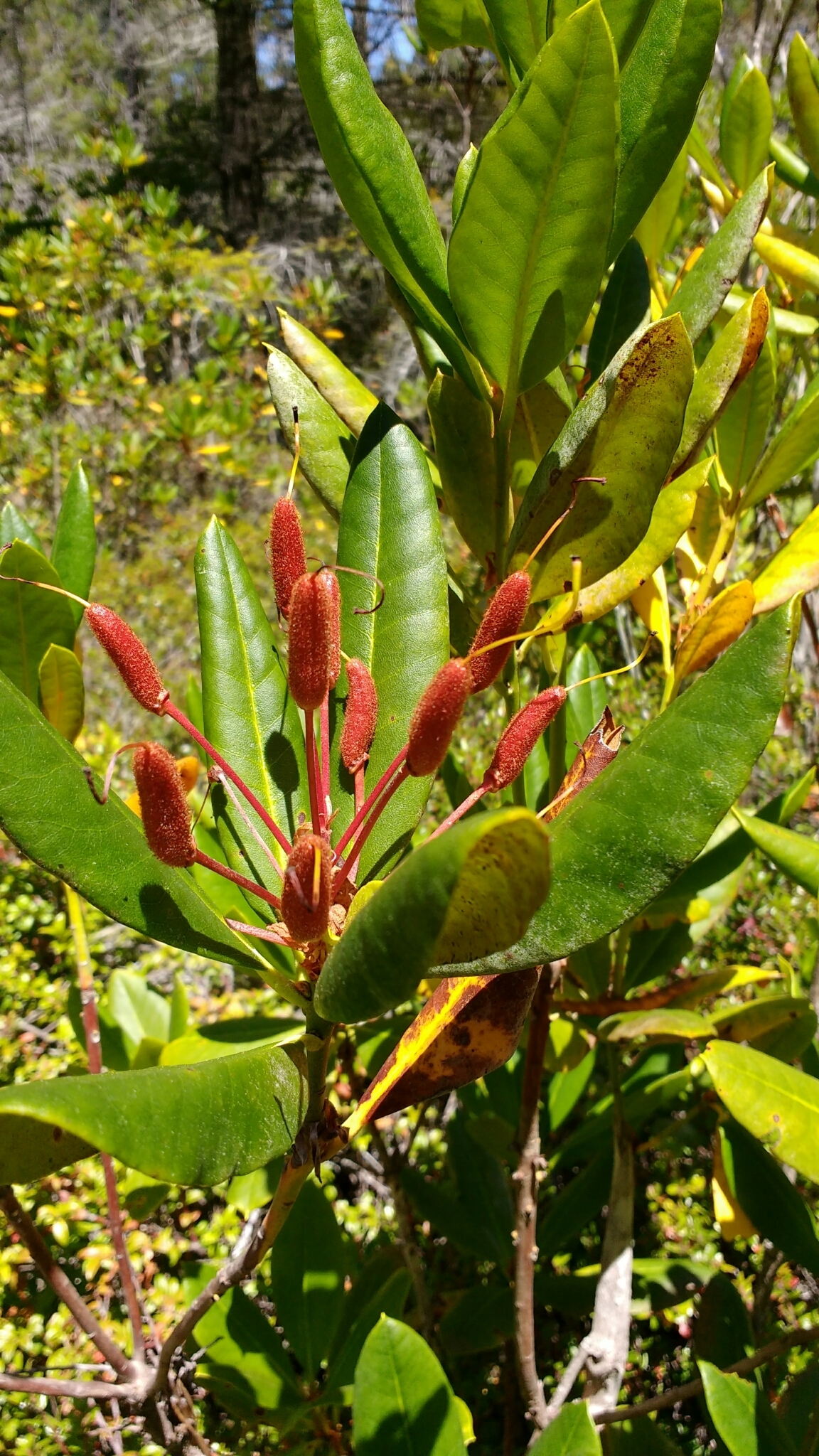
Pacific rhododendron blooms in large, showy terminal clusters of 10 to 20 bell-shaped pale to deep pink flowers (fig. 3), [19,25,50,76,92], each 2 to 5 cm long [4,19,50,76,92]. Fruits are hairy, glandular woody capsules up to 2 cm long [19,25,76,92] that persist on stems (figs. 4 and 5), [41]. Seeds are small (~5 mm long, 4,460 seeds/gram) [5] but are larger than those of other rhododendron species [75]. Seeds are elongate and flat without tails (fig. 6), and are loose within capsules [25].

Figure 4—Fruits on Pacific rhododendron in Mendocino County, CA.

Figure 5—Open fruits on Pacific rhododendron in Mendocino County, CA.

Figure 6—Illustration of a Pacific rhododendron seed. Left, external view; center, longitudinal section; bottom right, cross section.
Belowground Characteristics
Pacific rhododendron has a shallow [41], fibrous root system [61]. Ectomycorrhizal relationships have been observed with Pacific rhododendron roots [81,85] and in cultivation, mycorrhizae develop shortly after transplanting ornamental rhododendrons from potting medium to “suitable soil” outdoors [61]. Where Pacific rhododendron grows in a dense shrub layer, roots can form dense mats, as observed after clearcut logging [42]. Roots are also described as “sometimes rhizomatous” [25], though definitive evidence of rhizomes is lacking.
Stand Structure
Pacific rhododendron stem density varies widely within and among forest types. For example, in coast Douglas-fir-redwood/Pacific rhododendron/California huckleberry forests, Pacific rhododendron can make up as little as 2% to as much as 60% of the understory [74]. In a coast Douglas-fir forest in the southwest Oregon Coast Range, Pacific rhododendron made up 11% of shrub cover in dense forest, but 83% in forest openings [3].
In forest openings, including those created after disturbances such as clearcutting and fire, Pacific rhododendron grows as a compact shrub [3,36,58]. Growth is denser than when grown in shade, and woody biomass of 15-year-old plants in clearcuts may equal that of 25- to 60-year-old plants growing in adjacent shaded forest [31]. These compact shrubs likely sprouted vegetatively after disturbance [36,68,98,101], and they tend to grow in dense thickets on ridgetops, where blowdown is more likely to create canopy openings, and in clearcuts [3,31,42,45,76,81].
Raunkiaer Life Form
- Phanerophyte [77]
Seasonal Development
Pacific rhododendron blooms from spring to early summer depending on the region and elevation [4,25,41,76]. In western Oregon and southwestern Washington, flowers bloom from May to July [41]. In California, flowers bloom from April to July [4]. Generally, rhododendron fruits ripen in late summer [5,100]. Pacific rhododendron produces seeds in late summer and early fall [69,100]. Bud break occurs from mid-May to mid-June for plants growing between 410 and 1,630 m elevation at the H. J. Andrews Experimental Forest in the central Oregon, becoming later as elevation increases. Bud break tends to be positively related to the date of the last snowfall—when the snow date is later, buds break later [95].
Pacific rhododendron may live to 60 years old, but its average life span is unknown [31]. Its leaves remain on plants for 3 or more years [31], but information was not available about the time of year that leaves drop.
Regeneration Processes
Reproductive Mechanisms
In absence of disturbance, Pacific rhododendron appears to mainly regenerate from seeds [5,81] or by layering [18]. After disturbance or top-killing, it regenerates by sprouting from the root crown [23,81].
Pollination and Breeding System
Pacific rhododendron is mainly pollinated by bees [5,42] but it is also pollinated by other insects [81] and sometimes by birds [5].
Seed Production and Predation
Rhododendrons generally produce copious seeds annually once they mature [100]; however, viable seeds may not be produced every year [5]. One study in southwestern Oregon found that Pacific rhododendron plants began producing seeds at 5 years old and produced seeds annually thereafter [75]. No information was available regarding how long it takes plants to produce viable seeds from those that sprout from the root crown compared to those grown from seed. However, because plants can bloom profusely in openings and on forest margins [76], it is possible that plants growing in burned areas may produce more seeds than plants growing in adjacent shaded forest.
Seed predation of Pacific rhododendron has not been documented. However, like other species of rhododendron, all parts of the plant are toxic to humans and some animals [7,81]. As a result, this species may not experience extensive seed predation.
Seed Dispersal
Pacific rhododendron seeds are likely dispersed by gravity or wind because seeds are small ([5]; fig. 6), and capsules split open to release seeds while remaining on the plant [81].
Seed Banking
Generally, rhododendron seeds are not dormant and will germinate readily when sown [5,80], so long-term seed banks are unlikely. In nursery conditions, seeds from rhododendron species remained viable for 2 years at room temperature and two related species, great laurel and Catawba rosebay, had seeds that remained viable for 5 years when refrigerated or frozen [5]. No information is available about long-term seed banking or densities of seeds at different soil depths for Pacific rhododendron [12].
In the H. J. Andrews Experimental Forest in the Oregon Cascades, 5.3 Pacific rhododendron seedlings/m2 emerged from seed bank samples collected in spring (March) from old growth plots, suggesting that seeds at least persisted in the soil from fall (after dispersal) through spring. No seedlings emerged from seed bank samples collected after adjacent old-growth plots were clearcut and burned, suggesting that seeds that may have occurred in the soil were destroyed by cutting or burning treatments. Soil samples were taken in March, 16 months after clearcutting and 9 months after burning [11]. Burning occurred in July, before Pacific rhododendron seeds typically disperse (August to September), so any seeds in the seed bank would have remained in the soil for at least 1.5 years. While no seedlings emerged from the disturbed samples, Pacific rhododendron sprouted from the “bud bank” 1 and 2 years after disturbance [11]. In a separate study from the same area, Pacific rhododendron seeds were not found in the seed bank or collected from seed rain in sites where Pacific rhododendron plants occurred [44].
Germination
Rhododendron species seeds germinate quickly after sowing, but most require light to germinate [5,81,100]. Generally, rhododendron seeds do not need treatment to germinate [100], and Pacific rhododendron seeds collected in California in August to September germinated 13 days after sowing without treatment [69]. In greenhouse conditions, most rhododendron seeds germinate in 1 to 3 weeks [5]. Germination was reported to be as high as 90% in a greenhouse when seeds collected in California were sown in fine peat soil [69] and 80% in fine peat layered over coarse sand using seeds collected from a Pacific silver fir forest in Mt. Hood National Forest, Oregon [85]. Forty one percent of Pacific rhododendron seeds collected from a western hemlock – coast Douglas-fir forest in the H. J. Andrews Experimental Forest germinated with a daily cycle of 20 °C with light for 14 hours and 15 °C without light for 10 hours [12].
Experimental seed heating treatments suggest that Pacific rhododendron seeds are sensitive to heat especially in wet soil. Pacific rhododendron seeds collected from the soil seed bank of an old growth coast Douglas-fir forest in the H. J. Andrews Experimental Forest were treated with one of six temperature, duration, and moisture treatments (table 3). Seeds heated at the highest temperature (100 °C) and in wet soils were easily killed [12]. An earlier study in the same area found soil temperatures during a “light-intensity” slash burn reached 177 °C at the soil surface and 139 °C 2 cm below the surface [11]. This suggests that Pacific rhododendron seeds are unlikely to survive in soils even at temperatures characteristic of low-intensity fires.
| Soil status | 50° C; 60 minutes | 75° C; 15 minutes | 100° C; 15 minutes | Unheated Control |
|---|---|---|---|---|
| Wet soil | 37 | 0* | 0* | 41 |
| Dry soil | 33 | 48 | 2* | |
| *Treatment significantly different from the unheated control at P < 0.01 | ||||
Seedling Establishment and Plant Growth
Pacific rhododendron seedlings develop 2 to 4 true leaves (fig. 7) approximately 40 to 60 days after germination [5]. In greenhouse studies of other rhododendron species, any direct sunlight or a dry soil surface—even for a short period of time—easily killed young seedlings [5,61].
Pacific rhododendron seedlings often establish on rotting logs and in thick moss mats (e.g., fig. 8), as observed in multiple forest communities in southern British Columbia [18]. Both of these media may retain moisture when other parts of the forest floor become dry, supporting the greenhouse observations that consistent moisture is important for germination and seedling establishment. In the Oregon Cascades, inoculating soil with duff containing mycorrhizal fungi from collection sites reduced seedling mortality and improved growth rates [85].

Figure 7—Development of a Pacific rhododendron seedling from left to right at 1, 9, 40, and 60 days after germination [75].

Figure 8—Pacific rhododendron seedling in the Oregon Coast Range.
Pacific rhododendron can grow more quickly after fire and clearcut logging than in undisturbed forests. In high-elevation mountain hemlock forests in the eastern Cascades of Oregon, cover of Pacific rhododendron may increase “substantially” after fire, and high cover of Pacific rhododendron may indicate past disturbance [84]. A study in the southern Oregon Coast Range found that 15-year-old Pacific rhododendron plants growing in the open after clearcutting were the same size as 25 to 60-year-old plants growing in shaded conditions in adjacent mature forest. However, the leaves of plants growing in the open were less than half as large (21 cm2) as those on plants growing in the shade (49-58 cm2) [31].

Figure 9—Tree-like form of Pacific rhododendron growing in shade in a mature coast Douglas-fir forest in Skamania County, WA.
While Pacific rhododendron generally grows well in relatively low-nutrient soils, severe nutrient deficiency can restrict Pacific rhododendron growth. On the southern Oregon and northern California coasts, Pacific rhododendron is a dominant shrub in forests on marine terraces that experience seasonal flooding and have soils with very poor nutrients. In those conditions, Pacific rhododendron plants generally do not grow taller than 1 m, and may exhibit signs of nutrient deficiency such as die-back and fungal galls [54].
Models for estimating crown area during early stand development are available for Pacific rhododendron [94]; they demonstrate the range of growth forms possible for Pacific rhododendron (see Botanical Description). Crown area is a function of basal area and height, and models predict that crown area increases more rapidly in taller plants than shorter plants relative to basal area. That is, short plants are more compact (basal area and crown area were more similar) and taller plants had much larger crowns relative to their basal areas. For example, according to the model, plants with the same basal area (240 cm2) could range from a short, 10-cm tall shrub with a crown area of 1 m2, to a large, 2-m tall shrub with a crown area of 5 m2.
Vegetative Reproduction and Regeneration
Pacific rhododendron regenerates after top-kill by sprouting from the root crown (fig. 10) [35,81]. Some sources describe sprouting from “belowground structures” [21,68], suggesting the exact position of buds may be unknown. Pacific rhododendron generally sprouts within the first growing season after fire and clearcutting [3,98,99]. Postfire sprouting has been described as “vigorous” [20,98], and Pacific rhododendron may create dense thickets after clearcutting [42,45]. However, the degree of postfire or postlogging sprouting varies (see Plant Response to Fire). Unlike seedlings, Pacific rhododendron sprouts appear to tolerate direct sunlight, as they are often observed after fire and after clearcut logging [35,68,81,98].
Pacific rhododendron may reproduce via layering [18]. Douglas and Desrosiers (2006) describe that “asexual reproduction, by layering, appears to be much more common than sexual reproduction” in the Skagit River Valley in British Columbia [18]. In greenhouse or nursery settings, Pacific rhododendron can be propagated by layering and stem cuttings [5]. However, less than 1% of stems rooted in a greenhouse when Pacific rhododendron stem cuttings were collected from a field site in the Oregon Cascades [85]. Flora of North America describes Pacific rhododendron as “sometimes rhizomatous”, suggesting that it can reproduce from rhizomes [25], although this has not been described in the literature.

Figure 10—Pacific rhododendron sprouting from the root crown after fire, Curry County, OR.
The degree of soil disturbance from wildfire or logging can affect Pacific rhododendron regeneration because it sprouts from near-surface buds on the root crown. In a study comparing two logging methods, Pacific rhododendron rarely occurred 1 to 15 years after tractor logging (which disturbs and overturns soil). Cover ranged from <1% to 4%, but after high-lead logging (which is less impactful to soils), cover remained over 20%. Top-killed plants were likely uprooted or crushed by tractor logging activity, making it difficult for individuals to regenerate [3].
Successional Status
Pacific rhododendron is shade tolerant, and rhododendron seedlings are intolerant of direct sunlight [5,61] (see Seedling Establishment). However, sprouting individuals grow well in full sunlight after fire or other canopy-opening disturbances (fig. 11) [20,31,81,98]. While Pacific rhododendron grows in shade, it generally does not grow as densely as in openings or other sunny sites.
Pacific rhododendron occurs across successional stages, from early seral to old growth. In California, Pacific rhododendron is considered an early seral species and rhododendrons are retained when management objectives are to maintain early successional forests [81]. In western Oregon, colonizing forbs and shrubs such as snowbrush ceanothus and other Ceanothus species initially dominate after clearcutting and slash burning, while Pacific rhododendron cover is drastically reduced from pretreatment levels [26,101]. As succession progresses, Pacific rhododendron cover increases, and it becomes an understory dominant in some late successional forests [3,38,83,101]. For example, Pacific rhododendron grew into “tall, dense thickets” that closed the understory canopy in a coast Douglas-fir-redwood forest in southwest Oregon where fire was absent for approximately 100 years [98]. On other sites, Pacific rhododendron cover peaks in early- to mid-succession and declines with canopy closure [83].

Figure 11—Pacific rhododendron in bloom after a canopy-opening fire in Willamette National Forest, western Oregon Cascades.
Two chronosequence studies in coast Douglas-fir plantations [3,83] show variation in Pacific rhododendron cover 1 to 200 years after disturbances including clearcutting, slash burning, and wildfire. In the central Oregon Cascades, stands were clearcut, slash burned and replanted with conifers 2 to 40 years before sampling. Cover of Pacific rhododendron was highest in stands treated 15 years prior. Pacific rhododendron cover was less than 1% 2 years after treatments and 10.9% after 15 years. At 20 years, cover was only 2.6%; it was below 7% in plots treated up to 40 years prior to sampling [83]. In nearby undisturbed 450-year-old coast Douglas-fir forest, Pacific rhododendron cover averaged 13.2% [83]. In the Coast Range, stands were clearcut, and though slash burning was standard practice in the area until 8 years before data collection, burning history was not reported for this study. Plots were clearcut 1 to 80 years prior to sampling. Cover of Pacific rhododendron ranged from 23 to 43% 1 to 15 years after clearcutting, but it was only 13% 55 to 70 years after clearcutting. In comparison, cover was 83% in stands that had burned in a wildfire 190 years prior and had no logging history, and in an adjacent old growth (300-400 year old) coast Douglas-fir forest, it averaged 83% in forest openings, but only 11% in deep shade [3]. The authors of both studies suggest that canopy closure by conifers resulted in lower Pacific rhododendron cover in 20 to 70 year-old plots. However, rather than following individual plots over time, chronosequence studies sample plots of varying ages within a study area. As a result, factors other than time since disturbance (e.g., pre-disturbance condition, soil characteristics, climate variables) could also explain the differences in Pacific rhododendron cover in each plot.
Immediate Fire Effects
Pacific rhododendron is often top-killed by fire of all severities, and its cover is greatly reduced immediately after fire [35,98,101], but top-killed plants often sprout from the root crown [20,23,35,37,40,57,98,101]. Severe fire is most likely to kill Pacific rhododendron [81,101], but low-severity fire may kill some plants [98]. Seeds of Pacific rhododendron are not heat-tolerant [12] and are unlikely to survive fire of any severity.
Postfire Regeneration Strategy
- Tall shrub, adventitious buds and/or a sprouting root crown [87]
Fire Adaptations
Pacific rhododendron has been classified as “disturbance-sensitive” [20], because it is top-killed by fire even at low severities [98], and it is most abundant in unburned areas and areas burned at low-severity [20]. However, top-killed plants often sprout from the root crown (fig. 11) [22,23,36,37,81,98]. While Pacific rhododendron is more likely to be killed after severe fire, it can sprout after fire of all severities [20,71,98]. Sprouting plants can grow quickly and sometimes form dense thickets in open, postfire environments [31]. In some cases, Pacific rhododendron is one of the first plants to appear after fire [11,98] (fig. 12).

Figure 12—Pacific rhododendron sprouting after fire, Grande Ronde County, OR.
Plant Response to Fire
Wildfire and clearcutting (which is often accompanied by slash burning) are the two most common types of disturbance in forests where Pacific rhododendron occurs. Several studies describe Pacific rhododendron postfire sprouting and succession after fire (e.g., [20,22,23,30,39,71,98,101]), but no information was available about postfire flowering, or seeding. Information on postfire seedling establishments is limited to a single study in the Oregon Cascades, where no Pacific rhododendron seedlings emerged from soil samples collected 9 months after clearcutting and broadcast burning [11].
Pacific rhododendron tends to sprout after being top-killed by fire of all severities. For example, most Pacific rhododendron plants of all stem sizes sprouted “vigorously” after being top-killed by fire of all severities within one year after the Chetco Bar fire in the Klamath mountains of southwestern Oregon [98]. However, some individuals were killed (i.e., did not sprout) even at the lowest fire severities. Fire severity was determined by the field-based Composite Burn Index (CBI) [56], which ranges from unburned (0) to high severity (3). In a predictive model of likely postfire responses (with 80% accuracy), Pacific rhododendron would survive aboveground (i.e., not top-killed) when CBI was below 0.85, while it would sprout after top-kill when CBI was above 0.85. On the Chetco Bar fire, this model predicted 91% of individuals being top-killed but sprouting soon after fire, and the remaining 9% surviving the fire with aboveground stems intact. Complete mortality was observed, but because it did not occur in a discernible pattern related to fire severity, the model did not include a category for mortality of Pacific rhododendron after fire [98].
Pacific rhododendron tends to have higher cover on unburned sites or sites that burned with low- or moderate-severity than sites that burned at high-severity [20,57,70,71]. For example, cover of Pacific rhododendron was negatively correlated with burn severity in mixed-conifer stands 6 years after the Biscuit fire in southwestern Oregon. Cover was higher on unburned and low-severity sites compared to more severely burned sites [71]. Similarly, in coast Douglas-fir-western hemlock forests 10 and 22 years after the Tiller Complex and Warner Creek fires in the central Cascade Range in Oregon, relative abundance (defined as cover within a severity category compared to mean cover over the study area) was highest on unburned sites (44%), followed by moderate-severity sites (31%), low-severity (19%), and high-severity (6% cover). Relative frequency of Pacific rhododendron (percentage of plots within a severity category where Pacific rhododendron was present) was highest on sites that burned at low severity (46%), compared to 38% on unburned, 33% on moderate severity, and 15% on sites that burned at high severity [20]. Postfire weather may also influence Pacific rhododendron response; Pacific rhododendron was more likely to occur on sites with less rain and cooler August temperatures than other sites for 6 years after the Biscuit fire [71].
Studies that quantify Pacific rhododendron’s response to clearcutting and slash burning in coast Douglas-fir forests of western Oregon and Washington generally find that Pacific rhododendron cover declines precipitously immediately after clearcutting and burning [22,23,30,101], then increases with time-since-treatment [22,23,30,39,83,99] before stabilizing or declining after about 15 to 20 years. Peak cover may correspond to canopy closure of regenerating conifers (see Successional Status) [57,83]. For example, a longterm study (i.e., 13-45 years posttreatment) of vegetation response after clearcut logging and burning on the H. J. Andrews Experimental Forest found that Pacific rhododendron cover and biomass peaked about 20 years after logging and burning and gradually declined through 45 years (fig. 13) [39]. A similar study found that Pacific rhododendron cover stabilized 14 years (at <5%) after logging or logging and burning. However, Pacific rhododendron cover in control areas (i.e., not logged or burned) continued to increase to nearly 20% cover over the 25-year study period [57]. Pacific rhododendron cover did not return to preburn levels during either study [39,57]. In the absence of further disturbance, Pacific rhododendron cover may continue to increase after a temporary reduction at the time of canopy closure, as observed in the southern Oregon Coast Range [3].

Figure 13—Cover and biomass of Pacific rhododendron 13 to 45 years after clearcutting and broadcast burning in the H. J. Andrews Experimental Forest in the western Cascades, Oregon. Logging occurred between 1962 and 1966; broadcast burning occurred in 1963 and 1966.
One study reported cover after clearcutting but before slash burning [22] and showed that logging itself reduced Pacific rhododendron cover from ~10% to ~1% within postlogging year 1, except in one plot where initial cover was 0.6%. In that plot, clearcutting reduced cover to 0.3% and subsequent burning eliminated Pacific rhododendron, at least temporarily. However, the plants in the plots that were clearcut likely survived due to their ability to sprout after clearcutting (Figures 8-10 in Bailey 1966 [3]) and removal by chainsaw [68]. Thus, while cover may be greatly reduced after logging and/or burning, individual plants typically survive and sprout [20,33,35,98].
For detailed information on vegetation responses to slash burning in the western Oregon Cascades, see the Research Project Summary: Plant succession following clearcutting and slash burning in the western Cascade Range, Oregon.
Fuel Characteristics
Pacific rhododendron is a shrub or small tree that occurs in early seral to late successional forests. The forests where it occurs have a range of shrub densities from very sparse to quite dense (see Plant Communities, [74]). In forests where the shrub layer is sparse and herbaceous, growth is low (e.g., parts of California Coastal Closed-Cone Conifer Forest and Woodland (11770) and North Pacific Hypermaritime Sitka Spruce Forest (10360)) [42,74], and surface fuels including Pacific rhododendron may be minimal. In addition, forests with Pacific rhododendron as an understory dominant often have low-nutrient soils, so productivity (and therefore, fuels) is generally lower than adjacent forests [42,45,46,47]. Some forests with Pacific rhododendron as an understory dominant within the Maritime Douglas-fir-Western Hemlock Forest (10370, 10390) have relatively fewer snags, less down woody material, overall smaller trees, and lower shrub density than other nearby community types [42]. This suggests that while Pacific rhododendron may contribute to fuels when fires occur, some forests with Pacific rhododendron as an understory dominant may have lower fuel loads than nearby forests.
Pacific rhododendron grows in relatively dry areas when it occurs in wet forests, such as the North Pacific Mesic-Wet Maritime Douglas-fir – Western Hemlock Forest (10390) in the western Cascades and Oregon Coast Range [45,46,74]. These relatively dry areas may burn at low- or moderate-severity more regularly and thus have lower fuel loads than adjacent wetter areas, where fuels accumulate for long periods and fires burn infrequently but at higher severity [53].
Pacific rhododendron can form dense thickets, especially after disturbance or in natural clearings within forests [3,76,98]. On these sites, Pacific rhododendron may create continuous understory fuels and carry fire through forest openings. In areas where fire exclusion has contributed to increased understory density, such as in some redwood forests [98], Pacific rhododendron may act as a ladder fuel.
Fire Regimes
Pacific rhododendron occurs in forests with a range of historical fire regimes, from those characterized by frequent, low-severity fires to those characterized by infrequent mixed-severity and/or stand-replacing fires (table 4). While Pacific rhododendron does not require fire to reproduce (see Seedling Establishment and Plant Growth), it readily sprouts after fire (see Plant Response to Fire) enabling it to persist in recently burned areas, and it is shade tolerant (see Successional Status) enabling it to persist in areas with long fire-free intervals.
Pacific rhododendron occurs in forests with historically frequent, low-severity fires at the southern end of its distribution, including in Klamath-Siskiyou Lower Montane Serpentine Mixed Conifer Woodland (BpS code 10210), Mediterranean California Mixed Evergreen Forest (BpS code 10430), and California Coastal Redwood Forest (BpS code 10150). Modeled historical fire intervals range from 9 to 30 years (table 4). However, in some dry mixed evergreen forests in northern California, Pacific rhododendron may occur in areas protected from frequent fire such as steep, wet slopes and coves [73]. Fire exclusion since the early 20th century has reduced fire activity in many forests with historically frequent fire, resulting in increased height and density of understory vegetation. For example, in redwood forests in southwestern Oregon, fire exclusion has resulted in a tall, dense understory of Pacific rhododendron [98], contributing to abundant surface fuels.
Pacific rhododendron occurs in forests with infrequent, mixed-severity and/or stand-replacement fires such as Douglas-fir-Western Hemlock Forest (BpS codes 10370 and 10390), Hypermaritime Sitka Spruce Forest (BpS code 10360), and Mountain Hemlock Forest (BpS code 10412). Modeled historical fire intervals range from 80 to ~650 years (table 4). These forests tend to be wet or occur at high elevations. In wet coastal forests, moisture from rain and fog maintain wet conditions nearly year-round [47,74], making fires infrequent. In subalpine forests, precipitation mainly falls as snow and snowpack often persists until June or July [84], and cool summer temperatures prevent the forest from becoming dry [74]. Pacific rhododendron is present in the understory throughout the seral stages, but it may take over a century to return to predisturbance cover levels in some Douglas-fir – western hemlock forests [3]. Climate change models predict increased fire frequency and fire size throughout Pacific rhododendron’s range, including more fire activity at higher elevations (see Management in a Changing Climate). As a result, Pacific rhododendron cover in forests with historically infrequent fire may decrease as fires become more frequent.
| Biophysical Setting Name (BpS Code) | Fire interval (years) | Replacement severity fire (%) | Mixed severity fire (%) | Low severity fire (%) | Fire regime group |
|---|---|---|---|---|---|
| California Coastal Closed-Cone Conifer Forest and Woodland (11770) | 22 | 48 | 26 | 26 | I-C |
| California Coastal Redwood Forest (10150) | 30 | 7 | NA | 93 | I-C |
| Klamath-Siskiyou Lower Montane Serpentine Mixed Conifer Woodland (10210) | 9 | 5 | 13 | 82 | I-B |
| Mediterranean California Mixed Evergreen Forest (10430) | 9 | 3 | 14 | 83 | I-B |
| North Pacific Dry-Mesic Silver Fir-Western Hemlock-Douglas-fir Forest (11740) | 160 | 48 | 52 | NA | III-B |
| North Pacific Hypermaritime Sitka Spruce Forest (10360) | 657 | 100 | NA | NA | V-B |
| North Pacific Maritime Dry-Mesic Douglas-fir-Western Hemlock Forest (10370) | 80 | 24 | 76 | NA | III-A |
| North Pacific Maritime Mesic-Wet Douglas-fir-Western Hemlock Forest (10390) | 404 | 100 | NA | NA | V-A |
| North Pacific Mountain Hemlock Forest – Xeric (10412) | 166 | 56 | 27 | 17 | III-B |
For additional fire regime information, see the LANDFIRE Biophysical Settings section in this Species Review, search FEIS for this species by entering the species name on the Advanced Search page and selecting “Fire Regime” as the publication type, or see FEIS Fire Regime publications for the following plant communities in which Pacific rhododendron is most common or dominant:
- California Montane Mixed Conifer
- Mediterranean Mixed Evergreen
- Redwood
- Mesic-dry Western Hemlock
- Wet-mesic Western Hemlock
- Pacific Northwest Mountain Hemlock
- Pacific Northwest Coastal Forest
- California Cypress
Fire Management Considerations
Many of the forests where Pacific rhododendron is an understory dominant, including Douglas-fir – western hemlock and coastal redwood forests, historically grew very large trees that have been logged extensively over the past century [27,74,88] with some converted to timber plantations. The combination of clearcut logging and fire exclusion in the Pacific Northwest has altered fire regimes and plant communities [27,88]. However, due to its ability to sprout after top-kill, Pacific rhododendron is able to persist in these altered forests [22,23,98,101]. In some areas that historically burned frequently, such as redwood forests, fire exclusion has resulted in the accumulation of a tall, dense shrub layer with Pacific rhododendron as a dominant understory component [98]. In some maritime Douglas-fir – western hemlock forests, commercial logging has replaced complex multilayered forests with dense single-aged stands of coast Douglas-fir and a dense, shrubby understory [27], altering fuel characteristics and potential fire behavior substantially.
In timber plantations, Pacific rhododendron may shade out planted conifer seedlings [40,42,45,70,81,101] and studies have evaluated various methods of Pacific rhododendron control including burning, manual removal, and herbicides [32,68,81]. Broadcast burning to reduce Pacific rhododendron cover may be effective initially as recovery from fire is slower than that of postfire colonizers such as Ceanothus species [37,38,70,101]. If prefire cover of Pacific rhododendron is sparse (i.e., <1%), burning may eliminate it from that area [22,57]. However, if present after broadcast burning, Pacific rhododendron cover generally increases over time [23,36,37,39,40,101]; as such, burning is not effective for long-term control.
Many forest associations dominated or codominated by Pacific rhododendron in the understory tend to be low in soil nitrogen and have thin, rocky soils [3,8,41,42,74]. The thin, low-nutrient soil is unlikely to support most plant species on some sites, such as those in coast Douglas-fir – western hemlock forests of the western Cascades [42]. Slash burning after clearcut logging may further reduce the organic layer and hinder conifer growth. For example, Halverson (1986) observed widespread chlorosis (a lack of chlorophyll causing yellow or white needles) in planted conifer seedlings after slash burning on sites where Pacific rhododendron-dominated the understory [42].
Federal Status
None
Other Status
Information on state- and province-level protection status of plants in the United States and Canada is available at NatureServe.
Importance to Wildlife and Livestock
Pacific rhododendron is not an important source of food or cover for wildlife. It may be consumed occasionally, but all parts of the plant are toxic to humans and many animals [7,81]. Mature Pacific rhododendron stands may provide cover for large mammals [5,47], but some stands may be too dense for entry [47].
Palatability and Nutritional Value
Pacific rhododendron is not an important browse species for wildlife, likely because all parts of the plant contain a toxin that sickens livestock and humans, sometimes fatally [7,81]; it is presumed to affect at least some wildlife similarly. It was avoided by elk in a study of potential food sources in the Oregon and Washington Coast and Cascade ranges [14]; however, Pacific rhododendron is apparently consumed by some mammals. Researchers observed Columbian black-tailed deer eating Pacific rhododendron leaves in winter and listed it as “slightly palatable”, eaten casually or under stress [15]. Dusky-footed woodrats eat Pacific rhododendron leaves [66] and in the western Cascades, Pacific rhododendron is a preferred food source for mountain beaver [52]. Birds pollinate Pacific rhododendron [5], but they have not been observed consuming nectar or other plant parts.
Cover Value
Value of Pacific rhododendron for cover may depend on stand density. Hemstrom et al. (1987) suggested that when Pacific rhododendron cover is high, large mammals such as deer and elk may have trouble entering thickets [47]. However, dense thickets may provide hiding and thermal cover for deer and elk [47]. After clearcutting in the western Cascades, brush rabbits and snowshoe hares used dense patches of Pacific rhododendron and other shrub species for cover, but those species were rare in adjacent closed-canopy forest [52].
Value for Rehabilitation or Restoration of Disturbed Sites
Pacific rhododendron is planted for erosion control [81] particularly in steep watersheds [5].
Other Uses
Pacific rhododendron is the state flower of Washington [41,76,92] and is used extensively as an ornamental plant [41,61,81]. It is used in native landscaping, and its genetic material has been used to develop many ornamental varieties [61,81].
Other Management Considerations
Pacific rhododendron is infected by a fungal pathogen, Phytophthora ramorum, which causes sudden oak death in several oak species [17,29,43,78]. Pacific rhododendron infected with P. ramorum occur in northern California and southern Oregon, always in close association to infected tanoaks [17,43]. Symptoms in Pacific rhododendron generally include foliar lesions and stem and branch cankers [17,29,43], but dieback and mortality have been observed [17,29]. New growth of vegetation and flowers are most vulnerable to infection [43]. Climate change models predict that the area affected by P. ramorum will increase as winters become warmer and wetter [78]. Pacific rhododendron is also vulnerable to Exobasidium vaccinii-uliginosii, or witches’ broom, which produces abnormal growth in the form of profuse “brush-like” branching, sometimes covered with a white fungus [61].
One study conducted in lab and field settings suggests that Pacific rhododendron has allelopathic potential [13]. In the lab, aqueous extracts of Pacific rhododendron leaf litter reduced germination rates and radicle growth relative to a control in five species (cheatgrass, fireweed, Sitka spruce, coast Douglas-fir, and western hemlock). Field tests showed plant density and frequency increased with distance from drip lines releasing aqueous extracts into soil. However, these responses varied among species, and it is not known whether equivalent concentrations of aqueous solution occur naturally in soils at the necessary time and duration to affect neighboring plants [13]. Outside of this study, allelopathic effects of Pacific rhododendron have not been described.
Pacific rhododendron can interfere with growth of planted conifer seedlings when it regenerates in a dense shrub layer after clearcut logging [40,42,45,81,101]. Controls for Pacific rhododendron after logging include manual removal, burning, and herbicide application [32,68]. In northern California, tests of various combinations of manual (chainsaw) removal and herbicide application reduced cover and density of Pacific rhododendron up to 10 years after treatments. Multiple entries of manual removal over a period of 2 to 4 years were more effective than a single entry; otherwise, all treatment combinations had a similar effect. None of the treatments eliminated Pacific rhododendron from sites [68].
Management Under a Changing Climate
Pacific rhododendron is not described as being particularly vulnerable to climate change, as it occurs in multiple forest types and over a range of climatic regions. However, a 2018 synthesis that describes vulnerability to climate change in the Northwest suggests ecosystem changes [78], which may cause Pacific rhododendron to contract or expand in various parts of its range due to differences in expected climate conditions.
In southwestern Oregon and northern California, where forests are relatively dry, climate models project expansions of mixed-evergreen and hardwood forests, shrubland, and grasslands, and contractions of maritime conifer forests (where Pacific rhododendron commonly occurs). Increased fire frequency and area burned are predicted in most models, but it is less certain that fire severity is likely to increase [78]. This suggests that Pacific rhododendron distribution may contract with maritime conifer forest at the driest end of its range. Because Pacific rhododendron tends to have higher cover on unburned sites and sites burned at low-severity than sites burned at high-severity, and cover tends to increase with time-since fire (see Plant Response to Fire), projected increases in fire frequency or severity may reduce its ability to persist in some ecosystems. For example, in dry forests where fire is already relatively frequent, predicted increased fire frequency and/or severity may not provide Pacific rhododendron sufficient time between fires to regenerate.
At high elevations, some models project subalpine fir communities to contract and mountain hemlock communities to expand as temperatures rise [78]. In this scenario, Pacific rhododendron’s range could expand in higher-elevation mountain hemlock forests. However, other research suggests a drying trend in high-elevation forests in the western United States that were previously considered “too wet to burn”. In upper montane forests, there was a gradual increase in fire activity from 1984 to 2017, especially in the Cascade Mountains in Oregon and Washington [1]. Though Pacific rhododendron generally sprouts after fire, these high-elevation forests grow slowly and historically experienced infrequent fire [84], so it is uncertain how more frequent fire would affect high-elevation populations of Pacific rhododendron.
As the region becomes warmer and drier, Pacific rhododendron populations growing in shaded forest interiors and wet forest types may experience less moisture and heat stress than those growing in dry forests and in the open [78]. For example, in the central Oregon Cascades dense old-growth Douglas-fir – western hemlock forests maintain cooler temperatures and higher moisture compared to forest edges and openings, creating “microrefugia” from the effects of climate change [28]. Pacific rhododendron is a common understory species in these forests and may benefit from this cooling effect in dense old-growth stands. Climate models predict that wet coastal western hemlock – Sitka spruce forests are unlikely to transition to dry hardwood-dominated forests [78]. This suggests that Pacific rhododendron is likely to persist in more mesic forests while conditions become less suitable in drier forest types away from the coast.
Projections of a 10-fold increase in the range of Phytopthora ramorum by 2030 [78] (see Other Management Considerations), suggest that Pacific rhododendron may become more vulnerable to infection. Researchers predict that the warmer, wetter winters projected in climate models will increase infection risk to susceptible plant species [78].
For more details on climate projections within the area of the Northwest Forest Plan in the Pacific Northwest and management tactics to address vulnerabilities due to climate change, see Reilly et al. (2018) [78].
Table A1—Common and scientific names of plant and wildlife species mentioned in this review.
| Common name | Scientific name |
|---|---|
| Trees | |
| coast Douglas-fir | Pseudotsuga menziesii var. menziesii |
| giant chinquapin | Chrysolepis chrysophylla |
| Gowen cypress | Hesperocyparis goveniana |
| Monterey cypress | Hesperocyparis macrocarpa |
| mountain hemlock | Tsuga mertensiana |
| Pacific silver fir | Abies amabilis |
| Port-Orford-cedar | Chamaecyparis lawsoniana |
| redwood | Sequoia sempervirens |
| shore pine | Pinus contorta var. contorta |
| Sierra white fir | Abies lowiana |
| Sitka spruce | Picea sitchensis |
| tanoak | Notolithocarpus densiflorus |
| western hemlock | Tsuga heterophylla |
| Shrubs | |
| California huckleberry | Vaccinium ovatum |
| Cascade azalea | Rhododendron albiflorum |
| Cascade barberry | Mahonia nervosa |
| Catawba rosebay | Rhododendron catawbiense |
| great laurel | Rhododendron maximum |
| salal | Gaultheria shallon |
| snowbrush ceanothus | Ceanothus velutinus |
| western azalea | Rhododendron occidentale |
| western Cordilleran bunchberry | Cornus unalaschkensis |
| Forbs | |
| fireweed | Chamerion angustifolium |
| vanilla-leaf | Achlys triphylla |
| Graminoids | |
| cheatgrass | Bromus tectorum |
| Mammals | |
| brush rabbit | Sylvilagus bachmani |
| Columbian black-tailed deer | Odoceilus hemionus columbianus |
| deer | Odoceilus spp. |
| dusky-footed woodrat | Neotoma fuscipes |
| elk | Cervus elaphus |
| mountain beaver | Aplodontia rufa |
| snowshoe hare | Lepus americanus |
1. Alizadeh, Mohammad Reza; Abatzoglou, John T.; Luce, Charles H.; Adamowski, Jan F.; Farid, Arvin; Sadegh, Mojtaba. 2021. Warming enabled upslope advance in western US forest fires. PNAS. 118(22): e2009717118. [95892]
2. Atzet, Thomas; White, Diane E.; McCrimmon, Lisa A.; Martinez, Patricia A.; Fong, Paula Reid; Randall, Vince D., tech. coords. 1996. Field guide to the forested plant associations of southwestern Oregon. Tech. Pap. R6-NR-ECOL-TP-17-96. Portland, OR: U.S. Department of Agriculture, Forest Service, Pacific Northwest Region. 11 p. [49881]
3. Bailey, Arthur Wesley. 1966. Forest associations and secondary succession in the southern Oregon Coast range. Corvallis, OR: Oregon State University. 166 p. Thesis. [5786]
4. Baldwin, Bruce G.; Goldman, Douglas H.; Keil, David J.; Patterson, Robert; Rosatti, Thomas J.; Wilken, Dieter H., eds. 2012. The Jepson manual. Vascular plants of California, second edition. Berkeley, CA: University of California Press. 1568 p. [86254]
5. Blazich, Frank A.; Rowe, Bradley D. 2008. Rhododendron L.: rhododendron and azalea. In: Bonner, Franklin T.; Karrfalt, Robert P., eds. Woody plant seed manual. Agric. Handbook No. 727. Washington, DC: U.S. Department of Agriculture, Forest Service: 943-951. [79493]
6. Burns, Russell M.; Honkala, Barbara H., tech. coords. 1990. Silvics of North America. Volume 1. Conifers. Agric. Handb. 654. Washington, DC: U.S. Department of Agriculture, Forest Service. 675 p. [13362]
7. Casteel, S.; Wagstaff, J. 1989. Rhododendron macrophyllum poisoning in a group of goats and sheep. Veterinary and Human Toxicology. 31(2): 176-177. [95109]
8. Chappell, Christopher B.; Crawford, Rex C.; Barrett, Charley; Kagan, Jimmy; Johnson, David H.; O'Mealy, Mikell; Green, Greg A.; Ferguson, Howard L.; Edge, W. Daniel; Greda, Eva L.; O'Neil, Thomas A. 2001. Wildlife habitats: Descriptions, status, trends, and system dynamics. In: Johnson, David H.; O'Neil, Thomas A., managing directors. Wildlife-habitat relationships in Oregon and Washington. Corvallis, OR: Oregon State University Press: 22-114. [63870]
9. Cheng, Sheauchi, ed. 2004. Forest Service Research Natural Areas in California. Gen. Tech. Rep. PSW-GTR-188. Albany, CA: U.S. Department of Agriculture, Forest Service, Pacific Southwest Research Station. 338 p. [88290]
10. Chilcote, William W.; Fonda, Richard W.; Sawyer, John O.; Wiedemann, Alfred M. 1976. A survey of the potential natural landmarks, biotic themes, of the north Pacific border region. Washington, DC: National Park Service, U.S. Department of Interior. 741 p. [95047]
11. Clark, Deborah L. 1991. Factors determining species composition of post-disturbance vegetation following logging and burning of an old growth Douglas-fir forest. Corvallis, OR: Oregon State University. 82 p. Thesis. [95506]
12. Clark, Deborah L.; Wilson, Mark V. 1994. Heat-treatment effects on seed bank species of an old-growth Douglas-fir forest. Northwest Science. 68(1): 1-5. [25904]
13. Clark, Ivan W. 1979. The allelopathic potential of Rhododendron macrophyllum in a western Cascades clearcut. Portland, OR: Portland State University. 99 p. Thesis. [95531]
14. Cook, John G.; Cook, Rachel C.; Davis, Ronald W.; Irwin, Larry L. 2016. Nutritional ecology of elk during summer and autumn in the Pacific Northwest. Wildlife Monographs. 195(1): 1-81. [94692]
15. Cowan, Ian McTaggart. 1945. The ecological relationships of the food of the Columbian black-tailed deer, Odocoileus hemionus columbianus (Richardson), in the coast forest region of southern Vancouver Island, British Columbia. Ecological Monographs. 15(2): 110-139. [16006]
16. Database., ITIS. 2021. Integrated taxonomic information system, [Online]. Available: http://www.itis.gov/index.html. [51763]
17. Davidson, J. M.; Werres, S.; Garbelotto, M.; Hansen, E. M.; Rizzo, D. M. 2003. Sudden oak death and associated diseases caused by Phytophthora ramorum. Plant Health Progress. 4(1): 1-23. [95507]
18. Douglas, George W.; Desrosiers, Julie. 2006. Conservation evaluation of Pacific Rhododendron, Rhododendron macrophyllum, in Canada. Canadian Field-Naturalist. 120(2): 169-174. [95508]
19. Douglas, George W.; Meidinger, Del; Pojar, Jim (eds.). 1999. Illustrated Flora of British Columbia: Dicotyledons (Diapensiaceae through Onagraceae). Volume 3.: Victoria, BC: Ministry of Environment, Lands and Parks and Ministry of Forests. 423 p. [94204]
20. Dunn, Christopher J. 2015. Mixed-severity fire effects on biological legacies and vegetation response in Pseudotsuga forests of western Oregon's central Cascades, USA. Corvallis, OR: Oregon State University. 142 p. Dissertation. [95509]
21. Dunn, Christopher J.; Bailey, John D. 2015. Temporal fuel dynamics following high-severity fire in dry mixed conifer forests of the eastern Cascades, Oregon, USA. International Journal of Wildland Fire. 24(4): 470-483. [89592]
22. Dyrness, C. T. 1965. The effect of logging and slash burning on understory vegetation in the H. J. Andrews Experimental Forest. Res. Note PNW-31. Portland, OR: U.S. Department of Agriculture, Forest Service, Pacific Northwest Forest and Range Experiment Station. 13 p. [4939]
23. Dyrness, C. T. 1973. Early stages of plant succession following logging and burning in the western Cascades of Oregon. Ecology. 54(1): 57-69. [7345]
24. Dyrness, C. T.; Franklin, J. F.; Moir, W. H. 1974. A preliminary classification of forest communities in the central portion of the western Cascades in Oregon. Bulletin No. 4. Seattle, WA: University of Washington, Ecosystem Analysis Studies, Coniferous Forest Biome. 123 p. [8480]
25. Flora of North America Editorial Committee, eds. 2021. Flora of North America north of Mexico, [Online]. Flora of North America Association (Producer). Available: http://www.efloras.org/flora_page.aspx?flora_id=1. [36990]
26. Franklin, Jerry F. 1979. Vegetation of the Douglas-fir region. In: Heilman, Paul E.; Anderson, Harry W.; Baumgartner, David M., eds. Forest soils of the Douglas-fir region. Pullman, WA: Washington State University, Cooperative Extension Service: 93-112. [8207]
27. Franklin, Jerry F.; Dyrness, C. T. 1988. Natural vegetation of Oregon and Washington. Corvallis, OR: Oregon State University Press. 468 p. [92533]
28. Frey, Sarah J. K.; Hadley, Adam S.; Johnson, Sherri L.; Schulze, Mark; Jones, Julia A.; Betts, Matthew G. 2016. Spatial models reveal the microclimatic buffering capacity of old-growth forests. Ecology. 2(4): e1501392. [95885]
29. Garbelotto, Matteo; Davidson, Jennifer M.; Ivors, Kelly; Maloney, Patricia E.; Huberli, Daniel; Koike, Steven T.; Rizzo, David M. 2003. Non-oak native plants are main hosts for sudden oak death pathogen in California. California Agriculture. 57(1): 18-23. [50299]
30. Gashwiler, Jay S. 1970. Plant and mammal changes on a clearcut in west-central Oregon. Ecology. 51(6): 1018-1026. [8523]
31. Gholz, H. L. 1978. Assessing stress in Rhododendron macrophyllum through an analysis of leaf physical and chemical characteristics. Canadian Journal of Botany. 56(5): 546-556. [95510]
32. Gratkowski, H. 1975. Silvicultural use of herbicides in Pacific Northwest forests. Gen. Tech. Rep. PNW-37. Portland, OR: U.S. Department of Agriculture, Forest Service, Pacific Northwest Forest and Range Experiment Station. 44 p. [10998]
33. Haase, Diane L.; Rose, Robin. 2012. Development and distribution of planted seedlings, naturally regenerated seedlings, and competing vegetation 6 years after wildfire. Tree Planters' Notes. 55(1): 36-44. [95511]
34. Hall, Frederick C. 1984. Ecoclass coding system for Pacific Northwest plant associations. R6-Ecol-173. Portland, OR: U.S. Department of Agriculture, Forest Service, Pacific Northwest Region. 83 p. [80572]
35. Halofsky, Jessica E. 2007. Fire severity and vegetation response to fire in riparian areas of the Biscuit and B&B Complex Fires, Oregon. Corvallis, OR: Oregon State University. 156 p. Dissertation. [88376]
36. Halpern, C. B. 1989. Early successional patterns of forest species: Interactions of life history traits and disturbance. Ecology. 70(3): 704-720. [6829]
37. Halpern, Charles B. 1988. Early successional pathways and the resistance and resilience of forest communities. Ecology. 69(6): 1703-1715. [6390]
38. Halpern, Charles B.; Franklin, Jerry F. 1990. Physiognomic development of Pseudotsuga forests in relation to initial structure and disturbance intensity. Journal of Vegetation Science. 1(4): 475-482. [13288]
39. Halpern, Charles B.; Lutz, James A. 2013. Canopy closure exerts weak controls on understory dynamics: A 30-year study of overstory-understory interactions. Ecological Monographs. 83(2): 221-237. [95524]
40. Halpern, Charles B.; Spies, Thomas A. 1995. Plant species diversity in natural and managed forests of the Pacific Northwest. Ecological Applications. 5(4): 913-934. [62677]
41. Halverson, Nancy M., comp. 1986. Major indicator shrubs and herbs on national forests of western Oregon and southwestern Washington. R6-TM-229. Portland, OR: U.S. Department of Agriculture, Forest Service, Pacific Northwest Region. 180 p. [3233]
42. Halverson, Nancy M.; Topik, Christopher; Van Vickle, Robert. 1986. Plant association and management guide for the western hemlock zone: Mt. Hood National Forest. R6-ECOL-232A. Portland, OR: U.S. Department of Agriculture, Forest Service, Pacific Northwest Region. 111 p. [1068]
43. Hansen, E. M.; Kanaskie, A.; Prospero, S.; McWilliams, M.; Goheen, E. M.; Osterbauer, N.; Reeser, P.; Sutton, W. 2008. Epidemiology of Phytophthora ramorum in Oregon tanoak forests. Canadian Journal of Forest Research. 38(5): 1133-1143. [95512]
44. Harmon, Janice M.; Franklin, Jerry F. 1995. Seed rain and seed bank of third- and fifth-order streams on the western slope of the Cascade Range. Res. Pap. PNW-RP-480. Portland, OR: U.S. Department of Agriculture, Forest Service, Pacific Northwest Research Station. 27 p. [25915]
45. Hemstrom, Miles A.; Emmingham, W. H.; Halverson, Nancy M.; Logan, Shiela E.; Topik, Christopher. 1982. Plant association and management guide for the Pacific silver fir zone, Mt. Hood and Willamette National Forests. R6-Ecol 100-1982b. Portland, OR: U.S. Department of Agriculture, Forest Service, Pacific Northwest Region. 92 p. [81227]
46. Hemstrom, Miles A.; Logan, Sheila E. 1986. Plant association and management guide: Siuslaw National Forest. R6-Ecol 220-1986a. Portland, OR: U.S. Department of Agriculture, Forest Service, Pacific Northwest Region. 121 p. [10321]
47. Hemstrom, Miles A.; Logan, Sheila E.; Pavlat, Warren. 1987. Plant association and management guide: Willamette National Forest. R6-Ecol 257-B-86. Portland, OR: U.S. Department of Agriculture, Forest Service, Pacific Northwest Region. 312 p. [13402]
48. Henderson, Jan A.; Peter, David H.; Lesher, Robin D.; Shaw, David C. 1989. Forested plant associations of the Olympic National Forest. R6-ECOL-TP 001-88. Portland, OR: U.S. Department of Agriculture, Forest Service, Pacific Northwest Region. 502 p. [23405]
49. Hines, William Wester. 1971. Plant communities in the old-growth forests of north coastal Oregon. Corvallis, OR: Oregon State University. 146 p. Thesis. [10399]
50. Hitchcock, C. Leo; Cronquist, Arthur. 2018. Flora of the Pacific Northwest. 2nd ed.: Seattle, WA: University of Washington Press. 882 p. [94186]
51. Holland, Robert F. 1986. Preliminary descriptions of the terrestrial natural communities of California. Sacramento, CA: California Department of Fish and Game. 156 p. [12756]
52. Hooven, Edward F. 1969. The influence of forest succession on populations of small animals in western Oregon. In: Black, Hugh C., ed. Wildlife and reforestation in the Pacific Northwest: Proceedings of a symposium; 1968 September 12-13; Corvallis, OR. Corvallis, OR: Oregon State University, School of Forestry: 30-34. [7943]
53. Impara, Peter C. 1998. Spatial and temporal patterns of fire in the forests of the central Oregon Coast Range. Corvallis, OR: Oregon State University. 343 p. Dissertation. [29985]
54. Jenny, H.; Arkley, R. J.; Schultz, A. M. 1969. The pygmy forest-podsol ecosystem and its dune associates of the Mendocino Coast. Madrono. 20(2): 60-74. [10726]
55. Kartesz, J. T., The Biota of North America Program (BONAP). 2015. Taxonomic Data Center, [Online]. Chapel Hill, NC: The Biota of North America Program (Producer). Available: http://bonap.net/tdc [maps generated from Kartesz, J. T. 2015. Floristic synthesis of North America, Version 1.0. Biota of North America Program (BONAP) (in press)]. [84789]
56. Key, Carl H.; Benson, Nathan C. 2006. Landscape assessment (LA): Sampling and analysis methods. In: Lutes, Duncan C.; Keane, Robert E.; Caratti, John F.; Key, Carl H.; Benson, Nathan C.; Sutherland, Steve; Gangi, Larry J. FIREMON: Fire effects monitoring and inventory system. Gen. Tech. Rep. RMRS-GTR-164-CD. Fort Collins, CO: U.S. Department of Agriculture, Forest Service, Rocky Mountain Research Station.: LA 1-51. [88292]
57. Kraemer, James Fred. 1977. The long term effect of burning on plant succession. Corvallis, OR: Oregon State University. 135 p. Thesis. [95514]
58. Kruckeberg, A. R. 1982. Gardening with native plants of the Pacific Northwest. Seattle, WA: University of Washington Press. 252 p. [9980]
59. Largent, David L.; Sugihara, Neil; Wishner, Carl. 1980. Occurrence of mycorrhizae on ericaceous and pyrolaceous plants in northern California. Canadian Journal of Botany. 58(21): 2274-2279. [35868]
60. Latting, June, ed. 1976. Symposium proceedings: Plant communities of southern California. Special Publication No. 2. Berkeley, CA: California Native Plant Society. 164 p. [1414]
61. Leach, David G. 1963. Rhododendrons of the world and how to grow them. New York: Charles Scribner's Sons. 544 p. [10688]
62. Lenihan, James M. 1990. Forest associations of Little Lost Man Creek, Humboldt County, California: Reference-level in the hierarchical structure of old-growth coastal redwood vegetation. Madrono. 37(2): 69-87. [10673]
63. Lesher, Robin D.; Henderson, Jan A. 1989. Indicator species of the Olympic National Forest. R6-ECOL-TP003-88. Portland, OR: U.S. Department of Agriculture, Forest Service, Pacific Northwest Region. 79 p. [15376]
64. Little, Elbert L., Jr. 1976. Atlas of United States trees. Volume 3. Minor western hardwoods. Misc. Publ. 1314. Washington, DC: U.S. Department of Agriculture, Forest Service. 13 p. [+ 290 maps]. [10430]
65. Mahony, Thomas M.; Stuart, John D. 2000. Old-growth forest associations in the northern range of coastal redwood. Madrono. 47(1): 53-60. [36678]
66. Maser, Chris. 1981. Land mammals. In: Natural history of Oregon Coast mammals. Gen. Tech. Rep. PNW-133. Portland, OR: U.S. Department of Agriculture, Forest Service, Pacific Northwest Forest and Range Experiment Station: 35-371. [66302]
67. McCain, Cindy; Christy, John A. 2005. Field guide to riparian plant communities in northwestern Oregon. Tech. Pap. R6-NR-ECOL-TP-01-05. [Portland, OR]: U.S. Department of Agriculture, Forest Service, Pacific Northwest Region. 357 p. [63114]
68. McDonald, Philip M.; Fiddler, Gary O. 1999. Ecology and development of Douglas-fir seedlings and associated plant species in a Coast Range plantation. Res. Pap PSW-RP-243. Albany, CA: U.S. Department of Agriculture, Forest Service, Pacific Southwest Research Station. 18 p. [38457]
69. Mirov, N. T.; Kraebel, C. J. 1937. Collecting and propagating the seeds of California wild plants. Res. Note No. 18. Berkeley, CA: U.S. Department of Agriculture, Forest Service, California Forest and Range Experiment Station. 27 p. [9787]
70. Morris, William G. 1958. Influence of slash burning on regeneration, other plant cover, and fire hazard in the Douglas-fir region: A progress report. Res. Pap. PNW-29. Portland, OR: U.S. Department of Agriculture, Forest Service, Pacific Northwest Forest and Range Experiment Station. 49 p. [4803]
71. Nathanson, Amy. 2011. Dead fuels and understory vegetation six years after a large mixed-severity wildfire in southwest Oregon. Corvallis, OR: Oregon State University. 159 p. Thesis. [95515]
72. NatureServe. 2009. International ecological classification standard: Terrestrial ecological classifications. In: NatureServe Central Databases. Arlington, VA: NatureServe (Producer). 1172 p. Available: http://downloads.natureserve.org/get_data/data_sets/veg_data/nsDescriptions.pdf [2020, August 3]. [94380]
73. NatureServe. 2013. International Ecological Classification Standard: Terrestrial Ecological Classifications of the United States and Canada. In: NatureServe Central Databases. Arlington, VA, (Producer). 1530 p. [89169]
74. NatureServe. 2021. NatureServe Explorer, [Online]. Arlington, VA: NatureServe (Producer). Available: http://explorer.natureserve.org/. [94379]
75. Olson, David F., Jr. 1974. Rhododendron L. rhododendron. In: Schopmeyer, C. S., ed. Seeds of woody plants in the United States. Agric. Handb. 450. Washington, DC: U.S. Department of Agriculture, Forest Service: 709-712. [7739]
76. Pojar, Jim; MacKinnon, Andy, eds. 1994. Plants of the Pacific Northwest coast: Washington, Oregon, British Columbia and Alaska. Redmond, WA: Lone Pine Publishing. 526 p. [25159]
77. Raunkiaer, C. 1934. The life forms of plants and statistical plant geography. Oxford, England: Clarendon Press. 632 p. [2843]
78. Reilly, Matthew J.; Spies, Thomas A.; Littell, Jeremy; Butz, Ramona; Kim, John B. 2018. Climate, disturbance, and vulnerability to vegetation change in the Northwest Forest Plan area. In: Spies, Thomas A.; Gravenmier, Rebecca A.; Long, Jonathan W. Synthesis of science to inform land management within the Northwest Forest Plan area. Gen. Tech. Rep. PNW-GTR-966. Portland, OR: U.S. Department of Agriculture, Forest Service, Pacific Northwest Research Station: 29-92. [95530]
79. Roane, Martha K.; Henry, Josephine DeN. 1981. The species of rhododendron native to North America. Journal of the American Rhododendron Society. 37(3) [95534]
80. Romancier, Robert M. 1971. Ecology of the seedling establishment of Rhododendron maximum L. in the southern Appalachians. Durham, NC: Duke University. 189 p. Dissertation. [66957]
81. Ross, Christopher. 2004. Rhododendron macrophyllum. In: Francis, John K., ed. Wildland shrubs of the United States and its territories: Thamnic descriptions. Volume 1. Gen. Tech. Rep. IITF-GTR-26. San Juan, PR: U.S. Department of Agriculture, Forest Service, International Institute of Tropical Forestry; Fort Collins, CO: U.S. Department of Agriculture, Forest Service, Rocky Mountain Research Station: 621-622. [52233]
82. Sakai, A.; Fuchigami, L.; Weiser, C. J. 1986. Cold hardiness in the genus Rhododendron. Journal of the American Society for Horticultural Science. 111(2): 273-280. [10691]
83. Schoonmaker, Peter; McKee, Arthur. 1988. Species composition and diversity during secondary succession of coniferous forests in the western Cascade Mountains of Oregon. Forest Science. 34(4): 960-979. [6214]
84. Simpson, Michael. 2007. Forested plant associations of the Oregon East Cascades. Tech. Pap. R6-NR-ECOL-TP-03-2007. Portland, OR: U.S. Department of Agriculture, Forest Service, Pacific Northwest Region. 602 p. [92525]
85. Slagle, Kevin; Wilson, Mark Griswold. 1992. Revegetation efforts accompany campsite rehabilitation in a Pacific silver fir plant community. Restoration & Management Notes. 10(1): 82-83. [20624]
86. Smith, Jane E.; Molina, Randy; Perry, David A. 1995. Occurrence of ectomycorrhizas on ericaceous and coniferous seedlings grown in soils from the Oregon Coast range. New Phytologist. 129(1): 73-81. [95516]
87. Stickney, Peter F. 1989. Seral origin of species comprising secondary plant succession in northern Rocky Mountain forests. FEIS workshop: Postfire regeneration. Unpublished draft on file at: U.S. Department of Agriculture, Forest Service, Rocky Mountain Research Station, Missoula Fire Sciences Laboratory. 10 p. [20090]
88. Stine, Peter A.; Spies, Thomas A. 2018. Introduction: Background and purpose of this science synthesis. In: Spies, Thomas A.; Stine, Peter A.; Gravenmier, Rebecca; Long, Jonathan W.; Reilly, Matthew J.; Coord., Tech. Synthesis of science to inform land management within the northwest forest plan area. PNW-GTR-966 Vol. 1. Portland, OR: U.S. Dept. of Agriculture, Forest Service, Pacific Northwest Research Station: 1-22. [95757]
89. Strunk, Jacob L.; Harrington, Constance A.; Brodie, Leslie C.; Prevey, Janet S. 2020. Seeing the forest below the trees: Occurrences of shrubs in the Pacific Northwest. PNW-GTR-980. Olympia, WA: USDA, United States Department of Agriculture, Pacific Northwest Research Station. 94 p. [95014]
90. Thompson, Robert S.; Anderson, Katherine H.; Bartlein, Patrick J. 1999. Digital representations of tree species range maps from Atlas of United States trees by Elbert L. Little, Jr. (and other publications). In: Atlas of relations between climatic parameters and distributions of important trees and shrubs in North America. Denver, CO: U.S. Geological Survey, Information Services (Producer). On file at: U.S. Department of Agriculture, Forest Service, Rocky Mountain Research Station, Fire Sciences Laboratory, Missoula, MT; FEIS files. [92575]
91. Thorne, Robert F. 1976. The vascular plant communities of California. In: Latting, June, ed. Symposium proceedings: Plant communities of southern California; 1974 May 4; Fullerton, CA. Special Publication No. 2. Berkeley, CA: California Native Plant Society: 1-31. [3289]
92. Turner, Mark; Kuhlmann, Ellen. 2014. Trees and Shrubs of the Pacific Northwest. Portland, OR: Timber Press, Inc. 448 p. [95533]
93. USDA, NRCS. 2021. The PLANTS Database, [Online]. Greensboro, NC: U.S. Department of Agriculture, Natural Resources Conservation Service, National Plant Data Team (Producer). Available: https://plants.usda.gov/. [34262]
94. Uzoh, Fabian C. C.; Richie, Martin W. 1996. Crown area equations for 13 species of trees and shrubs in northern California and southwestern Oregon. Res. Paper PSW-RP-227. Albany, CA: U.S. Department of Agriculture, Forest Service, Pacific Southwest Research Station. 13 p. [38453]
95. Ward, Sarah E.; Schulze, Mark; Roy, Bitty. 2018. A long-term perspective on microclimate and spring plant. Ecosphere. 9(10): e02451{notes}Appendix added to end of article. [95517]
96. Westman, W. E.; Whittaker, R. H. 1975. The pygmy forest region of northern California: Studies on biomass and primary productivity. Journal of Ecology. 63(2): 493-520. [8186]
97. Whittaker, R. H. 1960. Vegetation of the Siskiyou Mountains, Oregon and California. Ecological Monographs. 30(3): 279-338. [6836]
98. Woodward, Brian David; Romme, William H.; Evangelista, Paul H. 2020. Early postfire response of a northern range margin coast redwood forest community. Forest Ecology and Management. 462: 117966. [95013]
99. Yerkes, Vern P. 1960. Occurrence of shrubs and herbaceous vegetation after clear cutting old-growth Douglas-fir. Res. Pap. PNW-34. Portland, OR: U.S. Department of Agriculture, Forest Service, Pacific Northwest Forest and Range Experiment Station. 12 p. [8937]
100. Young, James A.; Young, Cheryl G. 1992. Seeds of woody plants in North America. [Revised and enlarged edition]. Portland, OR: Dioscorides Press. 407 p. [72640]
101. Zouhar, Kris, compiler. 2013. Research Project Summary: Plant succession following clearcutting and slash burning in the western Cascade Range, Oregon, [Online]. In: Fire Effects Information System. Missoula, MT: U.S. Department of Agriculture, Forest Service, Rocky Mountain Research Station, Fire Sciences Laboratory (Producer). Available: https://research.fs.usda.gov/feis/fire-studies/halpern-et-al-2013 [2013, March 18]. [86763]