


Ribes montigenum, gooseberry currant
Marshall, K. Anna. 1995. Ribes montigenum, gooseberry currant. In: Fire Effects Information System, [Online]. U.S. Department of Agriculture, Forest Service, Rocky Mountain Research Station, Fire Sciences Laboratory (Producer). Available: https://research.fs.usda.gov/feis/species-reviews/ribmon
| Abbreviation | Common Name | Scientific Name | Classification | Status |
|---|---|---|---|---|
| Plants | ||||
| RIBMON | gooseberry currant | Ribes montigenum | Life Form: Plants/Shrub Kingdom: Plantae Class: Dicot Order: Rosales Family: Grossulariaceae Genus: Ribes | Fed. Protected: No Nativity: Native Invasiveness: Noninvasive |

Taxonomy
The currently accepted scientific name for gooseberry currant is Ribes montigenum McClatchie. It is a member of the gooseberry family (Grossulariaceae). There are no recognized infrataxa [17,19].
Synonyms
None
Other Common Names
mountain gooseberry, subalpine prickly currant, western prickly gooseberry
General Distribution
The distribution of gooseberry currant ranges from British Columbia east to central Montana, south to New Mexico, and west to the Sierra Nevada and the Cascade Range [6,14,16,44,45].
States and Provinces
- United States: AZ, CA, CO, ID, MT, NV, NM, OR, UT, WA, WY
- Canada: AB, BC
Site Characteristics
Gooseberry currant occurs on a variety of sites. It is found in dry, rocky places from the middle subalpine zone to timberline, sometimes extending into alpine communities. It grows on open, talus or scree slopes, on ridges, and in boulder fields, meadows, and forests [5,16,25,42,45]. It may also occur along streams and in wet forests, ravines, and washes [10,23]. Gooseberry currant occurs on loamy or clayey soils that contain gravel [7,23,40]. In northern Utah, habitat types in which gooseberry currant occurs have an average litter depth of 1.2 to 2.9 inches (3-7.4 cm) [23]. In central Idaho, average litter depth where gooseberry currant occurs may reach 2 inches (5 cm) [40].
Where gooseberry currant occurs in the Engelmann spruce (Picea engelmannii)-bristlecone pine (Pinus aristata) series in New Mexico, climate is at the cold extreme for forests. The mean annual air temperature is 34 to 36 degrees Fahrenheit (1-2 deg C), and the mean soil temperature is 33 to 34 degrees Fahrenheit (1 deg C). The growing season for forest plants is less than 110 days [24].
| State | Feet | Meters |
|---|---|---|
| California | 6,930-15,840 | 2,100-4,800 |
| Colorado | 7,500-11,500 | 2,273-3,485 |
| Central Idaho | 8,400- 9,800 | 2,545-2,970 |
| Utah | 7,046-12,078 | 2,135-3,660 |
Plant Communities
Gooseberry currant occurs in subalpine forests and extends into alpine communities throughout the West.
In addition to the plant associations and cover types listed in preceding slots, gooseberry currant occurs in the gooseberry currant/slender wheatgrass (Elymus trachycaulus) habitat type in Six Mile Canyon, central Utah. Associated grass species include California brome (Bromus carinatus) and Letterman needlegrass (Stipa lettermanii) [33].
Species associated with gooseberry currant but not previously mentioned include: Rocky Mountain maple (Acer glabrum), serviceberry (Amelanchier spp.), bearberry (Arctostaphylos uva-ursi), Oregon-grape (Mahonia repens), sedge (Carex spp.), rabbitbrush (Chrysothamnus spp.), field horsetail (Equisetum arvense), strawberry (Fragaria spp.), common juniper (Juniperus communis), woodrush (Luzula spp.), pachistima (Pachistima myrsinites), sickletop lousewort (Pedicularis racemosa), bluegrass (Poa spp.), skunkleaf polemonium (Polemonium pulcherrimum), chokecherry (Prunus virginiana), bittercherry (P. emarginata), white spiraea (Spiraea betulifolia), snowberry (Symphoricarpos spp.), huckleberry (Vaccinium spp.), and beargrass (Xerophyllum tenax) [1,2,7,23,24,29,35].
Gooseberry currant is listed as a dominant understory species in the following publications:
- Fire ecology of the forest habitat types of eastern Idaho and western Wyoming [5]
- Coniferous forest habitat types of northern Utah [23]
- Aspen community types of the Pike and San Isabel National Forests in south-central Colorado [29]
- Coniferous forest habitat types of the Wind River Mountains, Wyoming [35]
- Forest habitat types of the South Warner Mountains, Modoc County, California [36]
Botanical Description

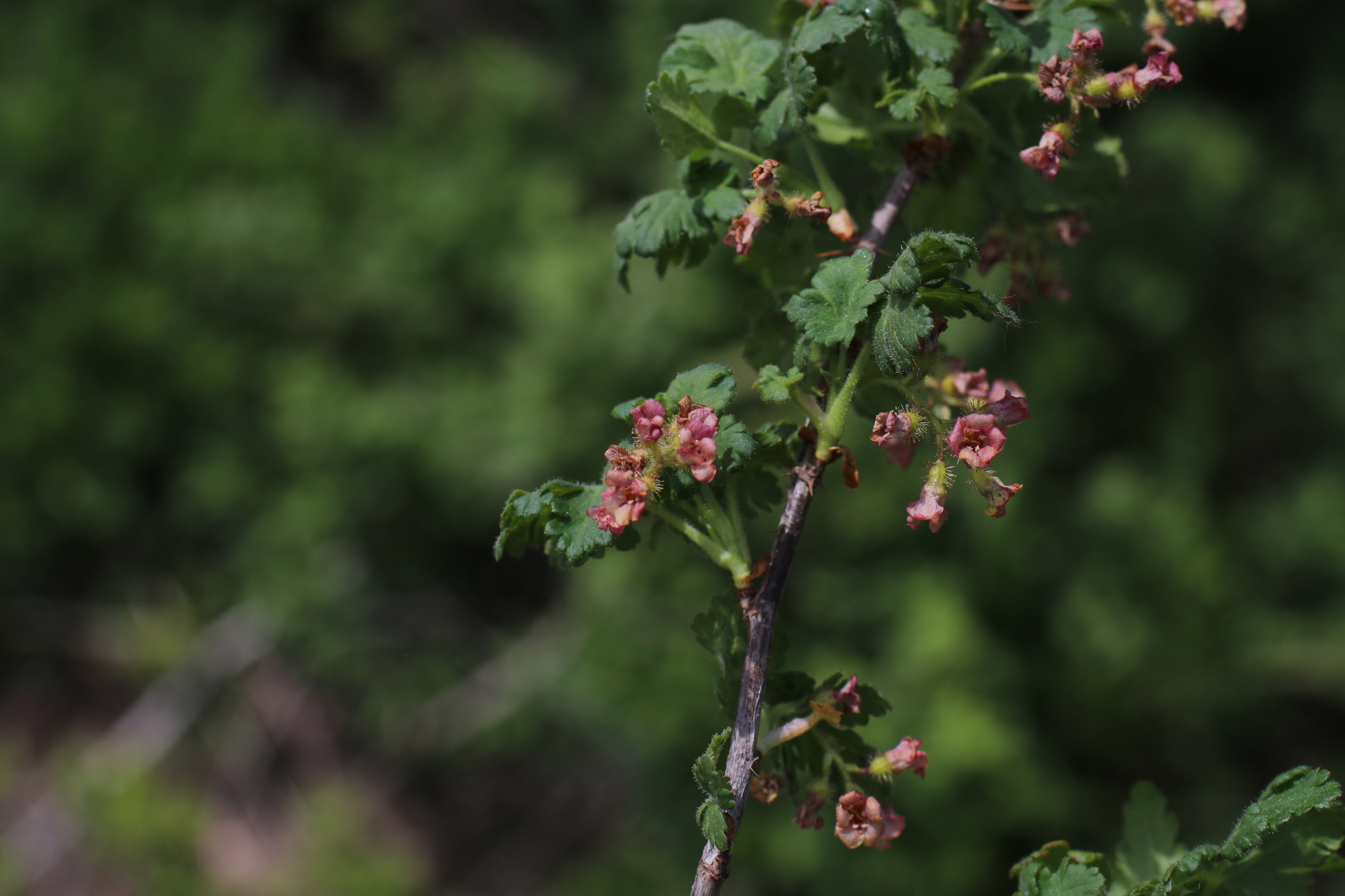
Gooseberry currant flowers, Routt National Forest, Grand County, Colorado. (CC BY-NC 4.0)
Gooseberry currant is a native, deciduous shrub growing from 0.6 to 3.3 feet (0.2-1 m) tall. Its many low, straggling branches are bristly. The orbicular, five-lobed leaves are 0.4 to 1.6 inches (1-4 cm) long, at least as wide, and glandular-pubescent on both sides. Drooping racemes are three- to eight-flowered. The smooth, globose berries are 0.2 to 0.4 inch (5-10 mm) in diameter and contain numerous seeds [6,10,14,16,45].
Raunkiaer Life Form (Raunkiaer 1934)
- Phanerophyte
Seasonal Development
Gooseberry currant flowers from late June to August [6,28]. Fruit ripens from August to September [28].
Regeneration Processes
Gooseberry currant reproduces vegetatively and by seed.
Neither the root system of gooseberry currant nor its ability to sprout from the root crown after fire or disturbance is described in the literature; however, on the Wasatch Plateau, Utah, Ellison [11] observed gooseberry currant forming adventitious roots. Decumbent outer branches partially covered by earth were rooting. The plants were spreading outward and dying in the center, forming a clonal ring. The rings were sometimes 15 to 20 feet (4.5-6.1 m) in diameter.
Ribes spp. generally begin fruiting after 3 years [3]. Many seeds fall beneath the parent plant; they are also dispersed by birds and animals. Fallen seeds of Ribes spp. may remain viable in the soil and duff for many years [38,39].
Mineral soil and scarification generally enhance germination in Ribes spp. [38,39,46]. In the laboratory, a 53 percent germination was obtained without scarification by stratifying gooseberry currant seeds at 32 degrees Fahrenheit (0 deg C) for 200 to 300 days. Seeds were stratified and germinated in sand moistened with nutrient solution [28].
Successional Status
Gooseberry currant is somewhat shade tolerant. It grows in dense forests with few canopy openings, but it occurs most often and grows most vigorously on sites without forest canopy. In the Big Horn Mountains of Wyoming, gooseberry currant occurred in the understory of spruce (Picea spp.)-fir (Abies spp.) forests but its average cover was less than 1 percent [7]. In the Crested Butte area of west-central Colorado, gooseberry currant was the most common tall shrub in dense spruce-fir forests, occurring throughout the understory with a constancy of 72 percent and an average cover of 4 percent. In canopy openings it formed thickets [21]. Near timberline in Colorado and Utah, gooseberry currant formed a dense fringe around spruce and fir "tree islands" [11,18,21,23].
Immediate Fire Effects
Fire probably kills most gooseberry currant.
Postfire Regeneration Strategy (Stickney 1989)
- Ground residual colonizer (on-site, initial community)

Gooseberry currant growing from the base of a burned, decaying stump in the Mount Blue Sky Wilderness, Park County, Colorado. (CC BY-NC 4.0)
Fire Adaptations
The fire ecology of gooseberry currant is not described in the literature. Although many authors discuss the effect of fire on Ribes spp., most refer to studies conducted by Quick [31,32]. Quick described postfire seedling establishment by Sierra Nevada gooseberry (R. roezli).
Gooseberry currant regeneration is probably favored by fire because scarification of soil-stored seed generally enhances germination in Ribes spp. [5,38,39]. The ability of gooseberry currant to sprout from the root crown after fire is described in the literature as "variable" [5,6].
Plant Response to Fire
In New Mexico spruce-fir forests and Utah tall shrub communities, gooseberry currant was described as a dominant early seral species after fire [9,11]. The origin of gooseberry currant (seedlings or sprouts) in postfire communities was not described.
Fire Regimes
For fire regime information, search FEIS for this species by entering the species name on the Advanced Search page and selecting “Fire Regime” as the publication type.
Fire Management Considerations
In south-central Colorado quaking aspen (Populus tremuloides)/gooseberry currant communities may be prescribe burned in the fall to encourage quaking aspen regeneration. Many of the community's undergrowth plants have high or moderate fire resistance and a postfire community "quickly" resembles the prefire one [29].
Federal Status
None
Other Status
No entry.
Importance to Wildlife and Livestock
The fruit of Ribes spp. is a valuable food source for songbirds, chipmunks, ground squirrels, and other animals [22].
Palatability and Nutritional Value
Gooseberry currant is not very palatable to livestock [8,11]. In Ephraim Canyon on the Wasatch Plateau, Utah, domestic sheep browsed gooseberry currant only a little or not at all. Observations were made in a 9-acre pasture for 2 consecutive years in July while a variety of other forage species were available [11]. Dittberner and Olson [8] rate the palatability of gooseberry currant in Utah as poor for cattle and horses and good for sheep.
Currants (Ribes spp.) contain high concentrations of mono- and disaccharides [48].
Cover Value
Cover values for gooseberry currant are as follows [8]:
| Wildlife | Utah | Wyoming |
|---|---|---|
| Pronghorn | Poor | Poor |
| Elk | Poor | Poor |
| Mule deer | Poor | Fair |
| White-tailed deer | — | Poor |
| Small mammals | Fair | Good |
| Small nongame birds | Fair | Good |
| Upland game birds | Fair | Good |
| Waterfowl | Poor | Poor |
Value for Rehabilitation or Restoration of Disturbed Sites
Gooseberry currant can be used to revegetate disturbed mountain areas. Plummer [47] rated the suitability of gooseberry currant for restoring high-elevation mountain environments as follows:
| Regeneration suitability type | Rating |
|---|---|
| Seed establishment | Good |
| Transplant establishment | Very good |
| Seed production | Medium |
| Natural seed spread | Medium |
| Vegetative spread | Good |
| Growth rate | Medium |
| Soil stability | Good |
| Adaptation to disturbance | Good |
Other Uses
Currants (Ribes spp.) can be used for making jam, jelly, or pie [28]. Some western Indian tribes used currants for making pemmican [26].
Other Management Considerations
Gooseberry currant is an alternate host for white pine blister rust (Cronartium ribicola) which infests five-needled pines. Because of their association with the rust, Ribes spp. have been the targets of various eradication efforts; however, these efforts have not been successful in the western states [15,27].
Table A1— Forest and range ecosystems, Bureau of Land Management (BLM) physiographic regions, Kuchler plant associations, Society for American Foresters (SAF) forest cover types, and Society for Rangeland Management (SRM) rangeland cover types in which this species occurs.
Forest and Range Ecosystems (Garrison et al. 1977)
- FRES23 Fir-spruce
- FRES26 Lodgepole pine
- FRES29 Sagebrush
- FRES34 Chaparral-mountain shrub
- FRES44 Alpine
BLM Physiographic Regions (Bernard and Brown 1977)
- 2 Cascade Mountains
- 4 Sierra Mountains
- 5 Columbia Plateau
- 6 Upper Basin and Range
- 7 Lower Basin and Range
- 8 Northern Rocky Mountains
- 9 Middle Rocky Mountains
- 10 Wyoming Basin
- 11 Southern Rocky Mountains
- 12 Colorado Plateau
Kuchler Plant Associations (Kuchler 1964)
- K004 Fir-hemlock forest
- K008 Lodgepole pine-subalpine forest
- K015 Western spruce-fir forest
- K020 Spruce-fir-Douglas-fir forest
- K021 Southwestern spruce-fir forest
- K037 Mountain-mahogany-oak scrub
- K038 Great Basin sagebrush
- K052 Alpine meadows and barren
- K055 Sagebrush steppe
SAF Cover Types (Eyre 1980)
- 206 Engelmann spruce-subalpine fir
- 208 Whitebark pine
- 209 Bristlecone pine
- 211 White fir
- 213 Grand fir
- 216 Blue spruce
- 218 Lodgepole pine
- 219 Limber pine
- 220 Rocky Mountain juniper
- 256 California mixed subalpine
SRM Rangeland Cover Types (Shiflet 1994)
- 108 Alpine Idaho fescue
- 213 Alpine grassland
- 322 Curlleaf mountain-mahogany-bluebunch wheatgrass
- 402 Mountain big sagebrush
- 409 Tall forb
- 410 Alpine rangeland
- 411 Aspen woodland
- 415 Curlleaf mountain-mahogany
- 416 True mountain-mahogany
- 417 Littleleaf mountain-mahogany
1. Arno, Stephen F.; Weaver, Tad. 1990. Whitebark pine community types and their patterns on the landscape. In: Schmidt, Wyman C.; McDonald, Kathy J., compilers. Proceedings--symposium on whitebark pine ecosystems: ecology and management of a high-mountain resource; 1989 March 29-31; Bozeman, MT. Gen Tech. Rep. INT-270. Ogden, UT: U.S. Department of Agriculture, Forest Service, Intermountain Research Station: 97-105. [11680]
2. Banner, Roger E.; Johnson, Kendall L.; McCawley, Paul F. 1990. Evaluation of curlleaf mountain mahogany (Cercocarpus ledifolius Nutt.) stands 23 years following mechanical treatment. In: Johnson, Kendall L., ed. Proceedings, 5th Utah shrub ecology workshop: The genus Cercocarpus; 1988 July 13-14; Logan, UT. Logan, UT: Utah State University, College of Natural Resources: 67-74. [16097]
3. Benedict, W. V.; Harris, T. H. 1931. Experimental Ribes eradication Stanislaus National Forest. Journal of Forestry. 29(5): 709-720. [427]
4. Bernard, Stephen R.; Brown, Kenneth F. 1977. Distribution of mammals, reptiles, and amphibians by BLM physiographic regions and A.W. Kuchler's associations for the eleven western states. Tech. Note 301. Denver, CO: U.S. Department of the Interior, Bureau of Land Management. 169 p. [434]
5. Bradley, Anne F.; Fischer, William C.; Noste, Nonan V. 1992. Fire ecology of the forest habitat types of eastern Idaho and western Wyoming. Gen. Tech. Rep. INT-290. Ogden, UT: U.S. Department of Agriculture, Forest Service, Intermountain Research Station. 92 p. [19557]
6. Conrad, C. Eugene. 1987. Common shrubs of chaparral and associated ecosystems of southern California. Gen. Tech. Rep. PSW-99. Berkeley, CA: U.S. Department of Agriculture, Forest Service, Pacific Southwest Forest and Range Experiment Station. 86 p. [4209]
7. Despain, Don G. 1973. Vegetation of the Big Horn Mountains, Wyoming, in relation to substrate and climate. Ecological Monographs. 43(3): 329-355. [789]
8. Dittberner, Phillip L.; Olson, Michael R. 1983. The plant information network (PIN) data base: Colorado, Montana, North Dakota, Utah, and Wyoming. FWS/OBS-83/86. Washington, DC: U.S. Department of the Interior, Fish and Wildlife Service. 786 p. [806]
9. Dye, A. J.; Moir, W. H. 1977. Spruce-fir forest at its southern distribution in the Rocky Mountains, New Mexico. American Midland Naturalist. 97(1): 133-146. [7476]
10. Elias, Thomas S.; Dykeman, Peter A. 1982. Field guide to North American edible wild plants. [Place of publication unknown]: Outdoor Life Books. 286 p. [21103]
11. Ellison, Lincoln. 1954. Subalpine vegetation of the Wasatch Plateau, Utah. Ecological Monographs. 24: 89-184. [861]
12. Eyre, F. H., ed. 1980. Forest cover types of the United States and Canada. Washington, DC: Society of American Foresters. 148 p. [905]
13. Garrison, George A.; Bjugstad, Ardell J.; Duncan, Don A.; [and others]. 1977. Vegetation and environmental features of forest and range ecosystems. Agric. Handb. 475. Washington, DC: U.S. Department of Agriculture, Forest Service. 68 p. [998]
14. Goodrich, Sherel. 1985. Utah flora: Saxifragaceae. Great Basin Naturalist. 45(2): 155-172. [15657]
15. Hagle, Susan K.; McDonald, Geral I.; Norby, Eugene A. 1989. White pine blister rust in northern Idaho and western Montana: alternatives for integrated management. Gen. Tech. Rep. INT-261. Ogden, UT: U.S. Department of Agriculture, Forest Service, Intermountain Research Station. 35 p. [9357]
16. Harrington, H. D. 1964. Manual of the plants of Colorado. 2d ed. Chicago: The Swallow Press Inc. 666 p. [6851]
17. Hickman, James C., ed. 1993. The Jepson manual: Higher plants of California. Berkeley, CA: University of California Press. 1400 p. [21992]
18. Holtmeier, Friedrich-Karl; Broll, Gabriele. 1992. The influence of tree islands and microtopography on pedoecological conditions in the forest-alpine tundra ecotone on Niwot Ridge, CO. Front Range, U.S.A. Arctic and Alpine Research. 24(3): 216-228. [20215]
19. Kartesz, John T. 1994. A synonymized checklist of the vascular flora of the United States, Canada, and Greenland. Volume II--thesaurus. 2nd ed. Portland, OR: Timber Press. 816 p. [23878]
20. Kuchler, A. W. 1964. Manual to accompany the map of potential vegetation of the conterminous United States. Special Publication No. 36. New York: American Geographical Society. 77 p. [1384]
21. Langenheim, Jean H. 1962. Vegetation and environmental patterns in the Crested Butte area, Gunnison County, Colorado. Ecological Monographs. 32(2): 249-285. [1399]
22. Martin, Alexander C.; Zim, Herbert S.; Nelson, Arnold L. 1951. American wildlife and plants. New York: McGraw-Hill Book Company, Inc. 500 p. [4021]
23. Mauk, Ronald L.; Henderson, Jan A. 1984. Coniferous forest habitat types of northern Utah. Gen. Tech. Rep. INT-170. Ogden, UT: U.S. Department of Agriculture, Forest Service, Intermountain Forest and Range Experiment Station. 89 p. [1553]
24. Moir, W. H. 1993. Alpine tundra and coniferous forest. In: Dick-Peddie, William A., ed. New Mexico vegetation: Past, present, and future. Albuquerque, NM: University of New Mexico Press: 47-84. [21099]
25. Moseley, Robert K.; Bernatas, Susan. 1992. Vascular flora of Kane Lake Cirque, Pioneer Mountains, Idaho. Great Basin Naturalist. 52(4): 335-343. [20212]
26. Mozingo, Hugh N. 1987. Shrubs of the Great Basin: A natural history. Reno, NV: University of Nevada Press. 342 p. [1702]
27. Offord, H. R.; Van Atta, G. R.; Swanson, H. E. 1940. Chemical and mechanical methods of Ribes eradication in the white pine areas of the western states. Tech. Bull. No. 692. Washington, DC: U.S. Department of Agriculture. 50 p. [1795]
28. Pfister, Robert D. 1974. Ribes L.--currant, gooseberry. In: Schopmeyer, C. S., tech. coord. Seeds of woody plants in the United States. Agric. Handb. 450. Washington, DC: U.S. Department of Agriculture, Forest Service: 720-727. [1877]
29. Powell, David C. 1988. Aspen community types of the Pike and San Isabel National Forests in south-central Colorado. R2-ECOL-88-01. Denver, CO: U.S. Department of Agriculture, Forest Service, Rocky Mountain Region. 254 p. [15285]
30. Potter, Loren D.; Moir, D. Ross. 1961. Phytosociological study of burned deciduous woods, Turtle Mountains North Dakota. Ecology. 42(3): 468-480. [10191]
31. Quick, Clarence R. 1954. Ecology of the Sierra Nevada gooseberry in relation to blister rust control. Circular No. 937. Washington, DC: U.S. Department of Agriculture, Forest Service. 30 p. [1920]
32. Quick, Clarence R. 1962. Resurgence of a gooseberry population after fire in mature timber. Journal of Forestry. February: 100-103. [1922]
33. Ralphs, M. H.; Pfister, J. A. 1992. Cattle diets in tall forb communities on mountain ranges. Journal of Range Management. 45(6): 534-537. [20189]
34. Raunkiaer, C. 1934. The life forms of plants and statistical plant geography. Oxford: Clarendon Press. 632 p. [2843]
35. Reed, Robert M. 1976. Coniferous forest habitat types of the Wind River Mountains, Wyoming. American Midland Naturalist. 95(1): 159-173. [1950]
36. Riegel, Gregg M.; Thornburgh, Dale A.; Sawyer, John O. 1990. Forest habitat types of the South Warner Mountains, Modoc County, California. Madrono. 37(2): 88-112. [11466]
37. Shiflet, Thomas N., ed. 1994. Rangeland cover types of the United States. Denver, CO: Society for Range Management. 152 p. [23362]
38. Steele, Robert; Geier-Hayes, Kathleen. 1989. The Douglas-fir/ninebark habitat type in central Idaho: succession and management. Gen. Tech. Rep. INT-252. Ogden, UT: U.S. Department of Agriculture, Forest Service, Intermountain Research Station. 65 p. [8136]
39. Steele, Robert; Geier-Hayes, Kathleen. 1993. The Douglas-fir/pinegrass habitat type in central Idaho: succession and management. Gen. Tech. Rep. INT-298. Ogden, UT: U.S. Department of Agriculture, Forest Service, Intermountain Research Station. 83 p. [21512]
40. Steele, Robert; Pfister, Robert D.; Ryker, Russell A.; Kittams, Jay A. 1981. Forest habitat types of central Idaho. Gen. Tech. Rep. INT-114. Ogden, UT: U.S. Department of Agriculture, Forest Service, Intermountain Forest and Range Experiment Station. 138 p. [2231]
41. Stickney, Peter F. 1989. Seral origin of species originating in northern Rocky Mountain forests. Unpublished draft on file at: U.S. Department of Agriculture, Forest Service, Intermountain Research Station, Fire Sciences Laboratory, Missoula, MT; RWU 4403 files. 7 p. [20090]
42. Taye, Alan C. 1983. Flora of the Stansbury Mountains, Utah. Great Basin Naturalist. 43(4): 619-646. [14669]
43. U.S. Department of Agriculture, Soil Conservation Service. 1994. Plants of the U.S.--alphabetical listing. Washington, DC: U.S. Department of Agriculture, Soil Conservation Service. 954 p. [23104]
44. U.S. Department of the Interior, National Biological Survey. [n.d.]. NP Flora [Data base]. Davis, CA: U.S. Department of the Interior, National Biological Survey. [23119]
45. Welsh, Stanley L.; Atwood, N. Duane; Goodrich, Sherel; Higgins, Larry C., eds. 1987. A Utah flora. Great Basin Naturalist Memoir No. 9. Provo, UT: Brigham Young University. 894 p. [2944]
46. Moss, Virgil D.; Wellner, Charles A. 1953. Aiding blister rust control by silvicultural measures in the western white pine type. Circular No. 919. Washington, DC: U.S. Department of Agriculture. 32 p. [12262]
47. Plummer, A. Perry. 1976. Shrubs for the subalpine zone of the Wasatch Plateau. In: Zuck, R. H.; Brown, L. F., eds. High altitude revegetation workshop: No. 2: Proceedings; 1976; Fort Collins, CO. Fort Collins, CO: Colorado State University: 33-40. [1899]
48. Stiles, Edmund W. 1980. Patterns of fruit presentation and seed dispersal in bird-disseminated woody plants in the Eastern deciduous forest. American Naturalist. 116(5): 670-688. [6508]