


Schoenoplectus tabernaemontani, softstem bulrush
Snyder, S. A. 1993. Schoenoplectus tabernaemontani, softstem bulrush. In: Fire Effects Information System, [Online]. U.S. Department of Agriculture, Forest Service, Rocky Mountain Research Station, Fire Sciences Laboratory (Producer). Available: https://research.fs.usda.gov/feis/species-reviews/schtab
| Abbreviation | Common Name | Scientific Name | Classification | Status |
|---|---|---|---|---|
| Plants | ||||
| SCHTAB | softstem bulrush | Schoenoplectus tabernaemontani | Life Form: Plants/Graminoid Kingdom: Plantae Class: Monocot Order: Cyperales Family: Cyperaceae Genus: Schoenoplectus | Fed. Protected: No Nativity: Native Invasiveness: Noninvasive |


Taxonomy
The scientific name of softstem bulrush is Schoenoplectus tabernaemontani (K.C. Gmel.) Palla (Cyperaceae) [35,36].
Synonyms
- Scirpus lacustris L. subsp. creber (Fernald) T. Koyama
- Scirpus lacustris L. subsp. glaucus (Rchb.) Hartm.
- Scirpus lacustris L. subsp. validus (Vahl) T. Koyama [35]
- Scirpus validus Vahl [16]
Other Common Names
soft-stem bulrush, soft-stem clubrush, great bulrush, giant bulrush, bullwhip, common bulrush
General Distribution
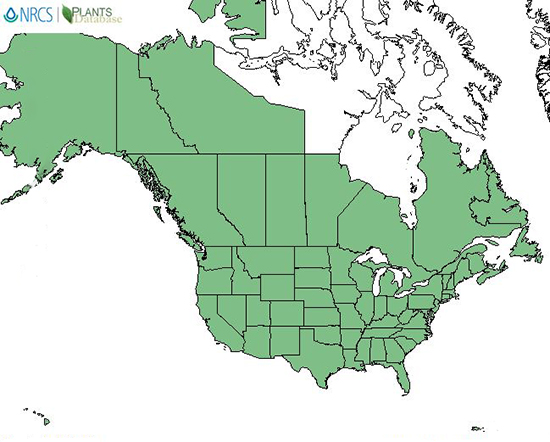
Softstem bulrush occurs throughout North America from central Alaska south to Mexico, east to the Maritime Provinces of Canada, and south through Florida. It does not occur through central and southern California [8]. It is native on the Hawaiian Islands of Niihau, Oahu, Molokai, and Hawaii [34].

Distribution of softstem bulrush.
States and Provinces
- United States: AL AK AZ AR CA CO CT DE FL GA HI ID IL IN IA KS KY LA ME MD MA MI MN MS MO MT NE NV NH NJ NM NY NC ND OH OK OR PA RI SC SD TN TX UT VT VA WA WV WI WY
- Canada: AB BC MB NB NF NT NS ON PE PQ SK YT
- Mexico
Site Characteristics
Softstem bulrush grows in marshes, along lake and stream shores, and in wet meadows. It grows in fresh or brackish water [5,16,23]. Soils are usually poorly-drained [5], or continually saturated [12]. Softstem bulrush grows in silty or peaty soils [18]. Under greenhouse conditions softstem bulrush produced more aboveground biomass in silty clay soils than in clay or sand alone [1]. Belowground biomass was equal in silty clays and clays, and lower in sandy soils. Softstem bulrush seems to grow better in saline conditions than in fresh water, and it tolerates a wide range of salinity [32].

Softstem bulrush growing near Rockford, Illinois.
Plant Communities
Softstem bulrush is a dominant in the following classification type:
- Landscape classification and plant successional trends in the Peace-Athabasca Delta [7]
Some species associated with softstem bulrush are smartweed (Polygonum spp.), sedge (Carex spp.), common cattail, reed (Phragmites spp.), water hemlock (Circuta maculata), spikerush (Eleocharis calva), fowl mannagrass (Glyceria striata), tufted hairgrass (Deschampsia caespitosa), beggartick (Bidens spp.), narrowlieaf burreed (Sparganium eurycarpum), common arrowhead (Sagittaria latifolia), sego pondweed (Potamogeton pectinatus), and nodding waternymph (Najas flexilis) [4,6,19].

A stand of softstem bulrush in Ontario, Canada.
Botanical Description
Softstem bulrush is a tall, leafless marsh plant 1.5 to 9 feet (0.5-3 m) high and 0.12 to 0.8 inches (0.3-2 cm) thick with scaly, stout, horizontal rhizomes [11]. The stems are obscurely three-sided and spongy [17]. Spikes occur near the stem tips in branched clusters [8]. The fruit is an achene [11].

The spongy interior of softstem bulrush.
Raunkiaer Life Form (Raunkiaer 1934)
- Geophyte
Seasonal Development
Because of the wide distribution of softstem bulrush, its growing seasons varies with latitude. In the northeast softstem bulrush flowers from July through August [23]. Flowering lasts from 5 to 6 months in wetland prairies of Nebraska [28]. Fernald [11] reported fruits generally ripening from June through September.

Flowering softstem bulrush.
Regeneration Processes
Softstem bulrush reproduces by both rhizomes and seeds [11,17]. It reproduces well from seed stored in the seedbank [18]. Soil-stored seed can remain viable for as long as 20 years [31]. In the lab, seed viability in dry storage is more than 2 years [14].
Successional Status
Softstem bulrush is a perennial [17] and is a dominant emergent in the northern plains and prairie states [19]. It is replaced by cattail (Typha spp.) in continuously flooded marshes following drawdown [18]. Softstem bulrush is found in the third sere of succession in Wisconsin marshes, preceded by submerged and floating plant stages and followed by sedge meadows, shrubs, and trees [12].
Immediate Fire Effects
Fire topkills softstem bulrush stands [13] and reduces shoot mass of Schoenoplectus species [27].
The effects of fire on wetland plants after drawdowns in Utah's Great Salt Lake Marsh were studied [27]. On burned sites new shoots had a lower biomass per inch of length than shoots on unburned sites.
Postfire Regeneration Strategy (Stickney 1989)
- Rhizomatous herb, rhizome in soil
- Ground residual colonizer (on-site, initial community)
Fire Adaptations
Softstem bulrush sprouts from rhizomes following fire [27].
Plant Response to Fire
Softstem bulrush sprouts from rhizomes following fire [27].
Fire increases protein content of Schoenoplectus acutus, a closely related species [33]. Wetland vertebrates may select certain marsh plant species due to protein increases following fire [27].
Prescribed fires were lit in early September following April drawdowns in the Great Salt Lake Marsh [27]. No distinction was made between S. tabernaemontani and S. acutus in this study. Both were referred to as "Scirpus lacustris". Burned and unburned sites were reflooded 1 week following fire. Stands of bulrush on burned sites were similar to those on unburned sites during the first year. Bulrush began sprouting immediately following fire, growing to a height of 1.3 feet (0.4 m) before the first winter. Production did not differ between sites.
Waterfowl and muskrats can reduce softstem bulrush through overgrazing, especially following fire [27].
Fire Regimes
For fire regime information, search FEIS for this species by entering the species name or acronym on the home page and selecting “Fire Regime” as the publication type.
Fire Management Considerations
No entry.
Federal Status
None
Other Status
No entry.
Importance to Wildlife and Livestock
The seeds of softstem bulrush are eaten by waterfowl and considered a good to excellent food source in South Dakota [3,9].
Palatability and Nutritional Value
No entry.
Cover Value
Softstem bulrush provides good cover for waterfowl, especially in conjunction with common cattail (Typha latifolia) [13].
Value for Rehabilitation or Restoration of Disturbed Sites
Softstem bulrush is used in wetland restoration and is best planted vegetatively because it can triple its biomass in one growing season [20]. It is also used to reduce pollutant loads carried by storm water runoff in urban wetlands [25].
Other Uses
Roots of softstem bulrush can be ground into flour or eaten whole. Syrup can be extracted from them [8].
Other Management Considerations
Livestock grazing in wetlands can reduce softstem bulrush [13].
Softstem bulrush will establish from the seedbank following periodic draining and reflooding of marshes [6,22]. However, prolonged draining and reflooding can reduce softstem bulrush stands [18]. In a Minnesota marsh, early to mid-June drawdowns favored softstem bulrush stands in the first 2 years. After the third-year drawdown, bulrush began to decrease in water depths greater than 15 inches (38 cm). Eventually it was eradicated from all areas reflooded annually [18].
Table A1— Forest and range ecosystems, Bureau of Land Management (BLM) physiographic regions, Kuchler plant associations, Society for American Foresters (SAF) forest cover types, and Society for Rangeland Management (SRM) rangeland cover types in which this species occurs.
Forest and Range Ecosystems (Garrison et al. 1977)
- FRES17 Elm - ash - cottonwood
- FRES28 Western hardwoods
- FRES36 Mountain grasslands
- FRES37 Mountain meadows
- FRES39 Prairie
- FRES41 Wet grasslands
BLM Physiographic Regions (Bernard and Brown 1977)
- 1 Northern Pacific Border
- 2 Cascade Mountains
- 4 Sierra Mountains
- 5 Columbia Plateau
- 6 Upper Basin and Range
- 7 Lower Basin and Range
- 8 Northern Rocky Mountains
- 9 Middle Rocky Mountains
- 10 Wyoming Basin
- 11 Southern Rocky Mountains
- 12 Colorado Plateau
- 13 Rocky Mountain Piedmont
- 14 Great Plains
- 15 Black Hills Uplift
- 16 Upper Missouri Basin and Broken Lands
Kuchler Plant Associations (Kuchler 1964)
- K025 Alder - ash forest
- K049 Tule marshes
- K063 Foothills prairie
- K072 Sea oats prairie
- K073 Northern cordgrass prairie
- K075 Nebraska Sandhills prairie
- K078 Southern cordgrass prairie
- K080 Marl - everglades
- K092 Everglades
- K098 Northern floodplain forest
SAF Cover Types (Eyre 1980)
- 63 Cottonwood
- 235 Cottonwood - willow
SRM Rangeland Cover Types (Shiflet 1994)
- No entry
1. Barko, John W.; Smart, R. Michael. 1978. The growth and biomass distribution of two emergent freshwater plants, Cyperus esculentus and Scirpus validus, on different sediments. Aquatic Botany. 5(2): 109-117. [21915]
2. Bernard, Stephen R.; Brown, Kenneth F. 1977. Distribution of mammals, reptiles, and amphibians by BLM physiographic regions and A.W. Kuchler's associations for the eleven western states. Tech. Note 301. Denver, CO: U.S. Department of the Interior, Bureau of Land Management. 169 p. [434]
3. Chamberlain, J. L. 1959. Gulf Coast marsh vegetation as food of wintering waterfowl. Journal of Wildlife Management. 23(1): 97-102. [14535]
4. Clambey, Gary K.; Landers, Roger Q. 1978. A survey of wetland vegetation in north-central Iowa. In: Glenn-Lewin, David C.; Landers, Roger Q., Jr., eds. Proceedings, 5th Midwest prairie conference; 1976 August 22-24; Ames, IA. Ames, IA: Iowa State University: 32-35. [3304]
5. Cooper, James A. 1978. The history and breeding biology of the Canada geese of Marshy Point, Manitoba. Wildlife Monographs No. 61. Washington, DC: The Wildlife Society. 87 p. [18122]
6. Currier, P. J.; Davis, C. B.; Vander Valk, A. G. 1978. A vegetation analysis of a wetland prairie marsh in northern Iowa. In: Glenn-Lewin, David C.; Landers, Roger Q., Jr., eds. Proceedings, 5th Midwest prairie conference; 1976 August 22-24; Ames, IA. Ames, IA: Iowa State University: 65-69. [3346]
7. Dirschl, German J.; Dabbs, Don L.; Gentle, Garry C. 1974. Landscape classification and plant successional trends in the Peace-Athabasca Delta. Canadian Wildlife Service Report Series 30. Ottawa, ON: Canadian Wildlife Service. 33 p. [6177]
8. Elias, Thomas S.; Dykeman, Peter A. 1982. Field guide to North American edible wild plants. [Place of publication unknown]: Outdoor Life Books. 286 p. [21103]
9. Evans, Keith E.; Kerbs, Roger R. 1977. Avian use of livestock watering ponds in western South Dakota. Gen. Tech. Rep. RM-35. Fort Collins, CO: U.S. Department of Agriculture, Forest Service, Rocky Mountain Forest and Range Experiment Station. 11 p. [19330]
10. Eyre, F. H., ed. 1980. Forest cover types of the United States and Canada. Washington, DC: Society of American Foresters. 148 p. [905]
11. Fernald, Merritt Lyndon. 1950. Gray's manual of botany. [Corrections supplied by R. C. Rollins]. Portland, OR: Dioscorides Press. 1632 p. (Dudley, Theodore R., gen. ed.; Biosystematics, Floristic & Phylogeny Series; vol. 2). [14935]
12. Frolik, A. L. 1941. Vegetation on the peat lands of Dane County, Wisconsin. Ecological Monographs. 11(1): 117-140. [16805]
13. Furniss, O. C. 1938. The 1937 waterfowl season in the Prince Albert District, central Saskatchewan. Wilson Bulletin. 50: 17-27. [14636]
14. Garbisch, Edgar W.; McIninch, Suzanne. 1992. Seed information for wetland plant species of the northeast United States. Restoration & Management Notes. 10(1): 85-86. [19412]
15. Garrison, George A.; Bjugstad, Ardell J.; Duncan, Don A.; [and others]. 1977. Vegetation and environmental features of forest and range ecosystems. Agric. Handb. 475. Washington, DC: U.S. Department of Agriculture, Forest Service. 68 p. [998]
16. Gleason, Henry A.; Cronquist, Arthur. 1991. Manual of vascular plants of northeastern United States and adjacent Canada. 2nd ed. New York: New York Botanical Garden. 910 p. [20329]
17. Godfrey, Robert K.; Wooten, Jean W. 1979. Aquatic and wetland plants of southeastern United States: Monocotyledons. Athens, GA: The University of Georgia Press. 712 p. [16906]
18. Harris, Stanley W.; Marshall, William H. 1963. Ecology of water-level manipulations on a northern marsh. Ecology. 44(2): 331-343. [17808]
19. Kantrud, Harold A.; Millar, John B.; van der Valk, A. G. 1989. Vegetation of wetlands of the prairie pothole region. In: van der Valk, Arnold, ed. Northern prairie wetlands. Ames, IA: Iowa State University Press: 132-187. [15217]
20. Kerans, Karen. 1990. Country Wetlands Nursery Ltd. Restoration & Management Notes. 8(1): 29-31. [14513]
21. Kuchler, A. W. 1964. Manual to accompany the map of potential vegetation of the conterminous United States. Special Publication No. 36. New York: American Geographical Society. 77 p. [1384]
22. Lehto, Bruce; Murphy, Jeff. 1989. Effects of drawdown and water management on a seriously eroded marsh. U.S. Fish and Wildlife Service: Biological Report. 89(22): 164-169. [17337]
23. Magee, Dennis W. 1981. Freshwater wetlands: A guide to common indicator plants of the Northeast. Amherst, MA: University of Massachusetts Press. 245 p. [14824]
24. Raunkiaer, C. 1934. The life forms of plants and statistical plant geography. Oxford: Clarendon Press. 632 p. [2843]
25. Schueler, Tom; Galli, John. 1990. Pond/marsh detention system key to urban stream restoration. Restoration and Management. 8(2): 115-116. [15042]
26. Shay, Jennifer M.; Macaulay, A. J.; Frego, K. A. 1988. A morphological comparison of Scirpus acutus and S. validus in southern Manitoba. Canadian Journal of Botany. 66(11): 2331-2337. [21916]
27. Smith, Loren M.; Kadlec, John A. 1985. Fire and herbivory in a Great Salt Lake marsh. Ecology. 66(1): 259-265. [7619]
28. Steiger, T. L. 1930. Structure of prairie vegetation. Ecology. 11(1): 170-217. [3777]
29. Stickney, Peter F. 1989. Seral origin of species originating in northern Rocky Mountain forests. Unpublished draft on file at: U.S. Department of Agriculture, Forest Service, Intermountain Research Station, Fire Sciences Laboratory, Missoula, MT; RWU 4403 files. 7 p. [20090]
30. U.S. Department of Agriculture, NRCS. 2018. PLANTS Database, [Online]. U.S. Department of Agriculture, Natural Resources Conservation Service (Producer). Available: https://plants.usda.gov/. [34262]
31. Wienhold, C. E.; van der Valk, A. G. 1989. The impact of duration of drainage on the seed banks of northern prairie wetlands. Canadian Journal of Botany. 67(6): 1878-1884. [13799]
32. Latham, Pamela J.; Pearlstine, Leonard G.; Kitchens, Wiley M. 1991. Spatial distributions of the softstem bulrush, Scirpus validus, across a salinity gradient. Estuaries. 14(2): 192-198. [18172]
33. Smith, Loren M.; Kadlec, John A; Fonnesbeck, Paul V. 1984. Effects of prescribed burning on nutritive quality of marsh plants in Utah. Journal of Wildlife Management. 48(1): 285-288. [8457]
34. St. John, Harold. 1973. List and summary of the flowering plants in the Hawaiian islands. Hong Kong: Cathay Press Limited. 519 p. [25354]
35. Kartesz, John T.; Meacham, Christopher A. 1999. Synthesis of the North American flora (Windows Version 1.0), [CD-ROM]. Available: North Carolina Botanical Garden. In cooperation with the Nature Conservancy, Natural Resources Conservation Service, and U.S. Fish and Wildlife Service [2001, January 16]. [38380]
36. Flora of North America Association. 2009. Flora of North America: The flora, [Online]. Flora of North America Association (Producer). Available: http://www.fna.org/FNA. [36990]