


Sporobolus heterolepis, prairie dropseed
Snyder, S. A. 1992. Sporobolus heterolepis, prairie dropseed. In: Fire Effects Information System, [Online]. U.S. Department of Agriculture, Forest Service, Rocky Mountain Research Station, Fire Sciences Laboratory (Producer). Available: https://research.fs.usda.gov/feis/species-reviews/spohet
| Abbreviation | Common Name | Scientific Name | Classification | Status |
|---|---|---|---|---|
| Plants | ||||
| SPOHET | prairie dropseed | Sporobolus heterolepis | Life Form: Plants/Graminoid Kingdom: Plantae Class: Monocot Order: Cyperales Family: Poaceae Genus: Sporobolus | Fed. Protected: No Nativity: Native Invasiveness: Noninvasive |


Taxonomy
The currently accepted scientific name for prairie dropseed is Sporobolus heterolepis (Gray) Gray (Poaceae) [12,19]. There are no recognized subspecies or varieties.
Synonyms
- Agrostis heterolepis Wood
- Vilfa heterolepis Gray
Other Common Names
northern dropseed
Notes
The Research Project Summary titled "Herbaceous responses to seasonal burning in experimental tallgrass prairie plots" provides information on postfire response of plant communities including prairie dropseed in experimental prairie plots that was not available when this species review was originally written. To find this summary, search FEIS for this species by entering the species name on the Advanced Search page and selecting “Fire Study” as the publication type.
General Distribution
Prairie dropseed is found in 24 states and 4 Canadian provinces with remnant tallgrass prairie stands. The species is scattered from Wyoming and Colorado east to Connecticut and Massachusetts and as far south as Texas [12,23].
States and Provinces
- United States: AR CO CT IL IN IA KS KY LA MA MI MN MO NE NY NC ND OH OK PA SD TX WI WY
- Canada: MB ON PQ SK
Site Characteristics
In Colorado, prairie dropseed grows at elevations between 5,300 and 7,200 feet (1,615-2,195 m) [19].
Soil types in Kansas include shallow, cherty, clay loams and deep silty, clay loams [15]. In North Dakota prairie dropseed grows in Hamerly and Barnes soil types in moderately drained rolling plains [24].

Prairie dropseed in a field in Minnesota.
Plant Communities
Prairie dropseed is a tallgrass species that grows in mesic prairies, well-drained moraines, rock outcrops, glades, pine savannahs and barrens, lightly grazed pastures, and along railroad and highway rights-of-way [3,5,14,23].
Associates include bluestems (Andropogon/Schizachyrium spp.), gramas (Bouteloua spp.), junegrass (Koeleria cristata), porcupine grass (Stipa spartea), panic grass (Panicum spp.), indiangrass (Sorghastrum nutans), northern bedstraw (Galium boreale), common goldstar (Hypoxis hirsuta), mountain deathcamas (Zygadenus elegans), leadplant (Amorpha canescens), green milkweed (Asclepias viridiflora), coreopsis (Coreopsis spp.), purple sorrel (Oxalis violacea), phlox (Phlox spp.), and yellow cone flower (Ratibida pinnata) [2,5,8,]. Species that invade prairie dropseed areas include Kentucky bluegrass (Poa pratensis), smooth brome (Bromus inermis), and quackgrass (Elytrigia repens) [3].
Botanical Description
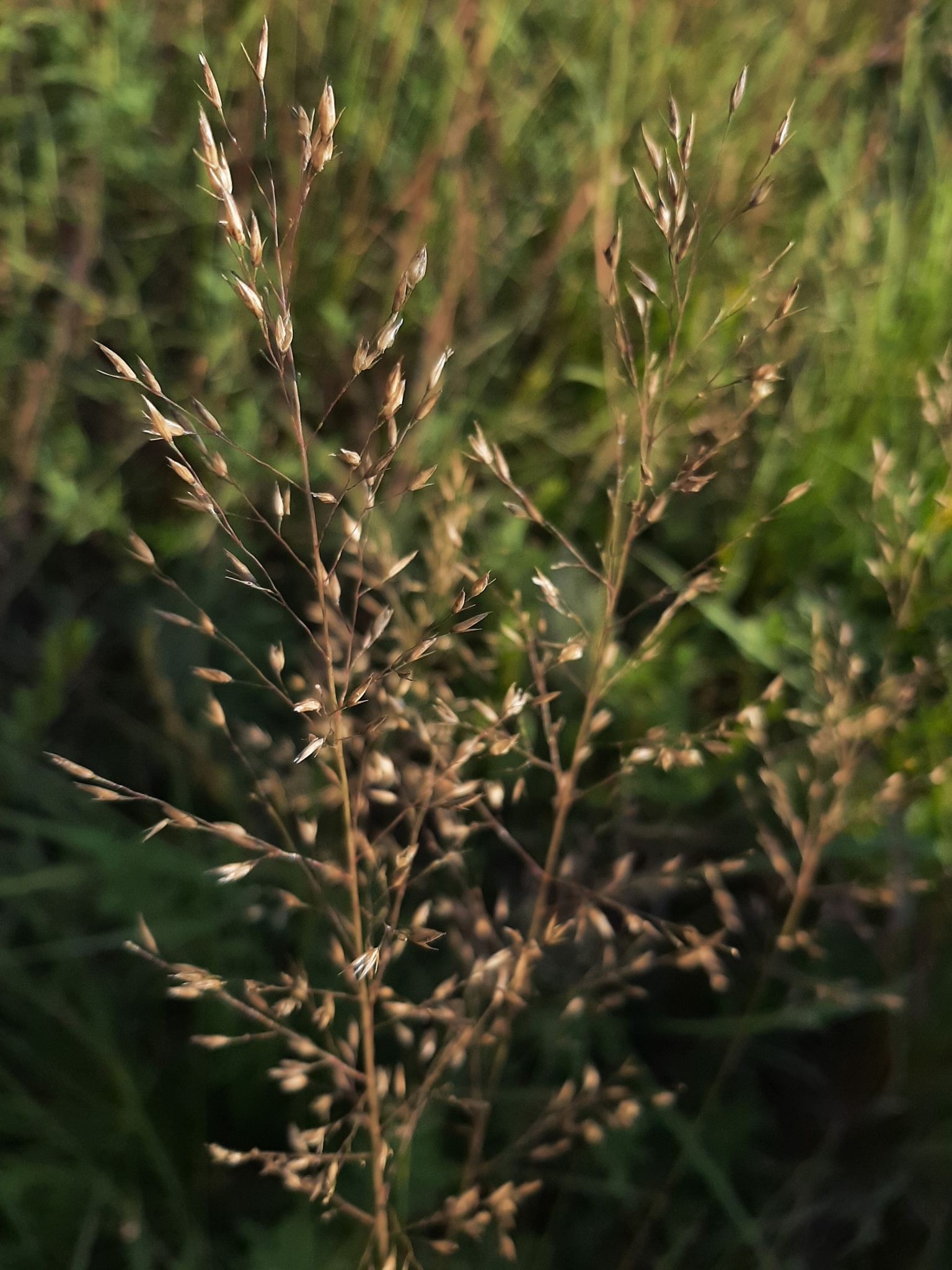
Prairie dropseed is a native, perennial, sod-forming, warm-season grass. It is 1 to 3 feet (0.5-1 m) tall, densely tufted, with alternate basal leaves. Its leaves are half as long as its stout culms; the panicles are purple to black and up to 11.8 inches (30 cm) long [12,23].
Raunkiaer Life Form (Raunkiaer 1934)
- Phanerophyte
Seasonal Development
Prairie dropseed flowers and fruits from August through November [12,23].

Prairie dropseed in fruit.
Regeneration Processes
Prairie dropseed regenerates by seed. In germination tests, seeds stratified in dry soil for 10 weeks germinated in 7 days; peak germination occurred in 25 days. Greenhouse temperatures during the day varied between 70 and 90 degrees F (21-32 deg C) and at night varied between 40 and 70 degrees F (4-21 deg C) [25]. Other tests showed that only slightly more seeds germinated when stratified than when unstratified [18]. Prairie dropseed does not establish well when direct seeded [25].
Successional Status
Prairie dropseed is a climax species that is codominant with little bluestem (Schizachyrium scoparium) in some community types of Ohio and Minnesota [8,20]. It codominates with prairie dropseed, big bluestem (Andropogon gerardii var. gerardii), and Indiangrass on remnant mesic prairies in Indiana [5].
Immediate Fire Effects
Fire top-kills prairie dropseed [1,2,3,7,10,16,17].
Postfire Regeneration Strategy (Stickney 1989)
- Tussock graminoid
- Secondary colonizer - off-site seed
Fire Adaptations
No entry.
Plant Response to Fire
Prairie dropseed sprouts and generally increases following fire [1,2,3,7,10,16,17].

Postfire sprouting by prairie dropseed.
In most prescribed burning studies prairie dropseed was shown to increase in flower production, height, and cover. It has been described as an increaser following spring or winter fires [17]. Following an April wildfire in Wisconsin, flower production increased by 25 times, cover by 30 times, and average plant height by 4 inches (10 cm) [7]. Other studies on the effects of prescribed burning have shown similar results [3,10]. Prairie dropseed appears to increase when burned during winter and spring and decrease when burned during summer or fall [2,16]. Annual fires are less beneficial to prairie dropseed than fires conducted every 2 to 3 years [1].
Fire Regimes
For fire regime information, search FEIS for this species by entering the species name or acronym on the home page and selecting “Fire Regime” as the publication type.
Fire Management Considerations
On prairie sites in Iowa, burning in early spring, after vegetation has dried but while soils are still frozen, has been recommended [10]. Timing of the burn is important; burning too early may expose soils to late winter storms, while burning too late may damage emerging plants.
Federal Status
None
Other Status
Prairie dropseed is endangered in Ohio and North Carolina and is a candidate for endangered species listing in Kentucky [20,23].
Importance to Wildlife and Livestock
Prairie dropseed (pre-maturation) has been rated as good in forage value for livestock. It is an important hay and pasture grass in Nebraska [29].
Palatability and Nutritional Value
Prairie dropseed is the most palatable Sporobolus species in Nebraska [29].
Cover Value
No entry.
Value for Rehabilitation or Restoration of Disturbed Sites
Prairie dropseed is widely used for roadside revegetation and prairie rehabilitation projects [9,25]. Planting by hand may be the best method for establishing this species. Refer to Schramm [28] for other planting techniques.
Other Uses
Prairie dropseed is used in residential landscapes [6].
Other Management Considerations
Prairie dropseed will decrease in response to heavy grazing [2,29].
Table A1— Forest and range ecosystems, Bureau of Land Management (BLM) physiographic regions, Kuchler plant associations, Society for American Foresters (SAF) forest cover types, and Society for Rangeland Management (SRM) rangeland cover types in which this species occurs.
Forest and Range Ecosystems (Garrison et al. 1977)
- FRES15 Oak - hickory
- FRES21 Ponderosa pine
- FRES39 Prairie
BLM Physiographic Regions (Bernard and Brown 1977)
- 10 Wyoming Basin
- 12 Colorado Plateau
- 14 Great Plains
- 15 Black Hills Uplift
Kuchler Plant Associations (Kuchler 1964)
- K017 Black Hills pine forest
- K065 Grama - buffalograss
- K067 Wheatgrass - bluestem - needlegrass
- K069 Bluestem - grama prairie
- K074 Bluestem prairie
- K075 Nebraska Sandhills prairie
- K100 Oak - hickory forest
SAF Cover Types (Eyre 1980)
- 42 Bur oak
- 53 White oak
SRM Rangeland Cover Types (Shiflet 1994)
- No entry
1. Abrams, Marc D. 1988. Effects of burning regime on buried seed banks and canopy coverage in a Kansas tallgrass prairie. Southwestern Naturalist. 33(1): 65-70. [4415]
2. Aldous, A. E. 1934. Effect of burning on Kansas bluestem pastures. Tech. Bull. 38. Manhattan, KS: Kansas State College of Agriculture and Applied Science, Agricultural Experiment Station. 65 p. [5999]
3. Becker, Donald A. 1989. Five years of annual prairie burns. In: Bragg, Thomas A.; Stubbendieck, James, eds. Prairie pioneers: ecology, history and culture: Proceedings, 11th North American prairie conference; 1988 August 7-11; Lincoln, NE. Lincoln, NE: University of Nebraska: 163-168. [14037]
4. Bernard, Stephen R.; Brown, Kenneth F. 1977. Distribution of mammals, reptiles, and amphibians by BLM physiographic regions and A.W. Kuchler's associations for the eleven western states. Tech. Note 301. Denver, CO: U.S. Department of the Interior, Bureau of Land Management. 169 p. [434]
5. Betz, Robert F. 1978. The prairies of Indiana. In: Glenn-Lewin, David C.; Landers, Roger Q., Jr., eds. Proceedings, 5th Midwest prairie conference; 1976 August 22-24; Ames, IA. Ames, IA: Iowa State University: 25-31. [3292]
6. Diekelmann, John; Howell, Evelyn A.; Harrington, John. 1986. An approach to residential landscaping with prairie. In: Clambey, Gary K.; Pemble, Richard H., eds. The prairie: past, present and future: Proceedings, 9th North American prairie conference; 1984 July 29 - August 1; Moorhead, MN. Fargo, ND: Tri-College University Center for Environmental Studies: 242-248. [3587]
7. Dix, Ralph L.; Butler, John E. 1954. The effects of fire on a dry, thinsoil prairie in Wisconsin. Journal of Range Management. 7: 265-268. [16154]
8. Dziadyk, Bohdan; Clambey, Gary K. 1983. Floristic composition of plant communities in a western Minnesota tallgrass prairie. In: Kucera, Clair L., ed. Proceedings, 7th North American prairie conference; 1980 August 4-6; Springfield, MO. Columbia, MO: University of Missouri: 45-54. [3194]
9. Ehley, Alan M. 1990. Program encourages use of prairie species on roadsides. Restoration & Management Notes. 8(2): 101-102. [14156]
10. Ehrenreich, John H.; Aikman, John M. 1963. An ecological study of the effect on certain management practices on native prairie in Iowa. Ecological Monographs. 33(2): 113-130. [9]
11. Eyre, F. H., ed. 1980. Forest cover types of the United States and Canada. Washington, DC: Society of American Foresters. 148 p. [905]
12. Kirchhoff, Matthew D. 1983. Black-tailed deer use in relation to forest clearcut edges in southeastern Alaska. Journal of Wildlife Management. 47(2): 497-501. [14395]
13. Garrison, George A.; Bjugstad, Ardell J.; Duncan, Don A.; [and others]. 1977. Vegetation and environmental features of forest and range ecosystems. Agric. Handb. 475. Washington, DC: U.S. Department of Agriculture, Forest Service. 68 p. [998]
14. Gartner, F. R. 1986. The many faces of South Dakota rangelands: description and classification. In: Clambey, Gary K.; Pemble, Richard H., eds. The prairie: past, present and future: Proceedings of the ninth North American prairie conference; 1984 July 29 - August 1; Moorhead, MN. Fargo, ND: Tri-College University Center for Environmental Studies: 81-85. [3529]
15. Gibson, David J.; Hulbert, Lloyd C. 1987. Effects of fire, topography and year-to-year climatic variation on species composition in tallgrass prairie. Vegetatio. 72: 175-185. [3866]
16. Gibson, David J. 1989. Hulbert's study of factors effecting botanical composition of tallgrass prairie. In: Bragg, Thomas B.; Stubbendieck, James, eds. Prairie pioneers: ecology, history and culture: Proceedings, 11th North American prairie conference; 1988 August 7-11; Lincoln, NE. Lincoln, NE: University of Nebraska: 115-133. [14029]
17. Glenn-Lewin, David C.; Johnson, Louise A.; Jurik, Thomas W.; [and others]. 1990. Fire in central North American grasslands: vegetative reproduction, seed germination, and seedling establishment. In: Collins, Scott L.; Wallace, Linda L., eds. Fire in North American tallgrass prairies. Norman, OK: University of Oklahoma Press: 28-45. [14194]
18. Greene, H. C.; Curtis, J. T. 1950. Germination studies of Wisconsin prairie plants. American Midland Naturalist. 43(1): 186-194. [4086]
19. Harrington, H. D. 1964. Manual of the plants of Colorado. 2d ed. Chicago: The Swallow Press Inc. 666 p. [6851]
20. Knoop, Jeffrey D. 1986. Floristic and vegetational survey of the W. Pearl King Prairie Grove, a prairie remnant in Madison County, Ohio. In: Clambey, Gary K.; Pemble, Richard H., eds. The prairie: past, present and future: Proceedings, 9th North American prairie conference; 1984 July 29 - August 1; Moorhead, MN. Fargo, ND: Tri-College University Center for Environmental Studies: 44-49. [3513]
21. Kuchler, A. W. 1964. Manual to accompany the map of potential vegetation of the conterminous United States. Special Publication No. 36. New York: American Geographical Society. 77 p. [1384]
22. Lyon, L. Jack; Stickney, Peter F. 1976. Early vegetal succession following large northern Rocky Mountain wildfires. In: Proceedings, Tall Timbers fire ecology conference and Intermountain Fire Research Council fire and land management symposium; 1974 October 8-10; Missoula, MT. No. 14. Tallahassee, FL: Tall Timbers Research Station: 355-373. [1496]
23. Massey, J. R.; Otte, D. K. S.; Atkinson, T. A.; Whetstone, R. D 1983. 1983. An atlas and illustrated guide to the threatened and endangered vascular plants of the mountains of North Carolina and Virginia. Gen. Tech. Rep. SE-20. Asheville, NC: U.S. Department of Agriculture, Forest Service, Southeastern Forest Experiment Station. 218 p. [10613]
24. Meyer, Marvis I. 1985. Classification of native vegetation at the Woodworth Station, North Dakota. Prairie Naturalist. 17(3): 167-175. [5432]
25. Nuzzo, Victoria. 1978. Propagation and planting of prairie forbs and grasses in southern Wisconsin. In: Glenn-Lewin, David C.; Landers, Roger Q., Jr., eds. Proceedings, 5th Midwest prairie conference; 1976 August 22-24; Ames, IA. Ames, IA: Iowa State University: 182-189. [3379]
26. Raunkiaer, C. 1934. The life forms of plants and statistical plant geography. Oxford: Clarendon Press. 632 p. [2843]
27. Redmann, Robert E. 1975. Production ecology of grassland plant communities in western North Dakota. Ecological Monographs. 45: 83-106. [4601]
28. Schramm, Peter. 1978. The "do's and don'ts" of prairie restoration. In: Glenn-Lewin, David C.; Landers, Roger Q., Jr., eds. Proceedings, 5th Midwest prairie conference; 1976 August 22-24; Ames, IA. Ames, IA: Iowa State University: 139-150. [3368]
29. Whitford, Walter G.; Dick-Peddie, Scott; Walters, David; Ludwig, John A. 1978. Effects of shrub defoliation on grass cover and rodent species in a Chihuahuan desert ecosystem. Journal of Arid Environments. 1: 237-242. [4403]
30. U.S. Department of Agriculture, Soil Conservation Service. 1982. National list of scientific plant names. Vol. 1. List of plant names. SCS-TP-159. Washington, DC. 416 p. [11573]
31. Stickney, Peter F. 1989. Seral origin of species originating in northern Rocky Mountain forests. Unpublished draft on file at: U.S. Department of Agriculture, Forest Service, Intermountain Research Station, Fire Sciences Laboratory, Missoula, MT; RWU 4403 files. 7 p. [20090]