


Sporobolus wrightii, big sacaton
Esser, Lora L. 1995. Sporobolus wrightii, big sacaton. In: Fire Effects Information System, [Online]. U.S. Department of Agriculture, Forest Service, Rocky Mountain Research Station, Fire Sciences Laboratory (Producer). Available: https://research.fs.usda.gov/feis/species-reviews/spowri
| Abbreviation | Common Name | Scientific Name | Classification | Status |
|---|---|---|---|---|
| Plants | ||||
| SPOWRI | big sacaton | Sporobolus wrightii | Life Form: Plants/Graminoid Kingdom: Plantae Class: Monocot Order: Cyperales Family: Poaceae Genus: Sporobolus | Fed. Protected: No Nativity: Native Invasiveness: Noninvasive |


Taxonomy

Big sacaton growing in Santa Cruz County, Arizona.
The currently accepted scientific name of big sacaton is Sporobolus wrightii Munro (Poaceae) [27,30,45,54].
Synonyms
- Sporobolus airodes var. wrightii (Munro) Gould [27,45,54]
Other Common Names
sacaton, giant sacaton

Big sacaton growing near Willcox, Arizona.
General Distribution
Big sacaton occurs from southeastern Arizona east to western Texas and Oklahoma south to northern Mexico [17,30,45].
States and Provinces
- United States: AZ CA HI NM OK TX UT
- Mexico
Site Characteristics
Big sacaton grows mainly on low alluvial flats, bottomlands, and arroyos subject to flooding [6,14,23,47,48]. It also occurs in wide floodplains [53]. In southeastern Arizona and southwestern New Mexico big sacaton forms nearly monotypic stands on broad floodplains [4]. It is also found on open, unshaded areas such as rocky slopes, plateaus, and mesas [30,46]. It generally grows on sand, sandy loam, silty clay loam [12,14,36], and saline soils [24,45]. Big sacaton occurs at elevations of 2,000 to 5,000 feet (600-1,500 m) in Arizona and 3,100 to 7,000 feet (930-2,100 m) in New Mexico [30,47].
Plant Communities
Big sacaton occurs mainly in semidesert grassland and shrubland communities [2,7,15,49]. It is also found in wetland communities such as desert marshes, playa lakes, bolson depressions (enclosed basins), and on floodplains [18,36,50,51].
In southeastern Arizona big sacaton grassland is common in lowland habitats and on floodplains [4,6,12]. Common associates include vine-mesquite (Panicum obtusum), hairy grama (Bouteloua hirsuta), slender grama (B. filiformis), and sand dropseed (Sporobolus cryptandrus) [6,34,43]. In Arizona and New Mexico big sacaton occurs on lower elevation plateaus and mesas with New Mexico feathergrass (Stipa neomexicana) [46]. In New Mexico a giant dropseed (Sporobolus giganteus)-big sacaton-little bluestem (Schizachyrium scoparium) series has been described [19]. In Texas big sacaton is a prominent species in bottomlands and on creek flats of the Rio Grande [33]. At the mouth of the Rio Grande, a big sacaton series has been described [40]. It forms a mosaic with shrublands in the Texas ebony (Pithecellobium flexicaule)-snake eyes (Phaulothamnus spinescens) series, tidal flats in the glasswort (Salicornia bigelovii/S. virginica)-saltwort (Batis maritima) series and cordgrass (Spartina spp.) marshes. It is also a member of the saltgrass (Distichlis spicata)-Olney threesquare (Scirpus americanus) series [40].

A stand of big sacaton.
In the Chihuahuan Desert big sacaton grassland communities have been described [25,49,50]. In Arizona a western honey mesquite (Prosopis glandulosa var. torreyana) and big sacaton grassland occurs [49]. Big sacaton is found in bolson depressions surrounded by desert scrub such as honey mesquite; these basins may encircle a saline marsh or playa [50]. Common associates include fourwing saltbush (Atriplex canescens), mound saltbush (A. obovata), tobosa (Hilaria mutica), alkali sacaton (Sporobolus airoides), and seepweed (Suaeda spp.) [25,50]. In north-central Mexico big sacaton is found in stands of prickly-pear (Opuntia spp.) cactus [29].
The following publications list big sacaton as a community dominant or codominant:
- Habitat relationships of some native perennial grasses in southeastern Arizona [6]
- Vegetation and community types of the Chihuahuan Desert [25]
- Desert grassland [36]
Botanical Description

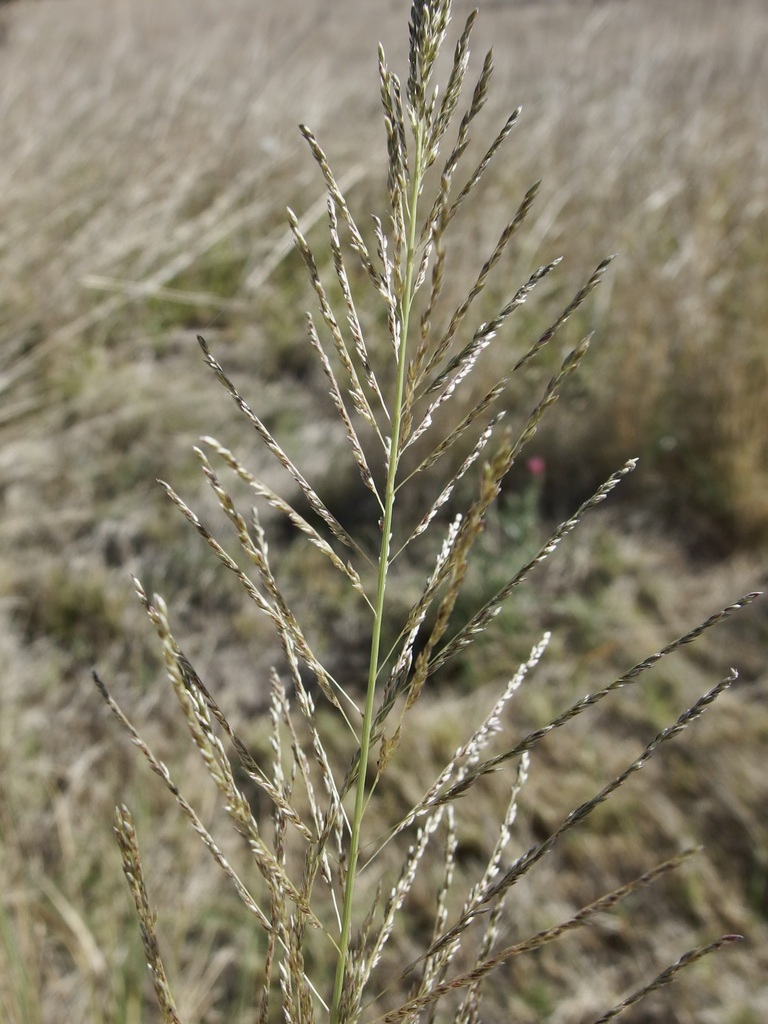
Big sacaton seedheads.
Big sacaton is a native, perennial bunchgrass 3 to 6 feet (0.9-1.8 m) tall [5,14,27,47] that grows in dense clumps up to 3 feet (0.9 m) in diameter [47,48]. Leaves are up to 12 inches (30 cm) long [47,48]. Seedheads are open and 1 to 2 feet (0.3-0.6 m) long [48].
Raunkiaer Life Form (Raunkiaer 1934)
- Hemicryptophyte
Seasonal Development
Big sacaton initiates leaf production in both summer and winter; winter leaves form within a protective sheath and expand in early spring [14]. Plants have some green foliage throughout the year [14,23]. Flowering occurs from April to May in California and from July to October in Arizona [32,45].
Regeneration Processes
Big sacaton reproduces exclusively by seed. It lacks specialized morphological seed dispersal mechanisms. In saline habitats of the Chihuahuan Desert, seed may be dispersed by ducks [24]. Big sacaton seed has low germination and establishment rates under high temperatures such as those found in the desert southwest [38]. Establishment of big sacaton seed increased with a reduction of soil temperature from an average of 104 degrees Fahrenheit (40 deg C) to 79 degrees Fahrenheit (26 deg C) [38]. In the laboratory, big sacaton germination was 84 percent under optimum conditions (alternating temperatures of 68-95 degrees Fahrenheit [20-35 deg C] and alternating light and dark periods) [52]. Emergence, average shoot height, average root and shoot weight, and average root length were all less in soils at temperatures of 127 degrees Fahrenheit (53 deg C) than in soils at temperatures of 102 degrees Fahrenheit (39 deg C) [38].
Successional Status
Big sacaton is shade intolerant [53]. In the early 1900's, the Southwest had extensive stands of big sacaton grassland. Channelization, drought, grazing, and fire suppression have all contributed to the invasion of these grasslands by mesquite (Prosopis spp.) and juniper (Juniperus spp.) [8,28,36,49,55].
Immediate Fire Effects
Many fires probably top-kill big sacaton. In southeastern Arizona a February 1985 wildfire "consumed" all available big sacaton forage [12].
"Hot" early summer fires may kill big sacaton plants. At the Research Ranch in southeastern Arizona, Bock and Bock [2] studied the impact of fire on an ungrazed sacaton grassland community. Height and percent cover of big sacaton were reduced until postfire year 2 on sites burned in summer or winter [2]. This study was part of an extensive body of research on fire effects in semidesert grassland, oak savanna, and Madrean oak woodlands of southeastern Arizona. See the Research Project Summary of this work for more information on burning conditions, fires, and fire effects on more than 100 species of plants, birds, small mammals, and grasshoppers.
Postfire Regeneration Strategy (Stickney 1989)
- Tussock graminoid
Fire Adaptations
Big sacaton sprouts after top-kill [6,53]. Burning may stimulate leaf production. The ability of big sacaton to recover after fire depends on the extent of root crown removal by fire [14]. The greatest potential for natural fire occurs when lightning strike frequency peaks in early summer [14]. Big sacaton is best adapted to summer fires. Fall and spring burning may have long-term negative effects [56].
Plant Response to Fire
Big sacaton sprouts after top-kill by fire [53]. Big sacaton may recover to prefire coverage in 2 to 3 years on ungrazed sites [4]. Postfire recovery is influenced by fire severity [2] and season of burning [14]. In southeastern Arizona in 1975 and 1976 three wildfires occurred in an ungrazed big sacaton grassland community [2]. The first two fires occurred in mid-May and mid-June 1975, and the third in February 1976. Permanent study sites were established on the two summer burns and on adjacent unburned (control) areas in August 1975. In February 1976 a wildfire occurred on one of the control sites which then became the winter burn study site. The summer burns occurred during hot, dry weather and were probably more severe than the winter burn [2]. Big sacaton postfire percent cover on the four study sites is listed below; prefire cover was not reported.
| Burn treatment | Big sacaton cover (%) |
|---|---|
| Control | 74 |
| Summer burn—1st year | 35 |
| Summer burn—2nd year | 70 |
| Winter burn—1st year | 50 |
In postfire year 1, big sacaton percent cover was less on burned than unburned sites, and less on the summer than winter burns. It was similar to prefire cover in the second year [2].
In southeastern Arizona the impacts of burning on big sacaton forage quality and quantity were studied [14,15]. Plots were burned with a headfire in winter (Feb. 6), summer (July 10), and fall (Oct. 2) 1980, 1981, and 1982. Plots had been lightly grazed for 5 years prior to burning. The time from ignition to total forage consumption by fire was recorded by plot. Fuel moistures and weather conditions were as follows [14]:
| Burn season | Fine fuel moisture (% oven dry weight) | Wind speed (mi/hr (km/hr)) | Air temperature (°F(°C)) |
|---|---|---|---|
| Winter | 10–30 | 10 (16) | 50–64 (10–18) |
| Summer | 20–25 | 8–15 (13–24) | 84–86 (29–30) |
| Fall | 45–55 | 8–10 (13–16) | 66–77 (19–25) |
Big sacaton green forage at the peak of the summer growing season (Aug. 21) 1,2, and 3 years after treatment was as follows:
| Peak forage (kg/ha) | |||
|---|---|---|---|
| Number of growing seasons after treatment | 1 | 2 | 3 |
| Winter burn | 400–735 | 690–850 | 595–695 |
| Summer burn | 700–865 | 850–935 | 1,375–1,590 |
| Fall burn | 260–725 | 575–805 | 745–890 |
| Unburned | 1,695–1,900 | 1,365–1,720 | 1,650–2,000 |
Green forage availability for the 3 treatment years was consistently greater on untreated plots than on burned plots. In postfire years 1 and 2, big sacaton green forage was greater on summer than on winter- or fall-burned plots. By postfire year 3 green forage on summer-burned plots was nearly equivalent to that on unburned plots [14]. At postfire year 1, standing crops were 60 percent less on spring- and fall-burned plots. At postfire year 2, live biomass on spring-burned plots was 30 percent less than on control plots. On fall-burned plots, 50 percent of plants failed to produce leaves the following spring. Removing hte standing dead biomass which insulates against cold temperatures may have killed the plants [56].
Fire Regimes
For fire regime information, search FEIS for this species by entering the species name or acronym on the home page and selecting “Fire Regime” as the publication type.
Fire Management Considerations
Land managers have traditionally recommended burning big sacaton grassland in either fall or winter [7,14]. According to Cox [14], winter and fall burns have a detrimental effect on big sacaton plant production for at least three summer growing seasons [14]. Loss of summer-formed leaves inhibits formation of winter leaves, and root crowns may be damaged by frost. Winter burning may reduce plant litter, making green foliage more available to livestock but reducing the long-term viability of big sacaton plants [17].
In Arizona seed-eating rodents are abundant on burned big sacaton sites. Bock and Bock [2] propose that ideal wildlife habitat would be mosaic of big sacaton stands in various stages of postfire succession.
Federal Status
None
Other Status
No entry.
Importance to Wildlife and Livestock
Big sacaton is a valuable forage species for livestock in arid and semiarid regions. In Arizona new spring growth of big sacaton is readily eaten by livestock [2]. It is grazed throughout the year when preferred grasses or forbs are not available [12,30].
Palatability and Nutritional Value
Big sacaton forage quality is highest in the spring [12]. As plants mature, leaves and stems become coarse and tough [48]. Average percentage of crude protein contained in big sacaton forage harvested from the South Texas Plains near Whitsett from May 1977 to February 1979 was as follows [23]:
| Defoliation treatment | % crude protein—spring | % crude protein—summer | % crude protein—fall | % crude protein—winter |
|---|---|---|---|---|
| None | 10.1 | 5.8 | 6.4 | 5.4 |
| Monthly (spring to fall) | 12.3 | 10.3 | 12.1 | 10.9 |
| Spring and mid-summer | 12.0 | 9.7 | 10.9 | 9.1 |
| Spring and early summer | 12.3 | 10.2 | 10.6 | 8.9 |
| Spring | 12.9 | 7.5 | 8.6 | 8.6 |
| Spring/late summer/fall | 12.1 | 7.2 | 10.9 | 10.0 |
| Mid-summer and fall | 12.8 | 6.4 | 11.5 | 10.1 |
Cover Value
Big sacaton stands provide cover for wildlife and cattle in summer [6,12]. In Arizona mature stands of big sacaton provide cover for Botteri's sparrow and other passerines, collared peccaries, diamondback rattlesnakes, and many rodents [2,4,53]. Botteri's sparrow reaches maximum breeding densities in big sacaton grasslands [5].
Value for Rehabilitation or Restoration of Disturbed Sites
No entry.
Other Uses
No entry.
Other Management Considerations
Big sacaton grasslands favor wildlife [2]; they are utilized by rodents and birds [2,4]. In the Southwest big sacaton grasslands have been severely degraded by channelization, erosion, and overgrazing [4,55]. They are now present in only 5 percent of their original range [14,17].
In southeastern Arizona big sacaton stands produce large green biomass quantities (1,500-3,200 pounds/acre [1,680-3,580 kg/ha]) in the summer that may slow runoff, enhance infiltration, and trap sediments [12]. Big sacaton is important for impeding erosion in areas where flash floods occur [53]. Forage is present throughout the year, but utilization of big sacaton is limited by dead standing foliage; burning or mowing can remove dead foliage, but may decrease forage production of big sacaton for up to 2 years [12,14]. For maximum big sacaton forage production, Cox and others [12] recommend grazing big sacaton in the spring, not grazing in dry summers, and discontinuing fall grazing. Fall defoliation exposes big sacaton crowns to below freezing temperatures; crown exposure may reduce forage production for up to 4 years [14] or kill plants [12].
Managers have traditionally recommended fall and winter burning or mowing big sacaton grassland [14,17]. In southeastern Arizona Cox [14] studied the effect of burning and mowing on big sacaton forage quantity and quality. Big sacaton plots were mowed to 2-inch (5 cm) stubble height in winter (Feb. 6), summer (July 10), and fall (Oct. 2) in 1980, 1981, and 1982. Big sacaton forage quality improved for 6 weeks after mowing in all seasons [14,23]. Accelerated growth on summer-defoliated plots supported the hypothesis that summer mowing has the least negative impact on big sacaton production. Winter and fall mowing had a detrimental effect on production for three summer growing seasons [14]. In another study in southeastern Arizona, Cox and Morton [17] reported that annual winter (February 27) mowing plus spring-summer grazing improved the availability and quality of big sacaton live biomass. However, mowing had a negative effect on growth early in the spring-summer grazing period [17]. See Plant Response to Fire for information on burning big sacaton grassland.
Table A1— Forest and range ecosystems, Bureau of Land Management (BLM) physiographic regions, Kuchler plant associations, Society for American Foresters (SAF) forest cover types, and Society for Rangeland Management (SRM) rangeland cover types in which this species occurs.
Forest and Range Ecosystems (Garrison et al. 1977)
- FRES30 Desert shrub
- FRES32 Texas savanna
- FRES33 Southwestern shrubsteppe
- FRES38 Plains grasslands
FRES40 Desert grasslands
BLM Physiographic Regions (Bernard and Brown 1977)
- 7 Lower Basin and Range
- 12 Colorado Plateau
- 13 Rocky Mountain Piedmont
Kuchler Plant Associations (Kuchler 1964)
- K027 Mesquite bosque
- K054 Grama-tobosa prairie
- K058 Grama-tobosa shrubsteppe
- K060 Mesquite savanna
- K065 Grama-buffalograss
- K085 Mesquite-buffalograss
SAF Cover Types (Eyre 1980)
- 68 Mesquite
- 242 Mesquite
SRM Rangeland Cover Types (Shiflet 1994)
- 414 Salt desert shrub
- 502 Grama-galleta
- 505 Grama-tobosa shrub
- 706 Blue grama-sideoats grama
- 707 Blue grama-sideoats grama-black grama
- 712 Galleta-alkali sacaton
- 725 Vine mesquite-alkali sacaton
- 727 Mesquite-buffalograss
- 729 Mesquite
1. Bernard, Stephen R.; Brown, Kenneth F. 1977. Distribution of mammals, reptiles, and amphibians by BLM physiographic regions and A.W. Kuchler's associations for the eleven western states. Tech. Note 301. Denver, CO: U.S. Department of the Interior, Bureau of Land Management. 169 p. [434]
2. Bock, Carl E.; Bock, Jane H. 1978. Response of birds, small mammals, and vegetation to burning sacaton grasslands in southeastern Arizona. Journal of Range Management. 31(4): 296-300. [3075]
3. Bock, Carl E.; Bock, Jane H. 1979. Relationship of the collared peccary to sacaton grassland. Journal of Wildlife Management. 43(3): 813-816. [24613]
4. Bock, Carl E.; Bock, Jane H. 1990. Effects of fire on wildlife in southwestern lowland habitats. In: Krammes, J. S., technical coordinator. Effects of fire management of Southwestern natural resources: Proceedings of the symposium; 1988 November 15-17; Tucson, AZ. Gen. Tech. Rep. RM-191. Fort Collins, CO: U.S. Department of Agriculture, Forest Service, Rocky Mountain Forest and Range Experiment Station: 50-64. [11273]
5. Bock, Carl E.; Bock, Jane H. 1992. Response of birds to wildfire in native versus exotic Arizona grassland. Southwestern Naturalist. 37(1): 73-81. [18594]
6. Bock, Jane H.; Bock, Carl E. 1986. Habitat relationships of some native perennial grasses in southeastern Arizona. Desert Plants. 8(1): 3-14. [478]
7. Britton, Carlton M.; Wright, Henry A. 1983. Brush management with fire. In: McDaniel, Kirk C., ed. Proceedings--brush management symposium; 1983 February 16; Albuquerque, NM. Denver, CO: Society for Range Management: 61-68. [521]
8. Cornejo, Dennis O.; Leigh, Linda S.; Felger, Richard S.; Hutchinson, Charles F. 1982. Utilization of mesquite in the Sonoran Desert: past and future. In: Parker, Harry W., editor. Mesquite utilization 1982: Proceedings of the symposium; 1982 October 29-30; Lubbock, TX. Lubbock, TX: Texas Tech University, College of Agricultural Sciences: Q-1-Q-20. [5457]
9. Cox, Jerry R. 1984. Shoot production and biomass transfer of big sacaton [Sporobolus wrightii]. Journal of Range Management. 37(4): 377-380. [24614]
10. Cox, Jerry, R. 1985. Above-ground biomass and nitrogen quantities in a big sacaton [Sporobolus wrightii] grassland. Journal of Range Management. 38(3): 273-276. [24615]
12. Cox, J. R.; Gillen, R. L.; Ruyle, G. B. 1989. Big sacaton riparian grassland management: Seasonal grazing effects on plant and animal production. Applied Agricultural Research. 4(2): 127-134. [11117]
13. Cox, J. R.; Madrigal, R. M. 1988. Establishing perennial grasses on abandoned farmland in southeastern Arizona. Applied Agricultural Research. 3(1): 36-43. [11177]
14. Cox, Jerry R. 1988. Seasonal burning and mowing impacts on Sporobolus wrightii grasslands. Journal of Range Management. 41(1): 12-15. [3046]
15. Cox, Jerry R.; Ibarra-F, F. A.; Martin-R, M. H. 1990. Fire effects on grasses in semiarid deserts. In: Krammes, J. S., technical coordinator. Effects of fire management of Southwestern natural resources: Proceedings of the symposium; 1988 November 15-17; Tucson, AZ. Gen. Tech. Rep. RM-191. Fort Collins, CO: U.S. Department of Agriculture, Forest Service, Rocky Mountain Forest and Range Experiment Station: 43-49. [11272]
16. Cox, Jerry R.; Morton, Howard L. 1985. Above-ground biomass quantities and livestock production at big sacaton riparian areas in southeastern Arizona. In: Proceedings of the North American riparian conference; 1985 April 15-18; Tucson, AZ. [Tucson, AZ: University of Arizona]: 305-309. [24617]
17. Cox, Jerry R.; Morton, Howard L. 1986. Big sacaton (Sporobolus wrightii) riparian grassland management: annual winter burning, annual winter mowing, and spring grazing. Applied Agricultural Research. 1(2): 105-111. [14990]
18. Cross, Anne Fernald. 1991. Vegetation of two southeastern Arizona desert marshes. Madrono. 38(3): 185-194. [16107]
19. Dick-Peddie, William A. 1993. New Mexico vegetation: past, present, and future. Albuquerque, NM: University of New Mexico Press. 244 p. [21097]
20. Eyre, F. H., ed. 1980. Forest cover types of the United States and Canada. Washington, DC: Society of American Foresters. 148 p. [905]
21. Garrison, George A.; Bjugstad, Ardell J.; Duncan, Don A.; [and others]. 1977. Vegetation and environmental features of forest and range ecosystems. Agric. Handb. 475. Washington, DC: U.S. Department of Agriculture, Forest Service. 68 p. [998]
22. Gavin, Thomas M. 1982. The effects of prescribed fire on the production, utilization, and nutritional value of sacaton in Brewster County, Texas. Alpine, TX: Sul Ross State University. 198 p. Thesis. [25188]
23. Haferkamp, Marshall R. 1982. Defoliation impacts on quality and quantity of forage harvested from big sacaton (Sporobolus wrightii Munro). Journal of Range Management. 35(1): 26-31. [24616]
24. Henrickson, James. 1974. Saline habitats and halophytic vegetation of the Chihuahuan Desert region. In: Wauer, Roland H.; Riskind, David H., eds. Transactions of the symposium on the biological resources of the Chihuahuan Desert region, United States and Mexico; 1974 October 17-18; Alpine, TX. Transactions and Proceedings Series No. 3. Washington, DC: U.S. Department of the Interior, National Park Service: 289-314. [16063]
25. Henrickson, James; Johnston, Marshall C. 1986. Vegetation and community types of the Chihuahuan Desert. In: Barlow, J. C.; [and others], eds. Chihuahuan Desert--U.S. and Mexico, II. Alpine, TX: Sul Ross State University: 20-39. [12979]
26. Herbel, C. H.; Steger, R.; Gould, W. L. 1974. Managing semidesert ranges of the Southwest. Circular 456. Las Cruces, NM: New Mexico State University, Cooperative Extension Service. 48 p. [4564]
27. Hickman, James C., ed. 1993. The Jepson manual: Higher plants of California. Berkeley, CA: University of California Press. 1400 p. [21992]
28. Humphrey, Robert R. 1963. The role of fire in the desert and desert grassland areas of Arizona. In: Proceedings, 2nd annual Tall Timbers fire ecology conference; 1963 March 14-15; Tallahassee, FL. Tallahassee, FL: Tall Timbers Research Station: 45-61. [19000]
29. Janzen, D. H. 1986. Chihuahuan Desert nopaleras: defaunated big mammal vegetation. Annual Review of Ecological Systems. 17: 595-636. [5018]
30. Kearney, Thomas H.; Peebles, Robert H.; Howell, John Thomas; McClintock, Elizabeth. 1960. Arizona flora. 2d ed. Berkeley, CA: University of California Press. 1085 p. [6563]
31. Kuchler, A. W. 1964. Manual to accompany the map of potential vegetation of the conterminous United States. Special Publication No. 36. New York: American Geographical Society. 77 p. [1384]
32. Munz, Philip A. 1973. A California flora and supplement. Berkeley, CA: University of California Press. 1905 p. [6155]
33. Nealley, G. C. 1888. Report of an investigation of the forage plants of western Texas. Bulletin 6. Washington, DC: U.S. Department of Agriculture, Botanical Division: 30-47. [5256]
34. Nichol, A. A. [revisions by Phillips, W. S.]. 1952. The natural vegetation of Arizona. Tech. Bull. 68 [revision]. Tucson, AZ: University of Arizona, Agricultural Experiment Station: 189-230. [3928]
35. Raunkiaer, C. 1934. The life forms of plants and statistical plant geography. Oxford: Clarendon Press. 632 p. [2843]
36. Schmutz, E. M.; Smith, E. L.; Ogden, P. R.; [and others]. 1992. Desert grassland. In: Coupland, R. T., ed. Natural grasslands: Introduction and western hemisphere. Ecosystems of the World 8A. Amsterdam, Netherlands: Elsevier Science Publishers B. V: 337-362. [23832]
37. Shiflet, Thomas N., ed. 1994. Rangeland cover types of the United States. Denver, CO: Society for Range Management. 152 p. [23362]
38. Sosebee, R. E.; Wan, C. 1989. Plant ecophysiology: a case study of honey mesquite. In: Wallace, Arthur; McArthur, E. Durant; Haferkamp, Marshall R., compilers. Proceedings--symposium on shrub ecophysiology and biotechnology; 1987 June 30 - July 2; Logan, UT. Gen. Tech. Rep. INT-256. Ogden, UT: U.S. Department of Agriculture, Forest Service, Intermountain Research Station: 103-118. [5931]
39. Stickney, Peter F. 1989. Seral origin of species originating in northern Rocky Mountain forests. Unpublished draft on file at: U.S. Department of Agriculture, Forest Service, Intermountain Research Station, Fire Sciences Laboratory, Missoula, MT; RWU 4403 files. 7 p. [20090]
40. Texas Parks and Wildlife Department. 1992. Plant communities of Texas (Series level): February 1992. Austin, TX: Texas Parks and Wildlife Department, Texas Natural Heritage Program. 38 p. [20509]
41. U.S. Department of Agriculture, Soil Conservation Service. 1994. Plants of the U.S.--alphabetical listing. Washington, DC: U.S. Department of Agriculture, Soil Conservation Service. 954 p. [23104]
42. U.S. Department of the Interior, National Biological Survey. [n.d.]. NP Flora [Data base]. Davis, CA: U.S. Department of the Interior, National Biological Survey. [23119]
43. Wallmo, O. C. 1955. Vegetation of the Huachuca Mountains, Arizona. American Midland Naturalist. 54: 466-480. [20325]
44. Warren, Peter L.; Hoy, Marina S.; Hoy, Wilton E. 1992. Vegetation and flora of Fort Bowie National Historic Site, Arizona. Tech. Rep. NPS/WRUA/NRTR-92/43. Tucson, AZ: The University of Arizona, School of Renewable Natural Resources, Cooperative National Park Resources Studies Unit. 78 p. [19871]
45. Welsh, Stanley L.; Atwood, N. Duane; Goodrich, Sherel; Higgins, Larry C., eds. 1987. A Utah flora. Great Basin Naturalist Memoir No. 9. Provo, UT: Brigham Young University. 894 p. [2944]
46. Allred, Kelly W.; Hatch, Stephan L.; Soreng, Robert. 1986. Verified checklist of the grasses of New Mexico. Res. Rep. 579. Las Cruces, NM: New Mexico State University, Agricultural Experiment Station. 47 p. [6577]
47. Gay, Charles W., Jr.; Dwyer, Don D. 1965. New Mexico range plants. Circular 374. Las Cruces, NM: New Mexico State University, Cooperative Extension Service. 85 p. [4039]
48. Humphrey, Robert R. 1970. Arizona range grasses: Their description, forage value and management. Tucson, AZ: The University of Arizona Press. 159 p. [5567]
49. Brown, David E. 1982. Semidesert grassland. In: Brown, David E., ed. Biotic communities of the American Southwest--United States and Mexico. Desert Plants. 4(1-4): 123-131. [3603]
50. Brown, David E. 1982. Chihuahuan desertscrub. In: Brown, David E., ed. Biotic communities of the American Southwest--United States and Mexico. Desert Plants. 4(1-4): 169-179. [3607]
51. Minckley, W. L.; Brown, David E. 1982. Wetlands. In: Brown, David E., ed. Biotic communities of the American Southwest--United States and Mexico. Desert Plants. 4(1-4): 223-287. [8898]
52. Sosebee, R. E.; Herbel, C. H. 1969. Effects of high temperatures on emergence and initial growth of range plants. Agronomy Journal. 61: 621-624. [4036]
53. Bock, J. H. 1995 [pers. comm.]
54. Kartesz, John T. 1994. A synonymized checklist of the vascular flora of the United States, Canada, and Greenland. Volume II--thesaurus. 2nd ed. Portland, OR: Timber Press. 816 p. [23878]
55. Cox, Jerry R.; Morton, Howard L.; LaBaume, Jimmy T.; Renard, Kenneth G. 1983. Reviving Arizona's rangelands. Journal of Soil and Water Conservation. 38: 342-345. [24914]
56. Cox, J. R.; Morton, H. L. 1986. The effects of seasonal fire on live biomass and standing crop in a big sacaton (Sporobolus wrightii) grassland. In: Joss, P. J.; Lynch, P. W.; Williams, D. B., editors. Rangelands under siege: [Proceedings, International Rangeland Congress]; 1894; Adelaide, Australia. New York: Cambridge University Press: 596-597. [24915]