


Ulmus rubra, slippery elm
Coladonato, Milo. 1993. Ulmus rubra, slippery elm. In: Fire Effects Information System, [Online]. U.S. Department of Agriculture, Forest Service, Rocky Mountain Research Station, Fire Sciences Laboratory (Producer). Available: https://research.fs.usda.gov/feis/species-reviews/ulmrub
| Abbreviation | Common Name | Scientific Name | Classification | Status |
|---|---|---|---|---|
| Plants | ||||
| ULMRUB | slippery elm | Ulmus rubra | Life Form: Plants/Tree Kingdom: Plantae Class: Dicot Order: Urticales Family: Ulmaceae Genus: Ulmus | Fed. Protected: No Nativity: Native Invasiveness: Noninvasive |

Taxonomy
The currently accepted scientific name for slippery elm is Ulmus rubra Muhl. [24]. There are no recognized subspecies, varieties, or forms.
Slippery elm is commonly crossed with Siberian elm (U. pumilia). Hybrids of rock elm (U. thomasii) and slippery elm have been observed in Sawyer County, Wisconsin, and along streets in Columbia, Missouri [10].
Synonyms
- No entry
Other Common Names
red elm, gray elm, soft elm
General Distribution
Slippery elm's range extends from southwestern Maine west to extreme southern Quebec, southern Ontario, New York, northern Michigan, central Minnesota, eastern North Dakota; south through eastern South Dakota, central Nebraska, southwestern Oklahoma, and central Texas; then east to northwestern Florida and Georgia. Slippery elm is uncommon in the part of its range south of Kentucky; it is most abundant in the southern part of the Lake States and in the cornbelt of the Midwest [10,12,24].

A large slippery elm, Ozaukee County, Wisconsin. (CC BY-NC 4.0)
States and Provinces
- United States: AL AR CT DE FL GA IL IN IA KS KY LA ME MD MA MI MN MS MO NE NH NJ NY NC ND OH OK PA RI SC SD TN TX VT VA WV WI
- Canada: ON PQ
Site Characteristics
Slippery elm grows best on moist, rich soils of lower slopes, streambanks, river terraces, and bottomlands but is also found on much drier sites, particularly those of limestone origin. Examples of sites on which it is an important species are floodplains, terraces, and well-drained uplands in east-central Illinois; the northern Mississippi River floodplain; alluvial terraces in western Pennsylvania; lower ravine slopes and uplands in central New York. Slippery elm can persist on poorly drained soils that are occasionally flooded for periods of 2 or 3 months, but it does not reproduce or grow well if flooding is frequent or prolonged [2,10,14,25,34].
Plant Communities
In addition to those species in Table A1, common associates of slippery elm include hickory (Carya spp.), box elder (Acer negundo), blackgum (Nyssa sylvatica), black walnut (Juglans nigra), hackberry (Celtis occidentalis), and honeylocust (Gleditsia triacanthos) [5,9,22].
Botanical Description

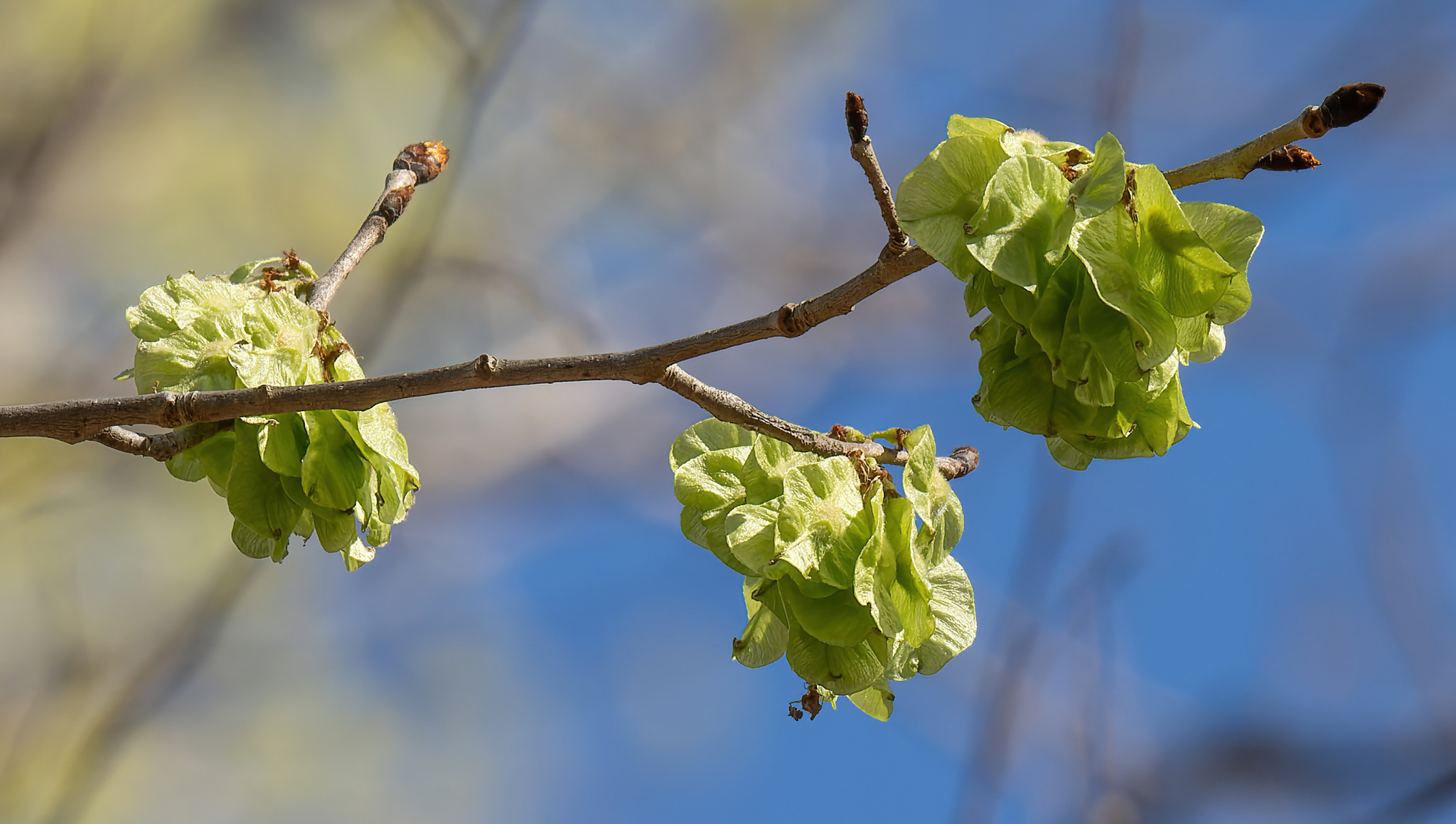
Slippery elm flowers, Montgomery County, Virginia. (CC BY-NC 4.0)
Slippery elm is a native, medium-sized, deciduous tree reaching 60 to 70 feet (18-21 m) on average sites and 135 feet (41 m) on the best sites. In the forest, it has a straight bole with the trunk dividing into wide spreading limbs high up the tree. The crown is broad and rather flat topped. The perfect flowers form dense packed clusters. The root system is shallow but wide spreading [8,11,18,21].
Raunkiaer Life Form (Raunkiaer 1934)
- Phanerophyte
Seasonal Development
The flowers open before the leaves, from February to May, depending on weather and location. Seeds ripen from April to June and are dispersed by wind and water as soon as they are ripe [10].
Regeneration Processes
Seeds of slippery elm are larger than those of many of the native elms. Dispersal is by gravity and wind [10,16].
Seeds sometimes show dormancy; seedlings are susceptible to damping off. Seedlings become established under a wide variety of conditions. Mineral soil seedbeds are best, but seeds germinate and survive in forest litter or among herbaceous plants [6,10].
Slippery elm sprouts readily from the stump or root crown. Seedlings produces sprouts from rhizomes. Slippery elm also reproduces by layering. Rootstocks of slippery elm are grafted to hybrid elms [10].
Successional Status
Facultative Seral Species.
Slippery elm is one of the more shade-tolerant species [4]. It is much more tolerant than quaking aspen (Populus tremuloides) but slightly less tolerant than sugar maple (Acer saccharum). Reproduction is erratic under fully stocked stands. In a river terrace forest in east-central Illinois, slippery elm was present in most size classes, but no seedlings were present. A nearby upland coppice, however, contained numerous slippery elm seedlings. Slippery elm is frequently a component of the subcanopy [10,20,29].
Immediate Fire Effects
Information regarding the fire effects on slippery elm is scant. Literature suggests that American elm is a fire decreaser [3,4,9]. Low- or moderate-severity fire top-kills American elm trees up to sapling size and wounds larger trees. Slippery elm is probably affected by fire in the same way due to its similar morphology.
Postfire Regeneration Strategy (Stickney 1989)
- Tree with adventitious-bud root crown/root sucker
- Secondary colonizer - off-site seed
Fire Adaptations
Fire rarely occurs in the moist areas where slippery elm typically grows. When fire does occur and conditions are dry, slippery elm decreases. Wind- and water-dispersed seed are important in the establishment of slippery elm following fire [5,10]. Young slippery elm will sprout from the root crown following top-kill by fire [1,28].
Plant Response to Fire
Young slippery elm sprouts from the root crown following fire [1].
The Research Paper by Bowles and others 2007 provides information on postfire responses of several plant species, including slippery elm, that was not available when this species review was originally written.
Fire Regimes
For additional fire regime information, search FEIS for this species by entering the species name on the Advanced Search page and selecting “Fire Regime” as the publication type.
Fire Management Considerations
No entry.
Federal Status
No special status.
Other Status
No entry.
Importance to Wildlife and Livestock
The seeds of slippery elm are eaten by birds and small mammals. Deer and rabbits browse the twigs [10,31].
Palatability and Nutritional Value
No entry.
Cover Value
Slippery elm trees provide thermal cover and nesting sites for a variety of primary and secondary cavity nesters [17,19].
Value for Rehabilitation or Restoration of Disturbed Sites
No entry.
Other Uses
The bark of slippery elm contains a mucilaginous substance that was used as a treatment for coughs and diarrhea by the early settlers. It has also been used as a street ornamental, but its use is limited due to Dutch elm disease [10,32,37].
Slippery elm is not an important lumber tree. The wood is considered inferior to that of American elm (U. americana) even though both are mixed and sold together as soft elm [26,35]. Slippery elm is used in the manufacture of boxes, baskets, crates, and barrels [37].
Other Management Considerations
Slippery elm is susceptible to many of the same diseases as American elm. It is attacked and killed by Dutch elm disease, caused by the fungus Ceratocystis ulmi [5,33]. Throughout much of its range, it is also killed by elm yellows or elm phloem necrosis. These two diseases are so virulent and widespread that slippery elm seldom reaches commercial size and volume as a forest tree, and it is being replaced as a street tree in many localities. In mixed-hardwood stands, bark stripping by deer is more frequent on stems of saplings and on roots of pole-sized trees [10].
Table A1— Forest and range ecosystems, Bureau of Land Management (BLM) physiographic regions, Kuchler plant associations, Society for American Foresters (SAF) forest cover types, and Society for Rangeland Management (SRM) rangeland cover types in which this species occurs.
Forest and Range Ecosystems (Garrison et al. 1977)
- FRES10 White - red - jack pine
- FRES11 Spruce - fir
- FRES13 Loblolly - shortleaf pine
- FRES14 Oak - pine
- FRES15 Oak - hickory
- FRES16 Oak - gum - cypress
- FRES17 Elm - ash - cottonwood
- FRES18 Maple - beech - birch
- FRES38 Plains grasslands
- FRES39 Prairie
BLM Physiographic Regions (Bernard and Brown 1977)
- 14 Great Plains
Kuchler Plant Associations (Kuchler 1964)
- K074 Bluestem prairie
- K082 Mosaic of K074 and K100
- K090 Live oak - sea oats
- K095 Great Lakes pine forest
- K098 Northern floodplain forest
- K099 Maple - basswood forest
- K100 Oak - hickory forest
- K102 Beech - maple forest
- K103 Mixed mesophytic forest
- K104 Appalachian oak forest
- K106 Northern hardwoods
- K107 Northern hardwoods - fir forest
- K111 Oak - hickory - pine forest
- K112 Southern mixed forest
SAF Cover Types (Eyre 1980)
- 14 Northern pin oak
- 15 Red pine
- 17 Pin cherry
- 18 Paper birch
- 19 Gray birch - red maple
- 20 White pine - northern red oak - red maple
- 21 Eastern white pine
- 22 White pine - hemlock
- 23 Eastern hemlock
- 24 Hemlock - yellow birch
- 25 Sugar maple - beech - yellow birch
- 26 Sugar maple - basswood
- 27 Sugar maple
- 28 Black cherry - maple
- 39 Black ash - American elm - red maple
- 42 Bur oak
- 43 Bear oak
- 52 White oak - black oak - northern red oak
- 53 White oak
- 55 Northern red oak
- 57 Yellow-poplar
- 58 Yellow-poplar - eastern hemlock
- 59 Yellow-poplar - white oak - northern red oak
- 60 Beech - sugar maple
- 61 River birch - sycamore
- 62 Silver maple - American elm
- 64 Sassafras - persimmon
- 65 Pin oak - sweetgum
- 80 Loblolly pine - shortleaf pine
- 81 Loblolly pine
- 82 Loblolly pine - hardwood
- 87 Sweet gum - yellow-poplar
- 89 Live oak
- 91 Swamp chestnut oak - cherrybark oak
- 92 Sweetgum - willow oak
- 93 Sugarberry - American elm - green ash
- 94 Sycamore - sweetgum - American elm
- 95 Black willow
- 96 Overcup oak - water hickory
- 101 Baldcypress
- 102 Baldcypress - tupelo
- 108 Red maple
- 109 Hawthorn
SRM Rangeland Cover Types (Shiflet 1994)
- No entry
1. Abrams, Marc D. 1986. Ecological role of fire in gallery forests in eastern Kansas. In: Koonce, Andrea L., ed. Prescribed burning in the Midwest: state-of-the-art: Proceedings of a symposium; 1986 March 3-6; Stevens Point, WI. Stevens Point, WI: University of Wisconsin, College of Natural Resources, Fire Science Center: 73-80. [16271]
2. Adams, Dwight E.; Anderson, Roger C. 1980. Species response to a moisture gradient in central Illinois forests. American Journal of Botany. 67(3): 381-392. [13295]
3. Auclair, Allan N.; Cottam, Grant. 1971. Dynamics of black cherry (Prunus serotina Erhr.) in southern Wisconsin oak forests. Ecological Monographs. 41(2): 153-177. [8102]
4. Beck, Donald E. 1988. Clearcutting and other regeneration options for upland hardwoods. In: Proceedings, 16th annual hardwood symposium of the Hardwood Research Council; 1988 May 15-18; Chashiers, NC. Vol. 16. [Place of publication unknown]. Hardwood Research Council: 44-54. [10903]
5. Bey, Calvin F. 1990. Ulmus americana L. American elm. In: Burns, Russell M.; Honkala, Barbara H., tech. coords. Agric. Handb. 654. Silvics of North America. Vol. 2. Hardwoods. Washington, DC: U.S. Department of Agriculture, Forest Service: 801-807. [18959]
6. Bray, J. Roger. 1956. Gap phase replacement in a maple-basswood forest. Ecology. 37(3): 598-600. [13003]
7. Brinkman, Kenneth A. 1974. Ulmus L. Elm. In: Schopmeyer, C. S., ed. Seeds of woody plants in the United States. Agriculture Handbook No. 450. Washington: U. S. Department of Agriculture, Forest Service: 829-834. [7772]
8. Chapman, William K.; Bessette, Alan E. 1990. Trees and shrubs of the Adirondacks. Utica, NY: North Country Books, Inc. 131 p. [12766]
9. Curtis, John T. 1959. The vegetation of Wisconsin. Madison, WI: The University of Wisconsin Press. 657 p. [7116]
10. Cooley, John H.; Van Sambeek, J. W. 1990. Ulmus rubra Muhl. slippery elm. In: Burns, Russell M.; Honkala, Barbara H., tech. coords. Silvics of North America. Vol. 2. Hardwoods. Agric. Handb. 654. Washington, DC: U.S. Department of Agriculture, Forest Service: 812-816. [20818]
11. Duncan, Wilbur H.; Duncan, Marion B. 1988. Trees of the southeastern United States. Athens, GA: The University of Georgia Press. 322 p. [12764]
12. Elias, Thomas S. 1970. The genera of Ulmaceae in the southeastern United States. Journal of the Arnold Arboretum. 51: 18-40. [11742]
13. Eyre, F. H., ed. 1980. Forest cover types of the United States and Canada. Washington, DC: Society of American Foresters. 148 p. [905]
14. Farrell, John D.; Ware, Stewart. 1991. Edaphic factors and forest vegetation in the piedmont of Virginia. Bulletin of the Torrey Botanical Club. 118(2): 161-169. [15694]
14. Garrison, George A.; Bjugstad, Ardell J.; Duncan, Don A.; [and others]. 1977. Vegetation and environmental features of forest and range ecosystems. Agric. Handb. 475. Washington, DC: U.S. Department of Agriculture, Forest Service. 68 p. [998]
16. George, David W.; Fischer, Burnell C. 1989. The effect of site and age on tree regeneration in young upland hardwood clearcuts. In: Rink, George; Budelsky, Carl A., eds. Proceedings, 7th central hardwood conference; 1989 March 5-8; Carbondale, IL. Gen. Tech. Rep. NC-132. St. Paul, MN: U.S. Department of Agriculture, Forest Service, North Central Forest Experiment Station: 40-47. [9365]
17. Gilmer, David S.; Ball, I. J.; Cowardin, Lewis M.; [and others]. 1978. Natural cavities used by wood ducks in north-central Minnesota. Journal of Wildlife Management. 42(2): 288-298. [13749]
18. Godfrey, Robert K. 1988. Trees, shrubs, and woody vines of northern Florida and adjacent Georgia and Alabama. Athens, GA: The University of Georgia Press. 734 p. [10239]
19. Hardin, Kimberly I.; Evans, Keith E. 1977. Cavity nesting bird habitat in the oak-hickory forests--a review. Gen. Tech. Rep. NC-30. St. Paul, MN: U.S. Department of Agriculture, Forest Service, North Central Forest Experiment Station. 23 p. [13859]
20. Hill, John P.; Dickmann, Donald I. 1988. A comparison of three methods for naturally reproducing oak in southern Michigan. Northern Journal of Applied Forestry. 5(2): 113-117. [14482]
21. Hosie, R. C. 1969. Native trees of Canada. 7th ed. Ottawa, ON: Canadian Forestry Service, Department of Fisheries and Forestry. 380 p. [3375]
22. Johnson, W. Carter. 1970. Trillium cernuum L. and Geranium maculatum L.: new for South Dakota. Rhodora. 72(792): 554. [19190]
23. Kuchler, A. W. 1964. Manual to accompany the map of potential vegetation of the conterminous United States. Special Publication No. 36. New York: American Geographical Society. 77 p. [1384]
24. Little, Elbert L., Jr. 1979. Checklist of United States trees (native and naturalized). Agric. Handb. 541. Washington, DC: U.S. Department of Agriculture, Forest Service. 375 p. [2952]
25. Martin, Christian J.; MacMillan, Paul C. 1982. Seven years of forest succession in Happy Valley, Jefferson County, Indiana. Indiana Academy of Science. 92: 197-206. [10369]
26. Ontario Department of Lands and Forests. 1953. Forest tree planting. 2d ed. Bull. No. R 1. Toronto, Canada: Ontario Department of Lands and Forests, Division of Reforestation. 68 p. [12130]
27. Ferguson, Dennis E.; Boyd, Raymond J. 1988. Bracken fern inhibition of conifer regeneration in northern Idaho. Ogden, UT: U.S. Department of Agriculture, Forest Service, Intermountain Research Station. 11 p. [2834]
28. Reuter, D. Dayton. 1986. Effects of prescribed burning, cutting and torching on shrubs in a sedge meadow wetland. In: Koonce, Andrea L., ed. Prescribed burning in the Midwest: state-of-the-art: Proceedings of a symposium; 1986 March 3-6; Stevens Point, WI. Stevens Point, WI: University of Wisconsin, College of Natural Resources, Fire Science Center: 108-115. [16278]
29. Smith, H. Clay; Rosier, Robert L.; Hammack, K. P.. 1976. Reproduction 12 years after seed-tree harvest cutting in Appalachian hardwoods. Res. Pap. NE-350. Upper Darby, PA: U.S. Department of Agriculture, Forest Service, Northeastern Forest Experiment Station. 11 p. [10887]
30. Stickney, Peter F. 1989. Seral origin of species originating in northern Rocky Mountain forests. Unpublished draft on file at: U.S. Department of Agriculture, Forest Service, Intermountain Research Station, Fire Sciences Laboratory, Missoula, MT; RWU 4403 files. 7 p. [20090]
31. Strole, Todd A.; Anderson, Roger C. 1992. White-tailed deer browsing: species preferences and implications for central Illinois forests. Natural Areas Journal. 12(3): 139-144. [19494]
32. Hodgkinson, Harmon S. 1975. Evaluation of winterfat in Washington. Journal of Range Management. 28(2): 138-141. [1174]
33. Swingle, Roger U. 1942. Phloem necrosis: A virus disease of the American elm. Circular No. 640. Washington, DC: U.S. Department of Agriculture. 8 p. [4761]
34. Thomson, Paul M.; Anderson, Roger C. 1976. An ecological investigation of the Oakwood Bottoms Greentree Reservoir in Illinois. In: Fralish, James S.; Weaver, George T.; Schlesinger, Richard C., eds. Central hardwood forest conference: Proceedings of a meeting; 1976 October 17-19; Carbondale, IL. Carbondale, IL: Southern Illinois University: 45-64. [3812]
35. U.S. Department of Agriculture, Forest Service, Forest Products Laboratory. 1974. Wood handbook: wood as an engineering material. Agric. Handb. No. 72. Washington, DC. 415 p. [16826]
36. U.S. Department of Agriculture, Soil Conservation Service. 1982. National list of scientific plant names. Vol. 1. List of plant names. SCS-TP-159. Washington, DC. 416 p. [11573]
37. Vines, Robert A. 1960. Trees, shrubs, and woody vines of the Southwest. Austin, TX: University of Texas Press. 1104 p. [7707]