


Umbellularia californica, California laurel
Howard, Janet L. 1992. Umbellularia californica, California laurel. In: Fire Effects Information System, [Online]. U.S. Department of Agriculture, Forest Service, Rocky Mountain Research Station, Fire Sciences Laboratory (Producer). Available: https://research.fs.usda.gov/feis/species-reviews/umbcal
| Abbreviation | Common Name | Scientific Name | Classification | Status |
|---|---|---|---|---|
| Plants | ||||
| UMBCAL | California laurel | Umbellularia californica | Life Form: Plants/Shrub, Plants/Tree Kingdom: Plantae Class: Dicot Order: Laurales Family: Lauraceae Genus: Umbellularia | Fed. Protected: No Nativity: Native Invasiveness: Noninvasive |


Taxonomy
The scientific name of California laurel is Umbellularia californica (Hook. & Arn.) Nutt. [9,22,31]. Recognized varieties are [9]:
- Umbellularia californica var. californica
- Umbellularia californica var. fresnensis Eastwood.
Synonyms
- Umbellularia californica f. pendula Rehd.
Other Common Names
California bay
General Distribution

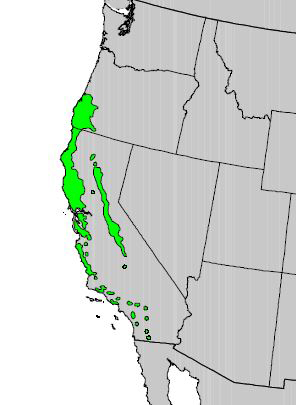
Distribution of California laurel.
California laurel occurs in the Klamath, Siskiyou, and Coast Ranges from Douglas County, Oregon south to San Diego County, California, and on the western slope of the Sierra Nevada from Shasta County south to Kern County. It is found along drainages in the Central Valley, California [16,23,31,48]. Umbellularia californica var. fresnensis occurs in Fresno County, California [9].
States and Provinces
- United States: CA OR
Site Characteristics

California laurel, Golden Gate National Recreation Area, Marin County, California. (CC BY-NC-ND 4.0)
California laurel grows on a variety of sites. It occurs on xeric chaparral, where the tree often grows in scrub form. Scrub trees are particularly common in serpentine chaparral [16]. California laurel also occurs on exposed ridges, steep mountain slopes, coastal bluffs, or rocky outcrops. Best development occurs on mesic sites: deep, well-drained alluvial benches, valley bottoms subjected to occasional inundation, well-watered coastal slopes, or along foothill streams [9].
Soil: California laurel grows in loam, sandy-loam, or clay soils. Soil pH ranges from 5.7 to 7.4 [9].
Climate: California laurel grows in the cool, humid maritime climate of dense coastal forests and the mediterranean climate of California hardwood forests and chaparral [9].
Elevation: California laurel is found from sea level to 4,000 feet (1,219 m) in northern California and Oregon and from 2,000 to 5,000 feet (610-1,524 m) in southern California [42].
Plant Communities
California laurel is sometimes codominant or dominant in various hardwood forests. Pure stands are rare, but there are a few California laurel forests in the Coast Ranges and in Tehama County, California [7,11,15]. The tree also occurs in various coniferous forests, where it is a codominant or dominant in the subcanopy or is an understory associate. Published classifications listing California laurel as codominant or dominant in community types (cts), ecoassociation types (eco), plant associations (pas), or vegetation types (vts) are as follows:
| Area | Classification | Authority |
|---|---|---|
| California: outer Coast Ranges | Ca. laurel forest cts | Holland 1986 |
| California: Coast Ranges | Ca. hardwoods eco | Allen & others 1991 |
| Northern California: Klamath, N. Coast Ranges | cismontane woodland cts | Holland 1986 |
| Northern California: Muir Woods NM | redwood forest vts | McBride & Jacobs 1980 |
| Southern California: N. Coast Ranges | riparian pas | Paysen & others 1980 |
| Southern California: Santa Ana Mountains | canyon woodlands cts | Vogl 1976 |
| Southwest Oregon: Siskiyou NF | mixed evergreen cts | Sawyer & others 1977 |
| Southwest Oregon: Siskiyou; Klamath Ranges | tanoak-Ca. laurel pas | Atzet & Wheeler 1984 |
Plant associates: Overstory associates include bigcone Douglas-fir (Pseudotsuga macrocarpa), grand fir (Abies grandis), white fir (A. concolor), Colter pine (Pinus coulteri), sugar pine (P. lambertiana), western white pine (P. monticola), eucalyptus (Eucalyptus globus; E. camaldulensis), valley oak (Quercus lobata), and black cottonwood (Populus trichocarpa) [9,11,34]. (also see SAF cover types)
Subcanopy and understory associates include California sycamore (Plantanus racemosa), bigleaf maple (Acer macrophyllum), boxelder (A. negundo), interior live oak (Q. wislizenii), coast live oak (Q. agrifolia), canyon live oak (Q. chrysolepis), blue oak (Q. douglasii), California scrub oak (Q. dumosa), Sadler oak (Q. sadleriana), Pacific dogwood (Cornus nuttallii), California buckeye (Aesculus californica), chamise (Adenostoma fasciculatum), various manzanitas (Arctostaphylos nevadensis; A. mariposa; A. viscida), yerba santa (Eriodictyon californicum), California rhododendron (Rhododendron californicum), Pacific rhododendron (R. macrophyllum), and evergreen huckleberry (Vaccinium ovatum) [9,11,34].
Botanical Description
California laurel is a highly-branched native evergreen tree that typically grows from 40 to 80 feet (12-24 m) in height [31]. The largest recorded tree is in Mendocino County California, and measures feet 108 feet (33 m) in height and 119 feet (36 m) in spread [51]. On poor sites the tree grows in scrub form [7,31]. The fruit is a drupe containing one large seed with a thin seedcoat [42]. The bark is thin and smooth on young trees, while older trees have thin, scaly bark that is continually shed. Authorities disagree on the rooting habit of California laurel. Roots are described as either shallow or as deep and wide-spreading. Rootwads of windthrown trees in southern Oregon were found to be limited in extent with no taproot, and 100 percent of California laurel trees excavated in the Berkeley Hills of California had their roots confined to the top 36 inches (90 cm) of soil [9].

California laurel flowerbuds. (CC BY-SA 3.0)
Raunkiaer Life Form (Raunkiaer 1934)
- Phanerophyte
Seasonal Development
The seasonal development of California laurel varies with latitude and elevation. The general development is as follows [9]:
| Event | Northern California | Southern California |
|---|---|---|
| Flowers out | April-September | Year-round |
| New leaves out | May-June | December-April |
| Seeds ripe | September-November | September-November |
| Flora primordia develop | September-November | September-November |
| Seed disseminated | November-January | November-January |
Regeneration Processes
Sexual: California laurel begins reproducing by seed at 30 to 40 years of age [7,9,31]. Seed crops are abundant in most years. Seed is disseminated by animals, water, and gravity. Limited research suggests that seed viability is retained over winter but diminishes rapidly after that time [42]. Some fresh seed will slowly germinate over a 3-month period without stratification or scarification. Germination rates improve, however, after a 2- to 3-month cold stratification at 40 degrees Fahrenheit (4 deg C). Scarified seed has a slightly higher germination rate than unscarified seed [9,42]. Germination is hypogeal. Germination and seedling establishment are favored in riparian areas where seed is buried by silt deposition or high water [27]. Seedling establishment is poor in drier environments unless the ground is disturbed [9]. Seedlings are good competitors against other species and grow under moderately dense canopies. Seedling recruitment is poor under other California laurel trees, however [9].

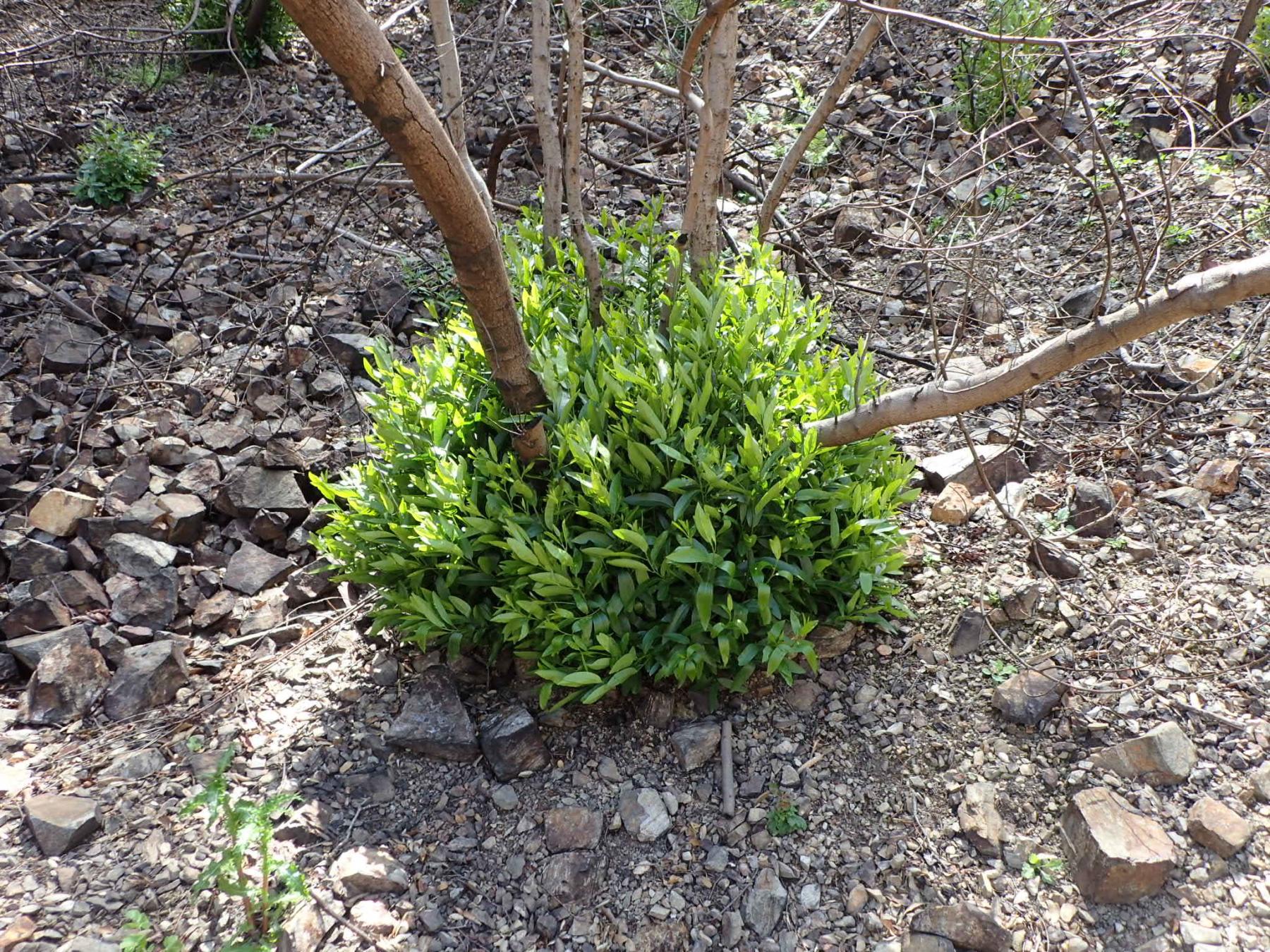
California laurel sprouting from the root crown, Cleveland National Forest, California. (CC BY-NC 4.0)
Vegetative: California laurel sprouts from the root crown, bole, or stump [9,34]. Sprouts arise wherever surviving meristematic tissue receives strong light [9]. Bole sprouts are more common on plants growing on south-facing slopes, while root collar sprouts usually appear on plants on north-facing slopes. Sixty sprouts have been reported growing on the trunk of one burned tree [34]. Sprouts have been observed growing from fallen California laurel trees in Muir Woods National Monument, California [25].
Successional Status
California laurel is seral in mixed evergreen forests, and climax in California hardwood forests, riparian communities, and chaparral [3,26,37]. In mixed-evergreen forest it is replaced by various conifers (see SAF cover types and Site Characteristics: Overstory associates). A sun- and shade-tolerant species, California laurel occurs in all seral stages of mixed evergreen forest. Pioneer seedlings or residual sprouters appear in the initial community, and the species frequently persists as a subcanopy dominant in the late seral community [3,25]. In California hardwood forests, it is dominant or codominant with other hardwood species [1,18]. In chaparral, it replaces brush species in the absence of fire. California laurel seedlings were found growing in a mature chamise (Adenostoma fasciculatum) chaparral community in the San Gabriel Mountains of southern California 40 years following fire [33]. Such seedlings occasionally grow to maturity and outcompete existing shrubs before the next fire cycle. In riparian communities, California laurel codominates with red alder (Alnus ruba), bigleaf maple, boxelder, and California buckeye [26,42].
Immediate Fire Effects
The thin bark of this tree provides little protection against fire. Moderate-severity fire kills California laurel seedlings and top-kills saplings and mature trees. Severe fire kills the seed [9,42].
Postfire Regeneration Strategy (Stickney 1989)
- Survivor species; on-site surviving root crown
- Off-site colonizer; seed carried by animals or water; postfire years 1 and 2
- Secondary colonizer; off-site seed carried to site after year 2
Fire Adaptations
Plant adaptations: California laurel sprouts from the root crown or bole following fire [9,25,27,43,42]. Some studies indicate that germination of buried seed may slightly increase following light to moderate fire due to the cracking of the thin seed coat [28,42].
Fire ecology: California laurel increases fuel loading by the continual shedding of its bark [9].
Plant Response to Fire
Top-killed California laurel recovers rapidly from fire. Taber and Dasmann [43] reported crown sprouts appearing 4 to 6 weeks after late winter and spring fires in the North Coast Ranges of California. Sprouting may also occur after summer or fall fires. Most California hardwoods sprout within a few weeks following fire in any season [29], and California laurel presumably has this ability. Reproductive ability is regained quickly; flowers have been noted on first-year sprouts [9]. Seedlings establish from postfire year 1 until the next fire cycle. In the redwood (Sequoia sempervirens) forest of Muir Woods National Monument, for example, 567 seedlings per acre (1,400 seedlings/ha) were observed at postfire year 134. The dense understory was codominated by redwood and California laurel trees that began as sprouts and seedlings following the 1845 fire [25].
Fire Regimes
For fire regime information, search FEIS for this species by entering the species name on the Advanced Search page and selecting “Fire Regime” as the publication type.
Fire Management Considerations
Hardwood timber: Prescribed burning is an effective tool for reclaiming California laurel in hardwood forests invaded by conifers [9].
Conifer timber: Prescribed burning alone is not effective in removing California laurel from clear-cut timber areas. Prescribed fire will top-kill California laurel, but follow-up mechanical or chemical control of sprouts will be necessary until conifer seedlings are established [9].
Other considerations: California laurel was an integral part of a fire hazard reduction project in the Berkeley Hills, where highly flammable exotic eucalyptus were removed to release the less flammable understory of California laurel and coast live oak [38].
California laurel in riparian areas is not usually threatened because fire is rare there [19,40].
Federal Status
No special status.
Other Status
No entry.
Importance to Wildlife and Livestock
California laurel leaves and twigs are browsed by black-tailed deer and livestock. The tree is in relatively short supply over most of its distribution, but is one of the principal browse species for deer in parts of the North Coast Ranges [42]. The seeds are eaten by birds, rodents, and domestic and wild pigs. [5,43,39]. Pigs also consume the roots [42].
Palatability and Nutritional Value
New shoots are highly palatable to black-tailed deer. Utilization of 60 to 80 percent by weight of young shoots was recorded on chaparral deer ranges in Madera and Lake counties, California [6,39]. The degree of use shown by livestock and wildlife species for California laurel leaves and twigs has been rated as follows [39]:
- Cattle - fair to poor
- Horses – poor
- Goats - fair to poor
- Sheep - fair to poor
- Mule deer - good to fair
California laurel leaves and twigs are high in protein. Studies conducted at several sites in northern California found that the protein content varies from 25.6 percent in May to 11.3 percent in January [43].
Cover Value
California laurel provides hiding and thermal cover for deer, wild pig, black bear, and various small mammals. It also provides nesting, hiding, and thermal cover for upland game birds and songbirds. It is heavily used for cover when it grows in ecotones between riparian and chaparral communities [10].
Value for Rehabilitation or Restoration of Disturbed Sites
California laurel is used for a variety of rehabilitative purposes. It has been utilized in riparian and wildlife habitat reclamation projects in Berkeley, the Santa Clara Valley, and Los Angeles County, California [14,35,49]. It has also been used in watershed projects for flood control and stream channel restoration [17,32]. California laurel is started from seed and transplants best when under 1 year of age. Cultivation methods have been detailed [42].
Other Uses
Native Americans made tea from the root bark of California laurel and used the leaves for control of biting insects. The leaves were also used medicinally by Native Americans and pioneers for treatment of headache and rheumatism.
California laurel leaves are marketed as a food seasoning. The tree is used in ornamental landscaping and is available at commercial nurseries [9,20].
California laurel wood is used for cabinets, furniture, interior trim, paneling, veneer, gunstocks, and turned woodenware. Burls, marketed as myrtlewood, are used for making novelty items and wood carvings [9].
Other Management Considerations
Hardwood timber: Silviculture of California laurel may become more important as East Coast hardwood production lessens. Although California laurel wood is valuable, young trees are not currently planted for future commercial harvest. A serious management problem of this species is heart rot. The fungus (Ganoderma applanatum) causing this disease will infect even young trees. Heart rot can be virtually eliminated from a stand by cutting down trees to stumps of less than 8 inches (20 cm) in height to promote root crown sprouting. Root crown sprouts have a very low incidence of heart rot. Slash disposal by broadcast burning is recommended to increase sprouting and kill fungi harbored in the slash [27]. California laurel has no serious insect pests, although the powderpost beetle (Ptilinus basalis) and various oak bark beetles (Pseudopithyophthorus spp.) will sometimes attack injured trees [9]. California laurel is not windfirm [27].
Conifer timber: California laurel severely reduces growth of conifer timber seedlings through allelopathic inhibition. The leaves contain water-soluble terpenes which retard root elongation [16]. A study done in the Siskiyou National Forest of southwestern Oregon showed that root elongation of Douglas-fir (Pseudotsuga menziesii) seedlings was 16 percent of normal following treatment with California laurel leaf extract. This was a greater rate of suppression than that shown by 10 other chaparral species tested for potential conifer growth inhibition [44].
Unless controlled, the California laurel understory in coniferous forests often becomes dominant or codominant within a few years following clear-cutting of mature timber trees [9].
Control: California laurel can be controlled by aerosol or injection/cut surface treatment with 2,4-D [8]. (also see Fire Management Considerations regarding control by burning)
Table A1— Forest and range ecosystems, Bureau of Land Management (BLM) physiographic regions, Kuchler plant associations, Society for American Foresters (SAF) forest cover types, and Society for Rangeland Management (SRM) rangeland cover types in which this species occurs.
Forest and Range Ecosystems (Garrison et al. 1977)
- FRES20 Douglas-fir
- FRES21 Ponderosa pine
- FRES24 Hemlock - Sitka spruce
- FRES27 Redwood
- FRES28 Western hardwoods
- FRES34 Chaparral - mountain shrub
BLM Physiographic Regions (Bernard and Brown 1977)
- 1 Northern Pacific Border
- 3 Southern Pacific Border
- 4 Sierra Mountains
Kuchler Plant Associations (Kuchler 1964)
- K001 Spruce - cedar - hemlock forest
- K002 Cedar - hemlock - Douglas-fir forest
- K005 Mixed conifer forest
- K006 Redwood forest
- K009 Pine - cypress forest
- K010 Ponderosa shrub forest
- K011 Western ponderosa forest
- K012 Douglas-fir forest
- K026 Oregon oakwoods
- K028 Mosaic of K002 and K026
- K029 California mixed evergreen forest
- K030 California oakwoods
- K033 Chaparral
- K034 Montane chaparral
SAF Cover Types (Eyre 1980)
- 221 Red alder
- 223 Sitka spruce
- 224 Western hemlock
- 225 Western hemlock - Stitka spruce
- 226 Coastal true fir - hemlock
- 229 Pacific Douglas-fir
- 230 Douglas-fir - western hemlock
- 231 Port-Orford-cedar
- 232 Redwood
- 233 Oregon white oak
- 234 Douglas-fir - tanoak - Pacific madrone
- 243 Sierra Nevada mixed conifer
- 244 Pacific ponderosa pine - Douglas-fir
- 245 Pacific ponderosa pine
- 246 California black oak
- 247 Jeffrey pine
- 248 Knobcone pine
- 249 Canyon live oak
- 250 Blue oak - grey pine
- 255 California coast live oak
SRM Rangeland Cover Types (Shiflet 1994)
- R1MEVGn California mixed evergreen
- R1PSMA Mixed evergreen-bigcone Douglas-fir
- R1MCONns Mixed conifer
- R1MCONss Mixed conifer
- R-DFWV Douglas-fir
- R-TAOAco Oregon coastal tanoak
- R-MCONsw Mixed conifer
- R-MEVG California mixed evergreen
- R1PIPO Ponderosa pine
- R1OAWD California oak woodlands
- R-OAPI Oregon white oak-ponderosa pine
- R-OWOA Oregon white oak
- R-TAOAco Oregon coastal tanoak
- R1SESE Coast redwood
- R1SAGEco Coastal sage scrub
- R1SCRBnc Coastal sage scrub-coastal prairie
- R1CHAP Chaparral
- R1CHAPmn Montane chaparral
1. Allen, Barbara H.; Holzman, Barbara A.; Evett, Rand R. 1991. A classification system for California's hardwood rangelands. Hilgardia. 59(2): 1-45. [17371]
2. Atzet, Thomas; Wheeler, David L. 1984. Preliminary plant associations of the Siskiyou Mountain Province. Portland, OR: U.S. Department of Agriculture, Forest Service, Pacific Northwest Region. 278 p. [9351]
3. Barbour, Michael G. 1987. Community ecology and distribution of California hardwood forests and woodlands. In: Plumb, Timothy R.; Pillsbury, Norman H., technical coordinators. Proceedings of the symposium on multiple-use management of California's hardwood resources; 1986 November 12-14; San Luis Obispo, CA. Gen. Tech. Rep. PSW-100. Berkeley, CA: U.S. Department of Agriculture, Forest Service, Pacific Southwest Forest and Range Experiment Station: 18-25. [5356]
4. Bernard, Stephen R.; Brown, Kenneth F. 1977. Distribution of mammals, reptiles, and amphibians by BLM physiographic regions and A.W. Kuchler's associations for the eleven western states. Tech. Note 301. Denver, CO: U.S. Department of the Interior, Bureau of Land Management. 169 p. [434]
5. Bissell, Harold D.; Strong, Helen. 1955. The crude protein variations in the browse diet of California deer. California Fish and Game. 41(2): 145-155. [10524]
6. Biswell, H. H.; Gilman, J. H. 1961. Brush management in relation to fire and other environmental factors on the Tehama deer winter range. California Fish and Game. 47(4): 357-389. [6275]
7. Bolsinger, Charles L. 1988. The hardwoods of California's timberlands, woodlands, and savannas. Resour. Bull. PNW-RB-148. Portland, OR: U.S. Department of Agriculture, Forest Service, Pacific Northwest Research Station. 148 p. [5291]
8. Bovey, Rodney W. 1977. Response of selected woody plants in the United States to herbicides. Agric. Handb. 493. Washington, DC: U.S. Department of Agriculture, Agricultural Research Service. 101 p. [8899]
9. Burns, Russell M.; Honkala, Barbara H., tech. coords. 1990. Silvics of North America. Vol 2. Hardwoods. Agric. Handb. 654. Washington, DC: U.S. Department of Agriculture, Forest Service. 877 p. [13955]
10. Capelli, Mark H.; Stanley, Stephen J. 1984. Preserving riparian vegetation along California's south central coast. In: Warner, Richard E.; Hendrix, Kathleen M., eds. California riparian systems: Ecology, conservation, and productive management. Berkeley, CA: University of California Press: 673-686. [5868]
11. Cooper, W. S. 1922. The broad-sclerophyll vegetation of California. Publ. No. 319. Washington, DC: The Carnegie Institution of Washington. 145 p. [6716]
12. Eyre, F. H., ed. 1980. Forest cover types of the United States and Canada. Washington, DC: Society of American Foresters. 148 p. [905]
13. Garrison, George A.; Bjugstad, Ardell J.; Duncan, Don A.; [and others]. 1977. Vegetation and environmental features of forest and range ecosystems. Agric. Handb. 475. Washington, DC: U.S. Department of Agriculture, Forest Service. 68 p. [998]
14. Goldner, Bernard H. 1984. Riparian restoration efforts associated with structurally modified flood control channels. In: Warner, Richard E.; Hendrix, Kathleen M., eds. California riparian systems: Ecology, conservation, and productive management: Proceedings of the conference; 1981 September 17-19; Davis, CA. Berkeley, CA: University of California Press: 445-451. [5852]
15. Griffin, James R. 1974. Notes on environment, vegetation and flora: Hastings Natural History Reservation. Memo Report. On file at: U.S. Department of Agriculture, Forest Service, Intermountain Research Station, Fire Sciences Laboratory, Missoula, MT. 90 p. [10531]
16. Griffin, James R.; Critchfield, William B. 1972. The distribution of forest trees in California. Res. Pap. PSW-82. Berkeley, CA: U.S. Department of Agriculture, Forest Service, Pacific Southwest Forest and Range Experiment Station. 118 p. [1041]
17. Hanes, Ted L. 1984. Vegetation of the Santa Ana River and some flood control implications. In: Warner, Richard E.; Hendrix, Kathleen M., eds. California riparian systems: Ecology, conservation, and productive management. Berkeley, CA: University of California Press: 882-888. [5879]
18. Holland, Robert F. 1986. Preliminary descriptions of the terrestrial natural communities of California. Sacramento, CA: California Department of Fish and Game. 156 p. [12756]
19. Horton, Jerome S.; Wright, John T. 1944. The wood rat as an ecological factor in southern California watersheds. Ecology. 25(3): 341-351. [10682]
20. Krochmal, Arnold; Krochmal, Connie. 1982. Uncultivated nuts of the United States. Agriculture Information Bulletin 450. Washington, DC: U.S. Department of Agriculture, Forest Service. 89 p. [1377]
21. Kuchler, A. W. 1964. Manual to accompany the map of potential vegetation of the conterminous United States. Special Publication No. 36. New York: American Geographical Society. 77 p. [1384]
22. Little, Elbert L., Jr. 1979. Checklist of United States trees (native and naturalized). Agric. Handb. 541. Washington, DC: U.S. Department of Agriculture, Forest Service. 375 p. [2952]
23. Little, Elbert L., Jr. 1971. Atlas of the United States trees. Volume 1. Conifers and important hardwoods. Misc. Publ. 1146. Washington, DC: U.S. Department of Agriculture, Forest Service. 320 p. [1462]
24. Lyon, L. Jack; Stickney, Peter F. 1976. Early vegetal succession following large northern Rocky Mountain wildfires. In: Proceedings, Tall Timbers fire ecology conference and Intermountain Fire Research Council fire and land management symposium; 1974 October 8-10; Missoula, MT. No. 14. Tallahassee, FL: Tall Timbers Research Station: 355-373. [1496]
25. McBride, Joe R.; Jacobs, Diana F. 1980. Information gathering for vegetation preservation management: a case study Muir Woods National Monument. In: Proceedings, 2nd conference on scientific research in the National Parks; 1979 November 26-30; San Francisco, CA. Volume 7: Ecosystem Studies/Interdisciplinary Studies. Washington, DC: U.S. Department of Agriculture, National Park Service, and American Institute of Biological Science: 464-477. [8780]
26. McBride, Joe R.; Strahan, Jan. 1984. Fluvial processes and woodland succession along Dry Creek, Sonoma County, California. In: Warner, Richard E.; Hendrix, Kathleen M., eds. California riparian systems: Ecology, conservation, and productive management: Proceedings of a conference; 1981 September 17-19; Davis, CA. Berkeley, CA: University of California Press: 110-119. [5832]
27. McDonald, Philip M.; Minore, Don; Atzet, Tom. 1983. Southwestern Oregon--northern California hardwoods. In: Burns, Russel M., compiler. Silvicultural systems for the major forest types of the United States. Agric. Handb. 445. Washington, DC: U.S. Department of Agriculture: 29-32. [7142]
28. Mirov, N. T.; Kraebel, C. J. 1937. Collecting and propagating the seeds of California wild plants. Res. Note No. 18. Berkeley, CA: U.S. Department of Agriculture, Forest Service, California Forest and Range Experiment Station. 27 p. [9787]
29. Mooney, H. A.; Hayes, R. I. 1973. Carbohydrate storage cycles in two Californian Mediterranean-climate trees. Flora. 162: 295-304. [10525]
30. Muller, Cornelius H. 1966. The role of chemical inhibition (allelopathy) in vegetational composition. Bulletin of the Torrey Botanical Club. 93(5): 332-351. [13672]
31. Munz, Philip A. 1973. A California flora and supplement. Berkeley, CA: University of California Press. 1905 p. [6155]
32. Parra-Szijj, Emilia A. 1990. Revegetation in the Sepulveda Wildlife Reserve: a seven year summary. In: Hughes, H. Glenn; Bonnicksen, Thomas M., eds. Restoration '89: the new management challenge: Proceedings, 1st annual meeting of the Society for Ecological Restoration; 1989 January 16-20; Oakland, CA. Madison, WI: The University of Wisconsin Arboretum, Society for Ecological Restoration: 139-151. [14693]
33. Patric, James H.; Hanes, Ted L. 1964. Chaparral succession in a San Gabriel Mountain area of California. Ecology. 45(2): 353-360. [9825]
34. Paysen, Timothy E.; Narog, Marcia G.; Tissell, Robert G.; Lardner, Melody A. 1991. Trunk and root sprouting on residual trees after thinning a Quercus chrysolepis stand. Forest Science. 37(1): 17-27. [15040]
35. Perala, C.; Hoover, D. A. 1990. Hand-removal of exotics and planting of natives key to restoration of riparian forest understory. Restoration & Management Notes. 8(2): 118. [13791]
36. Raunkiaer, C. 1934. The life forms of plants and statistical plant geography. Oxford: Clarendon Press. 632 p. [2843]
37. Ray, Dan; Woodroof, Wayne; Roberts, R. Chad. 1984. Management of riparian vegetation in the northcoast region of California's coastal zone. In: Warner, Richard E.; Hendrix, Kathleen M., eds. California riparian systems: Ecology, conservation, and productive management: Proceedings of a conference; 1981 September 17-19; Davis, CA. Berkeley, CA: University of California Press: 660-672. [5867]
38. Rice, Carol. 1990. Restoration plays an integral role in fire hazard reduction plan for the Berkeley Hills Area. Restoration & Management Notes. 8(2): 125-126. [13792]
39. Sampson, Arthur W.; Jespersen, Beryl S. 1963. California range brushlands and browse plants. Berkeley, CA: University of California, Division of Agricultural Sciences, California Agricultural Experiment Station, Extension Service. 162 p. [3240]
40. Sauer, Jonathan D. 1977. Fire history, environmental patterns, and species patterns in Santa Monica Mountain chaparral. In: Mooney, Harold A.; Conrad, C. Eugene, technical coordinators. Proceedings of the symp. of the environmental consequences of fire and fuel management in Mediterranean ecosystems; 1977 August 1-5; Palo Alto, CA. Gen. Tech. Rep. WO-3. Washington, DC: U.S. Department of Agriculture, Forest Service: 383-386. [4866]
41. Sawyer, John O.; Thornburgh, Dale A.; Griffin, James R. 1977. Mixed evergreen forest. In: Barbour, Michael G.; Major, Jack, eds. Terrestrial vegetation of California. New York: John Wiley and Sons: 359-381. [7218]
42. Stein, William I. 1974. Umbellularia (Nees) Nutt. California-laurel. In: Schopmeyer, C. S., ed. Seeds of woody plants in the United States. Agriculture Handbook No. 450. Washington: U. S. Department of Agriculture, Forest Service: 835-839. [7773]
43. Taber, Richard D.; Dasmann, Raymond F. 1958. The black-tailed deer of the chaparral: Its life history and management in the North Coast Range of California. Game Bulletin No. 8. Sacramento, CA: State of California, Department of Fish and Game, Game Management Branch. 166 p. [16312]
44. Tinnin, Robert O.; Kirkpatrick, Lee Ann. 1985. The allelopathic influence of broadleaf trees and shrubs on seedlings of Douglas-fir. Forest Science. 31(4): 945-952. [9692]
45. U.S. Department of Agriculture, Soil Conservation Service. 1982. National list of scientific plant names. Vol. 1. List of plant names. SCS-TP-159. Washington, DC. 416 p. [11573]
46. Veirs, Stephen D., Jr. 1980. The role of fire in northern coast redwood forest dynamics. In: Proceedings of the conference on scientific research in the National Parks: Fire ecology; 1979 November 28 - November 28; San Francisco. Washington, DC: U.S. Department of the Interior, National Park Service: 1-20. [7276]
47. Vogl, Richard J. 1976. An introduction to the plant communities of the Santa Ana and San Jacinto Mountains. In: Latting, June, ed. Symposium proceedings: plant communities of southern California; 1974 May 4; Fullerton, CA. Special Publication No. 2. Berkeley, CA: California Native Plant Society: 77-98. [4230]
48. Warner, Richard E. 1984. Structural, floristic, and condition inventory of central valley riparian systems. In: Warner, Richard E.; Hendrix, Kathleen M., eds. California riparian systems: Ecology, conservation, and productive management: Proceedings of a conference; 1981 September 17-19; Davis, CA. Berkeley, CA: University of California Press: 356-374. [5840]
49. Wolfe, Douglas. 1988. Recreating a "natural" riparian environment, or getting the creek out of the culvert. In: Rieger, John P.; Williams, Bradford K., eds. Proceedings of the second native plant revegetation symposium; 1987 April 15-18; San Diego, CA. Madison, WI: University of Wisconsin - Arboretum, Society of Ecological Restoration & Management: 193-197. [4114]
50. Stickney, Peter F. 1989. Seral origin of species originating in northern Rocky Mountain forests. Unpublished draft on file at: U.S. Department of Agriculture, Forest Service, Intermountain Research Station, Fire Sciences Laboratory, Missoula, MT; RWU 4403 files. 7 p. [20090]
51. American Forests. 2009. California-laurel: Umbellularia californica, [Online]. In: National register of big trees. Washington, DC: American Forests (Producer). Available: http://www.americanforests.org/resources/bigtrees/register.php?details=2771 [2009, November 30]. [77211]
52. Thompson, Robert S.; Anderson, Katherine H.; Bartlein, Patrick J. 1999. Digital representations of tree species range maps from "Atlas of United States trees" by Elbert L. Little, Jr. (and other publications). In: Atlas of relations between climatic parameters and distributions of important trees and shrubs in North America. Denver, CO: U.S. Geological Survey, Information Services (Producer). On file at: U.S. Department of Agriculture, Forest Service, Rocky Mountain Research Station, Fire Sciences Laboratory, Missoula, MT; FEIS files. [92575]