


Vaccinium alaskaense, Alaska blueberry
Matthews, Robin F. 1992. Vaccinium alaskaense, Alaska blueberry. In: Fire Effects Information System, [Online]. U.S. Department of Agriculture, Forest Service, Rocky Mountain Research Station, Fire Sciences Laboratory (Producer). Available: https://research.fs.usda.gov/feis/species-reviews/vacala
| Abbreviation | Common Name | Scientific Name | Classification | Status |
|---|---|---|---|---|
| Plants | ||||
| VACALA | Alaska blueberry | Vaccinium alaskaense | Life Form: Plants/Shrub Kingdom: Plantae Class: Dicot Order: Ericales Family: Ericaceae Genus: Vaccinium | Fed. Protected: No Nativity: Native Invasiveness: Noninvasive |


Taxonomy
The scientific name of Alaska blueberry is Vaccinium alaskaense Howell (Ericaceae) [51]. It has been placed within the Euvaccinium section of the taxonomically complex genus Vaccinium [9,42]. Alaska blueberry is thought to be a polyploid hybrid derived from oval-leaf blueberry (V. ovalifolium) and red huckleberry (V. parvifolium) [9].
Synonyms
- Vaccinium alaskensis Howell [4,32,33,55]
- Vaccinium oblatum Henry
Other Common Names
Alaska huckleberry
General Distribution
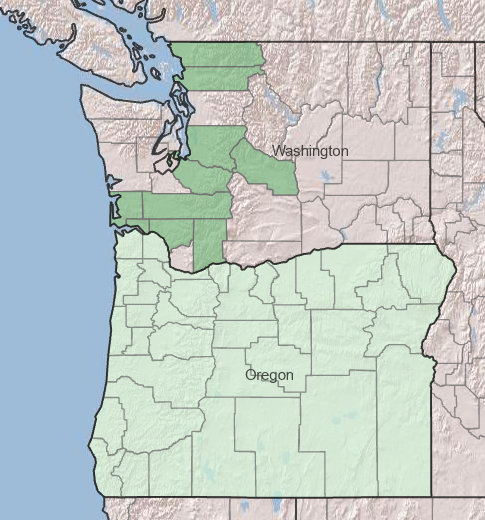
Alaska blueberry occurs from the Cascade Range in northern Oregon and Washington to Prince William Sound, Alaska [4,32,33,55].
States and Provinces
- United States: AK OR WA
- Canada: BC

Distribution of Alaska blueberry.

County-level distribution of Alaska blueberry in Washington and Oregon.
Site Characteristics
Alaska blueberry occupies a variety of different land forms from valley bottoms to mountain slopes [16,21,22,30]. It is most often found in cool, moist sites in montane forests [26]. These sites are generally classified as moderately productive [8,26,27]. Alaska blueberry is abundant on sites with minimal soil disturbance [2]. It is found at elevations ranging from sea level to around 6,000 feet (1,800 m). Aspect is variable [8,27]. Alaska blueberry can tolerate a wide range of soil moisture conditions and is found in well-drained to poorly drained sites [21,22,27,30]. Alaska blueberry has been classified as an indicator of hypermaritime to maritime climates, and moist to very moist, nitrogen-poor soils [34].
Alaska blueberry generally occurs in sandy, silt, or clay loams developed in tephra and colluvial, morainal, or glacial till [8,16,22,30].
Plant Communities
Alaska blueberry occurs as an understory dominant or codominant in many habitats within its range. It is most often associated with Pacific silver fir (Abies amabilis), western hemlock (Tsuga heterophylla), mountain hemlock (T. mertensiana), and Sitka spruce (Picea sitchensis). The Pacific silver fir/Alaska blueberry community type occurs over large areas of land from northern Oregon to southern British Columbia. It may be the most widely represented community type within the Cascade Range [18,20].
Other commonly associated species include noble fir (Abies procera), Alaska-cedar (Chamaecyparis nootkatensis), salal (Gaultheria shallon), rusty menziesia (Menziesia ferruginea), beargrass (Xerophyllum tenax), bunchberry dogwood (Cornus canadensis), Oregon grape (Berberis nervosa), Pacific rhododendron (Rhododendron macrophyllum), devil's club (Oplopanax horridum), skunk cabbage (Veratrum californicum), and various gooseberries (Ribes spp.), and blackberries (Rubus spp.). [also see SAF cover types]
Published classification schemes identifying Alaska blueberry as a major component of plant associations (pas), community types (cts), or habitat types (hts) are as follows:
| Area | Classification | Authority |
|---|---|---|
| AK | gen. veg. pas | Viereck & Dyrness 1980 |
| OR: Willamette NF | forest pas | Hemstrom and others 1987 |
| OR: MT Hood & Willamette NF | forest pas | Hemstrom and others 1982 |
| OR: MT Hood NF | forest pas | Halverson and others 1986 |
| OR: central Cascades | forest pas | Dyrness and others 1974 |
| WA: Gifford Pinchot NF | subalpine forest pas zone pas | Brockway and others 1985 |
| wWA | forest cts | del Moral & Fleming 1979 |
| wWA: Cedar River drainage | montane forest cts | del Moral & Long 1977 |
| WA: Cascades | forest cts | del Moral & Watson 1978 |
| sWA: Cascades | subalpine forest pas | Franklin 1966 |
| WA: MT Rainier NP | forest pas | Franklin and others 1988 |
| WA: Gifford Pinchot NF | forest pas | Topik and others 1986 |
| Pacific Northwest | noble fir ht | Franklin 1983 |
Botanical Description

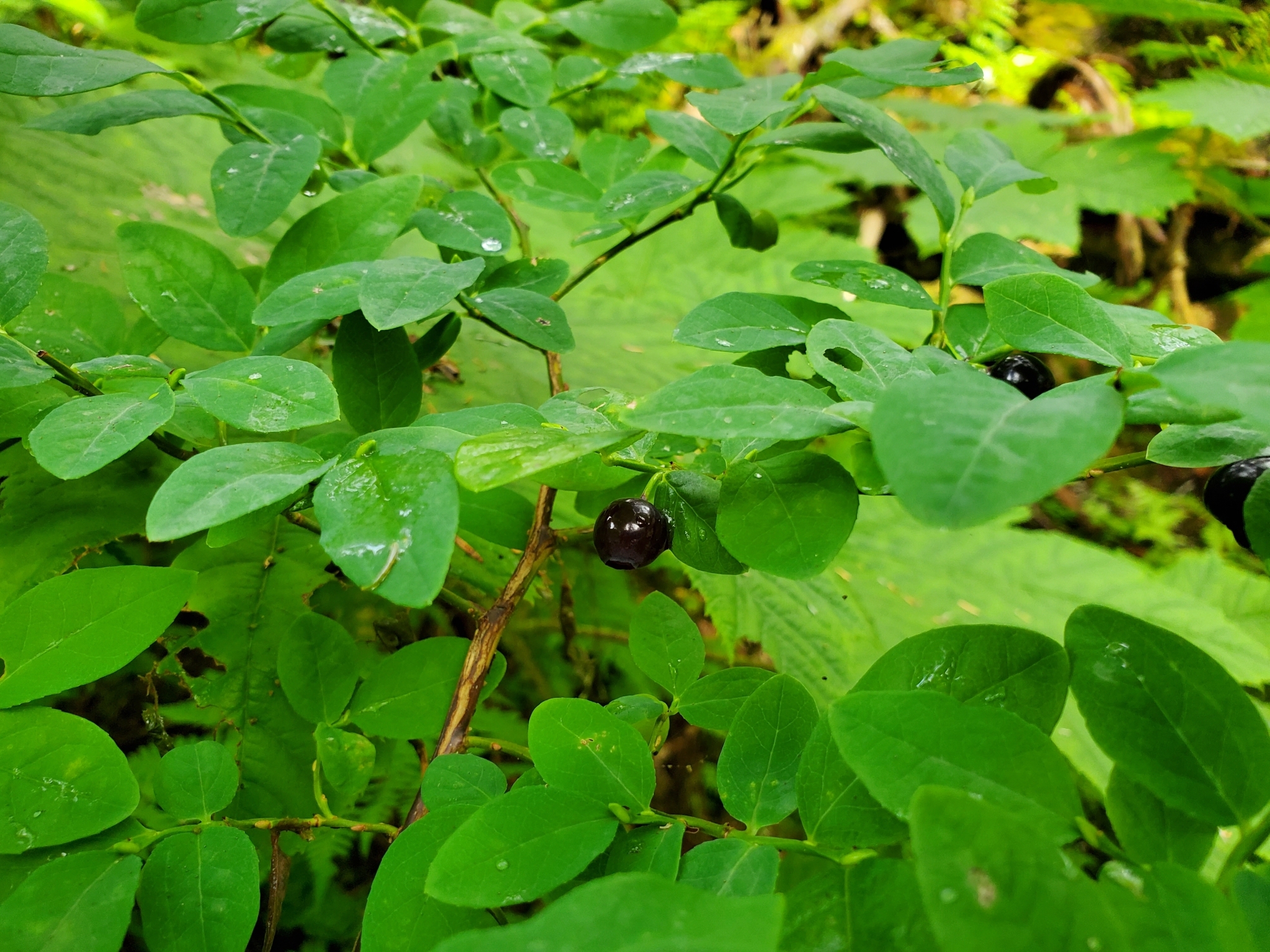
Alaska blueberry, (CC BY 4.0) https://creativecommons.org/licenses/by/4.0/
Alaska blueberry is a spreading to erect shrub reaching 6 feet (2 m) in height. Leaves are elliptic to obovate. The thin twigs are yellow green but become gray with age. The urn-shaped, bronzy-pink flowers are borne singly in leaf axils when the leaves are partially developed. The fruit is a globose blue-black to purple berry that may or may not have a bloom [4,32,33,55].
The plant is rhizomatous and generally has shallow roots.
Alaska blueberry is easily confused with ovalleaf blueberry. These two species can be distinguished by the fact that Alaska blueberry is taller and has larger leaves than ovalleaf blueberry, and the latter flowers before or with the leaves. Alaska blueberry is also more shade tolerant than ovalleaf blueberry [33,40,55].
Raunkiaer Life Form (Raunkiaer 1934)
- Phanerophyte
Seasonal Development
Alaska blueberry flowers emerge from April to May after the leaves are partially developed. Berries ripen from mid-July to mid-August [55].
Regeneration Processes
Alaska blueberry is capable of reproducing by seed or by vegetative means. Vegetative reproduction is of primary importance to most western Vaccinium species [39].
Seeds of most Vacciniums are not dormant and require no pretreatment for germination [11]. A single Alaska blueberry fruit may have up to 100 or more seeds [49]. The seeds germinate well, but seedling emergence and survival are strongly correlated with the amount of available light [29,49]. Seedling emergence in one study was 45 percent in light-limited young stands, and 73 percent in older stands [49]. Germination on nurse logs is common [47].
Seeds are readily dispersed by the many birds and mammals that eat Alaska blueberry fruits [3].
Vegetative reproduction: Most Vacciniums regenerate from basal sprouts, roots, or rhizomes [45]. Sprouting from branches or stems may also occur after fire or herbivory. Rhizome spreading allows for clonal expansion, even in the absence of disturbance [49].
Successional Status
Alaska blueberry is capable of surviving many types of disturbance and can be important in certain seral communities. It can be an early colonizer in clearcuts, burned areas, and in areas of windthrow [2,49]. However, as stands become dense and even-aged (stand age 25-150 years), Alaska blueberry decreases drastically in frequency and abundance. As the stand continues to mature (stand age 150-250 years) and begins to self-thin, Alaska blueberry again increases and forms a low, highly branched layer [2]. Alaska blueberry is most often associated with these late seral or climax community types. It occurs frequently in mature-climax western hemlock, Sitka spruce-western hemlock, coastal true fir-hemlock, and Douglas-fir types [10,31,34,46,47].
Immediate Fire Effects
Fire top-kills Alaska blueberry. Moderate- to high-severity fires also kill underground vegetative portions.
Seeds of most western Vaccinium spp. are susceptible to heat and are killed by fire [39].
Postfire Regeneration Strategy (Stickney 1989)
- Survivor species; on-site surviving root crown or caudex
- Survivor species; on-site surviving rhizomes
- Off-site colonizer; seed carried by animals or water; postfire years 1 and 2
Fire Adaptations
Alaska blueberry sprouts from rhizomes after burning [49]. It may also sprout from roots and underground stems like other Vacciniums [25,41,45]. Seedling establishment in most western Vacciniums is not common but may occur as birds and animals disperse seeds from off-site sources [39].
Plant Response to Fire
Fire severity significantly influences vegetative response and plants may not sprout on heavily burned sites where underground regenerative structures have been damaged or destroyed.
Clearcutting and subsequent burning increased the vigor of Alaska blueberry in southeast Alaska. Within 4 years the number of aerial stems sprouting from rhizomes in clearcut and burned areas was twice the number found in old stands [49].
In a study at the Sawtooth Huckleberry Field near Mount Adams, Washington, Vaccinium species sprouted in burned areas by the first postfire growing season. However, no flowers or berries were produced by the plants for 3 years following the fire. Significant berry production was delayed 5 years [41]. On some sites, production may be reduced for 20 to 30 years or longer [39].
Fire Regimes
Seral blueberry fields in Oregon and Washington are most likely the result of wildfires [40]. These fields are dwindling in size as a result of decades of fire suppression. Fire has apparently been used in the past by Native Americans of the Northwest to enhance or maintain Vaccinium fruit production [36,40]. Alaska blueberry primarily occurs in cool-moist forests that have very long fire intervals (perhaps 400-500 years).
For additional fire regime information, search FEIS for this species by entering the species name on the Advanced Search page and selecting “Fire Regime” as the publication type.
Fire Management Considerations
Flower buds tend to be more numerous on new shoots and periodic removal of old shoots can increase flower production in many Vacciniums. Prescribed fire has long been used to rejuvenate commercial lowbush blueberry (V. angustifolium) fields and to increase fruit production. Spring burns, conducted when the soil is moist, are generally most effective in promoting blueberry fruit development [39].
Federal Status
No special status.
Other Status
No entry.
Importance to Wildlife and Livestock
Alaska blueberry fruits are utilized by many species of wildlife including songbirds, gamebirds, mice, chipmunks, squirrels, raccoons, and black bears [38,55]. Along the coast of British Columbia, grizzly bears consume the berries [6].
Twigs and foliage are used as browse by rabbit, snowshoe hare, bear, goat, elk, and deer [29,38].
Alaska blueberry is very important as winter browse because it is often found in older stands with shallow snowpack, making it more accessible to wildlife. Utilization may also increase in early winter in open areas when lower growing vegetation becomes covered with snow.
Palatability and Nutritional Value
Palatability of Vaccinium species as browse is rated at fair to moderate [12].
Alaska blueberry leaves found in forested areas are more palatable to deer than those found in clearcuts [28].
Alaska blueberry leaves collected in clearcuts differ in nutrient content from leaves collected in older stands. In older stands, leaves have a higher concentration of nitrogen and percentage of digestible protein. However, leaves from clearcut areas are higher in overall digestible dry matter. Values for digestible protein (DP) and digestible dry matter (DDM) are as follows:
| Cover type | MDP (% dry weight) | DDM (% dry weight) |
|---|---|---|
| Clearcut | 4.8 | 57.8 |
| Forest | 11.2 | 54.7 |
Van Horne [52] found that phosphorous and potassium concentrations are also greater in leaves from older stands. These concentrations decrease sharply from spring to fall. Nutrient concentrations (percent dry weight) are as follows:
| Nutrient | May | October |
|---|---|---|
| Nitrogen | 5.79 | 1.54 |
| Phosphorous | 0.81 | 0.14 |
| Potassium | 1.93 | 0.73 |
Vaccinium species in general have sweet berries that contain high concentrations of mono- and di- saccharides [48]. They are rich in vitamin C and high in energy content, but low in fat [44].
Cover Value
Alaska blueberry presumably provides cover for a variety of wildlife species. It often forms a dense understory layer that may serve as hiding, resting, or nesting sites for many smaller birds and mammals.
Value for Rehabilitation or Restoration of Disturbed Sites
Much of the natural disturbance in areas that Alaska blueberry occupies is a result of windthrow. Alaska blueberry readily colonizes sites where trees have been blown down, the canopy has opened up, and sunlight has been made available [1,2].
After the eruption of Mount St. Helens in Washington, Alaska blueberry plants did not develop adventitious root systems or change the orientation of their rhizomes in order to recover from burial by tephra (volcanic ejecta), although many other species did [5].
Other Uses
Alaska blueberry fruits are edible and sweet [33,55]. They are used in jams and jellies, and along with ovalleaf blueberry, constitute the majority of blueberries picked along coastal Alaska [55]. Alaska blueberry may produce up to 100 berries per bush, making commercial collection very time efficient and profitable. The berries have been an important traditional food source for Native Americans including the Nuxalk of the Bella Coola region of British Columbia [36]. Blueberry (Vaccinium spp.) leaves, flowers, and rhizomes have also been used for medicinal purposes [53].
Other Management Considerations
Alaska blueberry rapidly sprouts from underground stems or establishes by seed within 3 years of clearcutting [2]. Desired commercial tree species should be established as soon as possible after timber harvest because Alaska blueberry may provide competition to tree seedlings. However, most western blueberry species are severely damaged by postlogging treatments such as mechanical piling that include harsh scarification [39].
Alaska blueberry in old spruce-hemlock stands in central Oregon responded best to heavy or extreme thinning treatments [3].
Net biomass production of Alaska blueberry differs drastically in different habitats. In hemlock-spruce types, Alaska blueberry produced 98.6 pounds per acre (110.5 kg/ha) of biomass when associated with skunk cabbage but only 8.66 pounds per acre (9.7 kg/ha) when associated with bunchberry dogwood [29].
Values for available biomass in four forest types are as follows [2]:
| Forest type | Stand age | Biomass available |
|---|---|---|
| Clearcut | 1-25 yrs. | 740 lbs/acre (829 kg/ha) |
| Dense, even-aged | 26-150 yrs. | 15 lbs/acre (16 kg/ha) |
| Mature, even-aged | 150-250 yrs. | 62 lbs/acre (69 kg/ha) |
| Old-growth | >250 yrs. | 337 lbs/acre (378 kg/ha) |
Blueberries (Vaccinium spp.) are not actively cultivated in the Northwest, but they do produce a profitable and highly demanded crop. Most of the naturally occurring blueberry fields in Oregon and Washington are seral and have originated from wildfire. Succession must be delayed in order to preserve areas where blueberry production is the most important land use. Burning every 2 to 3 years and chemical or mechanical weeding may help maintain these areas of high berry production [40].
Management techniques for cultivation of western Vaccinium species have not been well documented, although eastern blueberries have been cultivated successfully for years. Vacciniums are most often propogated by hardwood cuttings but also can be grown from seed. In general, the seeds should be planted in a mixture of sand and peat. Seedlings grown in the greenhouse can be transplanted 6 to 7 weeks after emergence but should not be transferred to the field until after the first growing season [11].
Vaccinium spp. can be controlled by applying 2,4-D to foliage, stems, or basal areas [24].
Table A1— Forest and range ecosystems, Bureau of Land Management (BLM) physiographic regions, Kuchler plant associations, Society for American Foresters (SAF) forest cover types, and Society for Rangeland Management (SRM) rangeland cover types in which this species occurs.
Forest and Range Ecosystems (Garrison et al. 1977)
- FRES20 Douglas-fir
- FRES23 Fir – spruce
- FRES24 Hemlock - Sitka spruce
BLM Physiographic Regions (Bernard and Brown 1977)
- 1 Northern Pacific Border
- 2 Cascade Mountains
Kuchler Plant Associations (Kuchler 1964)
- K001 Spruce - cedar - hemlock forest
- K002 Cedar - hemlock - Douglas-fir forest
- K003 Silver fir - Douglas-fir forest
- K004 Fir - hemlock forest
- K012 Douglas-fir forest
- K015 Western spruce - fir forest
SAF Cover Types (Eyre 1980)
- 205 Mountain hemlock
- 206 Engelmann spruce - subalpine fir
- 223 Sitka spruce
- 224 Western hemlock
- 225 Western hemlock - Sitka spruce
- 226 Coastal true fir – hemlock
- 227 Western redcedar - western hemlock
- 228 Western redcedar
- 229 Pacific Douglas-fir
- 230 Douglas-fir - western hemlock
SRM Rangeland Cover Types (Shiflet 1994)
- No entry
1. Alaback, Paul B. 1982. Dynamics of understory biomass in Sitka spruce-western hemlock forests of southeast Alaska. Ecology. 63(6): 1932-1948. [7305]
2. Alaback, Paul B. 1984. Plant succession following logging in the Sitka spruce-western hemlock forests of southeast Alaska. Gen. Tech. Rep. PNW-173. Portland, OR: U.S. Department of Agriculture, Forest Service, Pacific Northwest Forest and Range Experiment Station. 26 p. [7849]
3. Alaback, Paul B.; Herman, F. R. 1988. Long-term response of understory vegetation to stand density in Picea-Tsuga forests. Canadian Journal of Forest Research. 18: 1522-1530. [6227]
4. Anderson, J. P. 1959. Flora of Alaska and adjacent parts of Canada. Ames, IA: Iowa State University Press. 543 p. [9928]
5. Antos, Joseph A.; Zobel, Donald B. 1985. Plant form, developmental plasticity and survival following burial by volcanic tephra. Canadian Journal of Botany. 63: 2083-2090. [12553]
6. Banner, Allen; Pojar, Jim; Trowbridge, Rick; Hamilton, Anthony. 1986. Grizzly bear habitat in the Kimsquit River Valley, coastal British Columbia: classification, description, and mapping. In: Contreras, Glen P.; Evans, Keith E., compilers. Proceedings--grizzly bear habitat symposium; 1985 April 30 - May 2; Missoula, MT. Gen. Tech. Rep. INT-207. Ogden, UT: U.S. Department of Agriculture, Forest Service, Intermountain Research Station: 36-49. [10810]
7. Bernard, Stephen R.; Brown, Kenneth F. 1977. Distribution of mammals, reptiles, and amphibians by BLM physiographic regions and A.W. Kuchler's associations for the eleven western states. Tech. Note 301. Denver, CO: U.S. Department of the Interior, Bureau of Land Management. 169 p. [434]
8. Brockway, Dale G.; Topik, Christopher; Hemstrom, Miles A.; Emmingham, William H. 1985. Plant association and management guide for the Pacific silver fir zone: Gifford Pinchot National Forest. R6-Ecol-130a. Portland, OR: U.S. Department of Agriculture, Forest Service, Pacific Northwest Region. 122 p. [525]
9. Camp, W. H. 1942. A survey of the American species of Vaccinium, subgenus Euvaccinium. Brittonia. 4: 205-247. [6950]
10. Clement, C. J. E. 1985. Floodplain succession on the west coast of Vancouver Island. Canadian Field-Naturalist. 99(1): 34-39. [8928]
11. Crossley, John A. 1974. Vaccinium L. Blueberry. In: Schopmeyer, C. S., ed. Seeds of woody plants in the United States. Agric. Handb. 450. Washington, DC: U.S. Department of Agriculture, Forest Service: 840-843. [7774]
12. Dayton, William A. 1931. Important western browse plants. Misc. Publ. 101. Washington, DC: U.S. Department of Agriculture. 214 p. [768]
13. del Moral, Roger; Fleming, Richard S. 1979. Structure of coniferous forest communities in western Washington: diversity and ecotype properties. Vegetatio. 41(3): 143-154. [7495]
14. del Moral, Roger; Long, James N. 1977. Classification of montane forest community types in the Cedar River drainage of western Washington, U.S.A. Canadian Journal of Forest Research. 7: 217-225. [8778]
15. del Moral, Roger; Watson, Alan F. 1978. Gradient structure of forest vegetation in the central Washington Cascades. Vegetatio. 38(1): 29-48. [8800]
16. Dyrness, C. T.; Franklin, J. F.; Moir, W. H. 1974. A preliminary classification of forest communities in the central portion of the western Cascades in Oregon. Bulletin No. 4. Seattle, WA: University of Washington, Ecosystem Analysis Studies, Coniferous Forest Biome. 123 p. [8480]
17. Eyre, F. H., ed. 1980. Forest cover types of the United States and Canada. Washington, DC: Society of American Foresters. 148 p. [905]
18. Franklin, Jerry Forest. 1966. Vegetation and soils in the subalpine forests of the southern Washington Cascade Range. Pullman, WA: Washington State University. 132 p. Thesis. [10392]
19. Franklin, Jerry F. 1983. Ecology of noble fir. In: Oliver, Chadwick Dearing; Kenady, Reid M., eds. Proceedings of the biology and management of true fir in the Pacific Northwest symposium; 1981 February 24-26; Seattle-Tacoma, WA. Contribution No. 45. Seattle, WA: University of Washington, College of Forest Resources: 59-69. [7783]
20. Franklin, Jerry F. 1988. Pacific Northwest forests. In: Barbour, Michael G.; Billings, William Dwight, eds. North American terrestrial vegetation. Cambridge; New York: Cambridge University Press: 103-130. [13879]
21. Franklin, Jerry F. 1990. Abies procera Rehd. noble fir. In: Burns, Russell M.; Honkala, Barbara H., technical coordinators. Silvics of North America. Volume 1. Conifers. Agric. Handb. 654. Washington, DC: U.S. Department of Agriculture, Forest Service: 80-87. [13371]
22. Franklin, Jerry F.; Moir, William H.; Hemstrom, Miles A.; [and others]. 1988. The forest communities of Mount Rainier National Park. Scientific Monograph Series No 19. Washington, DC: U.S. Department of the Interior, National Park Service. 194 p. [12392]
23. Garrison, George A.; Bjugstad, Ardell J.; Duncan, Don A.; [and others]. 1977. Vegetation and environmental features of forest and range ecosystems. Agric. Handb. 475. Washington, DC: U.S. Department of Agriculture, Forest Service. 68 p. [998]
24. Gill, John D.; Healy, William M. 1974. Shrubs and vines for Northeastern wildlife. Gen. Tech. Rep. NE-9. Upper Darby, PA: U.S. Department of Agriculture, Forest Service, Northeastern Forest Experiment Station. 180 p. [6207]
25. Halpern, C. B. 1989. Early successional patterns of forest species: interactions of life history traits and disturbance. Ecology. 70(3): 704-720. [6829]
26. Halverson, Nancy M., compiler. 1986. Major indicator shrubs and herbs on National Forests of western Oregon and southwestern Washington. R6-TM-229. Portland, OR: U.S. Department of Agriculture, Forest Service, Pacific Northwest Region. 180 p. [3233]
27. Halverson, Nancy M.; Topik, Christopher; Van Vickle, Robert. 1986. Plant association and management guide for the western hemlock zone: Mt. Hood National Forest. R6-ECOL-232A. Portland, OR: U.S. Department of Agriculture, Forest Service, Pacific Northwest Region. 111 p. [1068]
28. Hanley, Thomas A.; Cates, Rex G.; Van Horne, Beatrice; McKendrick, Jay D. 1987. Forest stand-age related differences in apparent nutritional quality of forage for deer in southeastern Alaska. In: Provenza, Frederick D.; Flinders, Jerran T.; McArthur, E. Durant, compilers. Proceedings--symposium on plant-herbivore interactions; 1985 August 7-9; Snowbird, UT. Gen. Tech. Rep. INT-222. Ogden, UT: U.S. Department of Agriculture, Forest Service, Intermountain Research Station: 9-17. [7395]
29. Hanley, Thomas A.; Robbins, Charles T.; Spalinger, Donald E. 1989. Forest habitats and the nutritional ecology of Sitka black-tailed deer: a research synthesis with implications for forest management. Gen. Tech. Rep. PNW-GTR-230. Portland, OR: U.S. Department of Agriculture, Forest Service, Pacific Northwest Research Station. 52 p. [7509]
30. Hemstrom, Miles A.; Emmingham, W. H.; Halverson, Nancy M.; [and others]. 1982. Plant association and management guide for the Pacific silver fir zone, Mt. Hood and Willamette National Forests. R6-Ecol 100-1982a. Portland, OR: U.S. Department of Agriculture, Forest Service, Pacific Northwest Region. 104 p. [5784]
31. Hemstrom, Miles A.; Logan, Sheila E.; Pavlat, Warren. 1987. Plant association and management guide: Willamette National Forest. R6-Ecol 257-B-86. Portland, OR: U.S. Department of Agriculture, Forest Service, Pacific Northwest Region. 312 p. [13402]
32. Hitchcock, C. Leo; Cronquist, Arthur. 1964. Vascular plants of the Pacific Northwest. Part 2: Salicaceae to Saxifragaceae. Seattle, WA: University of Washington Press. 597 p. [1166]
33. Hulten, Eric. 1968. Flora of Alaska and neighboring territories. Stanford, CA: Stanford University Press. 1008 p. [13403]
34. Klinka, K.; Krajina, V. J.; Ceska, A.; Scagel, A. M. 1989. Indicator plants of coastal British Columbia. Vancouver, BC: University of British Columbia Press. 288 p. [10703]
35. Kuchler, A. W. 1964. Manual to accompany the map of potential vegetation of the conterminous United States. Special Publication No. 36. New York: American Geographical Society. 77 p. [1384]
36. Lepofsky, Dana; Turner, Nancy J.; Kuhnlein, Harriet V. 1985. Determining the availability of traditional wild plant foods: an example of Nuxalk foods, Bella Coola, British Columbia. Ecology of Food and Nutrition. 16: 223-241. [7002]
37. Lyon, L. Jack; Stickney, Peter F. 1976. Early vegetal succession following large northern Rocky Mountain wildfires. In: Proceedings, Tall Timbers fire ecology conference and Intermountain Fire Research Council fire and land management symposium; 1974 October 8-10; Missoula, MT. No. 14. Tallahassee, FL: Tall Timbers Research Station: 355-373. [1496]
38. Martin, Alexander C.; Zim, Herbert S.; Nelson, Arnold L. 1951. American wildlife and plants. New York: McGraw-Hill Book Company, Inc. 500 p. [4021]
39. Martin, Patricia A. E. 1979. Productivity and taxonomy of the Vaccinium globulare, V. membranaceum complex in western Montana. Missoula, MT: University of Montana. 136 p. Thesis. [9130]
40. Minore, Don. 1972. The wild huckleberries of Oregon and Washington -- a dwindling resource. PNW-143. Portland, OR: U.S. Department of Agriculture, Forest Service, Pacific Northwest Forest and Range Experiment Station. 20 p. [8952]
41. Minore, Don; Smart, Alan W.; Dubrasich, Michael E. 1979. Huckleberry ecology and management research in the Pacific Northwest. Gen. Tech. Rep. PNW-93. Portland, OR: U.S. Department of Agriculture, Forest Service, Pacific Northwest Forest and Range Experiment Station. 50 p. [6336]
42. Palser, Barbara F. 1961. Studies of floral morphology in the Ericales. V. Organography and vascular anatomy in several United States species of the Vacciniaceae. Botanical Gazette. 123(2): 79-111. [9032]
43. Raunkiaer, C. 1934. The life forms of plants and statistical plant geography. Oxford: Clarendon Press. 632 p. [2843]
44. Reich, Lee. 1988. Backyard blues. Organic Gardening. 35(6): 28-34. [9179]
45. Rowe, J. S.; Scotter, G. W. 1973. Fire in the boreal forest. Quaternary Research. 3: 444-464. [72]
46. Ruggiero, Leonard F.; Jones, Lawrence L. C.; Aubry, Keith B. 1991. Plant and animal habitat associations in Douglas-fir forests of the Pacific Northwest: an overview. In: Ruggiero, Leonard F.; Aubry, Keith B.; Carey, Andrew B.; Huff, Mark H., technical coordinators. Wildlife and vegetation of unmanaged Douglas-fir forests. Gen. Tech. Rep. PNW-GTR-285. Portland, OR: U.S. Department of Agriculture, Forest Service, Pacific Northwest Research Station: 447-462. [17334]
47. Sonnenfeld, Nancy L. 1987. A guide to the vegetative communities at the Valley of the Giants, Outstanding Natural Area, northwestern Oregon, USA. Arboricultural Journal. 11: 209-225. [7453]
48. Stiles, Edmund W. 1980. Patterns of fruit presentation and seed dispersal in bird-disseminated woody plants in the Eastern deciduous forest. American Naturalist. 116(5): 670-688. [6508]
49. Tappeiner, J. C.; Alaback, P. B. 1989. Early establishment and vegetative growth of understory species in the western hemlock-Sitka spruce forests of southeast Alaska. Canadian Journal of Botany. 67(2): 318-326. [8931]
50. Topik, Christopher; Halverson, Nancy M.; Brockway, Dale G. 1986. Plant association and management guide for the western hemlock zone: Gifford Pichot National Forest. R6-ECOL-230A. Portland, OR: U.S. Department of Agriculture, Forest Service, Pacific Northwest Region. 132 p. [2351]
51. U.S. Department of Agriculture, Natural Resources Conservation Service. 2018. PLANTS Database, [Online]. U.S. Department of Agriculture, Natural Resources Conservation Service (Producer). Available: https://plants.usda.gov/. [34262]]
52. Van Horne, B.; Hanley, T. A.; Cates, R. G.; McKencrick, J. D.; Horner, J. D. 1988. Influence of seral stage and season on leaf chemistry of southeastern Alaska deer forage. Canadian Journal of Forest Research. 18(1): 90-99. [8873]
53. Vander Kloet, S. P. 1988. The genus Vaccinium in North America. Publication 1828. Ottawa: Research Branch, Agriculture Canada. 201 p. [11436]
54. Viereck, L. A.; Dyrness, C. T.; Batten, A. R.; Wenzlick, K. J. 1992. The Alaska vegetation classification. Gen. Tech. Rep. PNW-GTR-286. Portland, OR: U.S. Department of Agriculture, Forest Service, Pacific Northwest Research Station. 278 p. [2431]
55. Viereck, Leslie A.; Little, Elbert L., Jr. 1972. Alaska trees and shrubs. Agric. Handb. 410. Washington, DC: U.S. Department of Agriculture, Forest Service. 265 p. [6884]