


Vaccinium oxycoccos, small cranberry
Matthews, Robin F. 1992. Vaccinium oxycoccos, small cranberry. In: Fire Effects Information System, [Online]. U.S. Department of Agriculture, Forest Service, Rocky Mountain Research Station, Fire Sciences Laboratory (Producer). Available: https://research.fs.usda.gov/feis/species-reviews/vacoxy
| Abbreviation | Common Name | Scientific Name | Classification | Status |
|---|---|---|---|---|
| Plants | ||||
| VACOXY | small cranberry | Vaccinium oxycoccos | Life Form: Plants/Shrub Kingdom: Plantae Class: Dicot Order: Ericales Family: Ericaceae Genus: Vaccinium | Fed. Protected: No Nativity: Native Invasiveness: Noninvasive |
Taxonomy
The scientific name of small cranberry is Vaccinium oxycoccos Linnaeus [20,24,31,50], in the family Ericaceae. The taxonomically complex genus Vaccinium has been divided into a number of subgenera or sections. The cranberry genera is often segregated as the subgenus or genus Oxycoccos [1,21,36,41].
Synonyms
- Oxycoccos microcarpus Turcz.
- Oxycoccos palustris Persh
- Oxycoccos oxycoccos MacM.
- Oxycoccos quadripetalus Gilib.
- Oxycoccos intermedius Rydb.
- Vaccinium oxycoccos var. microcarpus (Turcz.) Fedtsh. Flerov.
- Vaccinium oxycoccos var. ovalifolium Michx.
- Vaccinium oxycoccos var. intermedium Gray [20,24,36,50]
Other Common Names
bog cranberry, swamp cranberry, wild cranberry
General Distribution
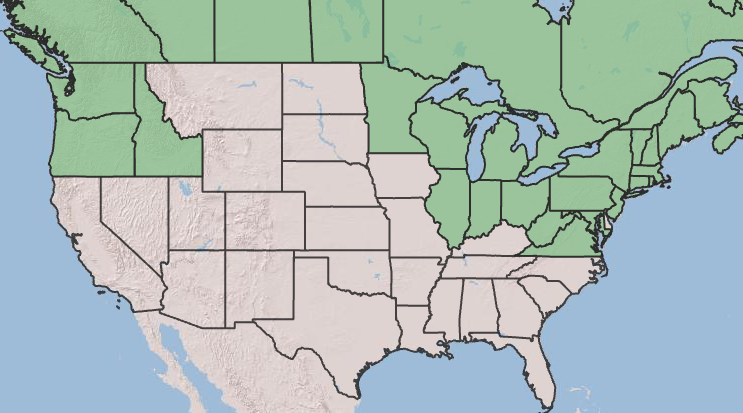
Small cranberry is distributed throughout Alaska and across Canada to Labrador, Greenland, and Newfoundland. It also occurs south through New England, the northern portions of the Great Lakes States, and western Washington and Oregon. Small cranberry is also found in Europe and Asia [11,20,44,50].

Distribution of small cranberry in North America.
States and Provinces
- United States: AK CT ID IL IN ME MD MA MI MN NH NJ NY NC OH OR PA RI VT VA WA WV WI
- Canada: AB BC LB MB NB NF NT NS ON PE PQ SK YT
Site Characteristics
Small cranberry is found in ombrotrophic sphagnum bogs and minerotrophic fens in moist coastal and boreal forests [4,17,18,50]. Small cranberry grows on peat in these poorly drained, subhygric to hygric sites that have a very high water table [7,27,32,38]. The ground may be saturated for most or part of the year. The bog sites derive water from precipitation only and are generally nutrient-poor and low in productivity. The soil is very acidic and pH ranges from about 2.9 to 4.7 [7,17,32]. Since fen water is derived from ground water as well as precipitation, the fen sites are more ion-rich, and therefore, more alkaline. The soil pH ranges from about 6.0 to 7.5 [4,17,43]. These sites are generally not as nutrient-poor since the environment is more favorable for decomposer species [4]. Bogs are generally level but are often patterned by scattered mounds of sphagnum moss. Small cranberry often grows on these hummocks. Small cranberry is found in cool-temperate to cool-mesothermal climates [25].
Plant Communities
Small cranberry is classified as an indicator of moist to very wet, nitrogen-poor soils and high surface groundwater [25]. It is also an indicator of coniferous swamps [37]. Small cranberry is not listed as a dominant or codominant understory species in published classification schemes.
Associated tree species include: eastern hemlock (Tsuga canadensis), western hemlock (T. heterophylla), northern white cedar (Thuja occidentalis), western redcedar (T. plicata), yellow-cedar (Callitropsis nootkatensis), Altantic white cedar (Chameacyparis thyoides), quaking aspen (Populus tremuloides), balsam poplar (P. balsamifera), swamp birch (Betula pumila), bog birch (B. glandulosa), paper birch (B. papyrifera), yellow birch (B. alleghaniensis), and black ash (Fraxinus nigra).
Associated understory species include: leatherleaf (Chamaedaphne calyculata), bog rosemary (Andromeda glaucophylla), bog laurel (Kalmia polifolia), pitcher plant (Sarracenia purpurea), Labrador tea (Ledum groenlandicum), cloudberry (Rubus chamaemorus), rhodora (Rhododendron canadense), glossy buckthorn (Rhamnus frangula), sundew (Drosera spp.), cottonsedge (Eriophorum virginatum and E. angustifolium), and various sedges (Carex spp.), lichens (Cladina and Cladonia spp.), and sphagnum mosses.
Botanical Description

Small cranberry.
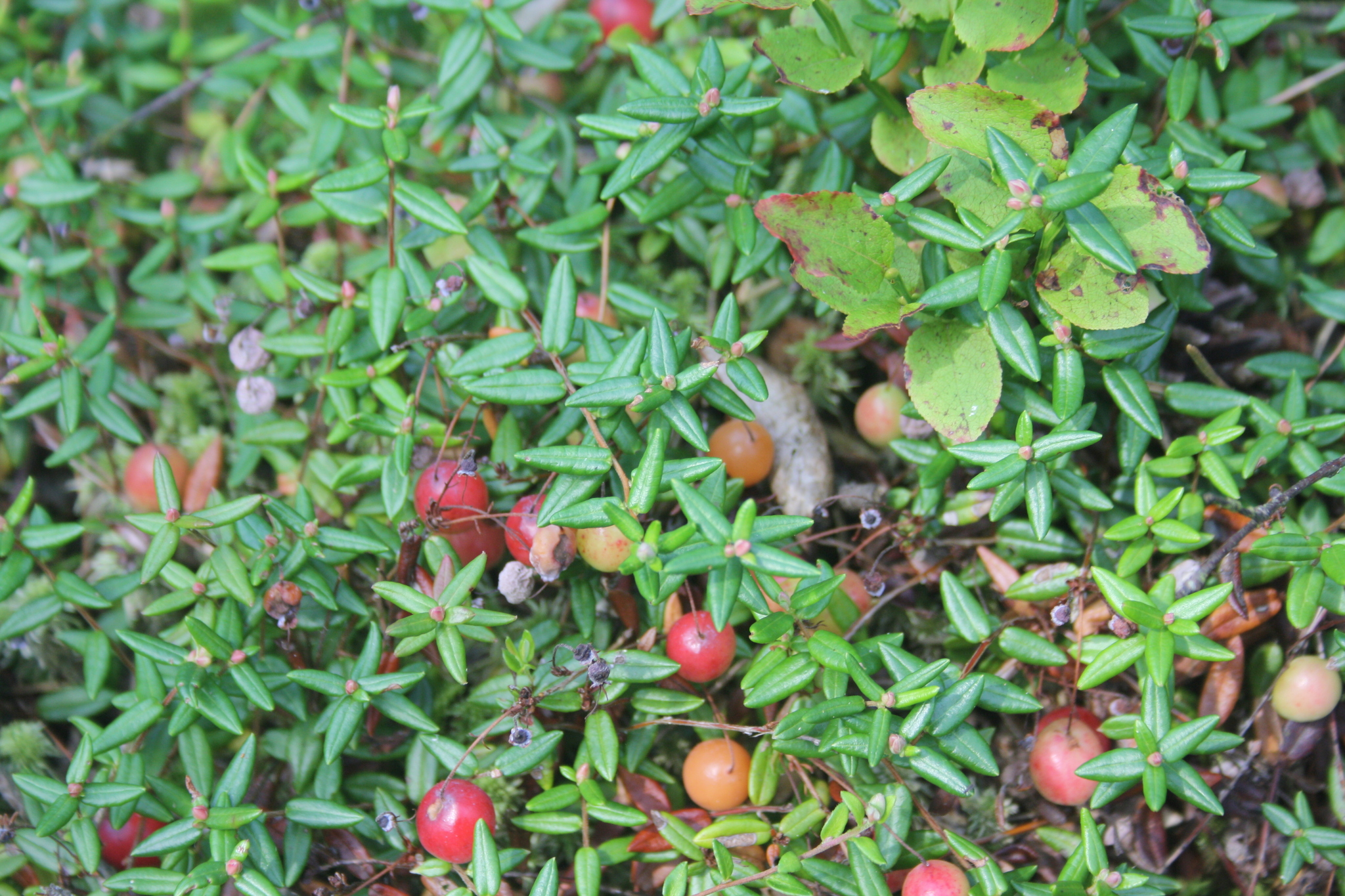
Small cranberry is a very small, prostrate, evergreen shrub. The slender stems are vinelike, and root at the nodes. The lance-shaped leaves are leathery and have revolute margins. Pink to red flowers are borne singly or in clusters at the ends of stems. The fruit is a red, juicy berry [1,21,50]. Underground perennating structures are generally well below the soil surface [12]. Mycorrhizal associations exist on unsuberized portions of the roots and allow for improved plant nutrient levels and growth rates in the acid or peat soil in which small cranberry is found [49].
Raunkiaer Life Form (Raunkiaer 1934)
- Chamaephyte
- Cryptophyte (geophyte)
Seasonal Development
Small cranberry flowers emerge from June to July. Fruits ripen from August to October [44,50]. The berries often persist through the winter [48].
Regeneration Processes
Vegetative regeneration is the most important mode of reproduction of small cranberry. It can also establish by seed; seedlings, however, are rare [6].
Small cranberry is self-pollinating, but pollination by insects (especially bees) increases seed production [34]. Cranberry (Vaccinium spp. sec. Oxycoccos) seeds do not germinate immediately after berries become ripe, but dormancy can be overcome by afterripening. Storage of seeds at 32 degrees Fahrenheit (0 deg C) for 6 to 7 months allows for germination of seeds at 77 degrees Fahrenheit (25 deg C) [40].
Seeds are dispersed by birds and animals that eat small cranberry fruits [49].
Small cranberry regenerates vegetatively by sprouting from rhizomes and by layering [1,2,13,50].
Successional Status
Small cranberry can be an early colonizer in secondary succession but is generally associated with mid-seral stages of primary succession. It is one of the first colonizers of burned bogs and increases in abundance with repeated fires [12]. In bog development however, small cranberry becomes more abundant after an initial sedge mat has formed. It is most important in the sphagnum community stage, which consists mainly of sphagnum mosses and ericaceous shrubs [6,16,45]. Small cranberry is shade intolerant [25], and is generally only present as a relic in climax bogs that have developed a conifer overstory [16].
Immediate Fire Effects
Fire usually top-kills small cranberry. Severe fires that remove the underlying sphagnum layer generally kill underground reproductive organs [52].
Postfire Regeneration Strategy (Stickney 1989)
- Survivor species; on-site surviving rhizomes
- Off-site colonizer; seed carried by animals or water; postfire years 1 and 2
Fire Adaptations
Members of the family Ericaceae easily regenerate from rhizomes following fire [8]. Small cranberry is able to survive low- to moderate-severity fires because rhizomes are found well below the surface of the bog [12]. Small cranberry can utilize ash nutrients for rapid growth, preventing additional nutrient loss from the burn site [14].
Plant Response to Fire
Small cranberry sprouts from rhizomes following fire [13]. It generally becomes more abundant with repeated fires [12]. In the Acadian Forest Region of Maine, small cranberry in tamarack (Larix laricina) bogs increased after a prescribed fire. Prior to burning, small cranberry stems were present at less than 0.09 per square foot (1/sq m). Within 5 months following the fire, the number of small cranberry stems had increased via rhizome sprouting to 2.7 per square foot (29/sq m) [13].
After a prescribed fire in northern Wisconsin, increased fruit and seed production and active succulent green growth was observed in small cranberry. The plant flowered and fruited profusely within 1 to 3 years following the fire [52].
Fire Regimes
Wildfires are infrequent in the wet or saturated habitats that small cranberry generally occupies [51].
For fire regime information, search FEIS for this species by entering the species name on the Advanced Search page and selecting “Fire Regime” as the publication type.
Fire Management Considerations
Prescribed burning is the recommended management tool for the sites that small cranberry inhabits [22]. Fire reduces tall shrub cover, which allows low shrub species to persist in bogs [46]. Burning produces a retrogression from a bog forest dominated by trees to an open sphagnum bog dominated by sedges and shrubs such as small cranberry [52]. Without fire, small cranberry eventually is shaded out by taller shrub and tree species.
Commercial cranberry growers often use fire to maintain bogs and increase fruiting of small cranberry [52].
Federal Status
No special status.
Other Status
Small cranberry is listed as endangered in Ohio by the Natural Heritage Program [54]. It is considered threatened in Illinois [46]. The variety ovalifolium is classified as rare in Nova Scotia and New England [36,41].
Importance to Wildlife and Livestock
Small cranberry is of limited use to wildlife. It is not utilized as browse by big game animals [9]. A few bird species including Hudsonian godwits, sharp-tailed grouse, and ring-necked pheasants eat small cranberry fruits [30,39,48]. Small mammals such as chipmunks, squirrels, rabbits, and hares may occasionally utilize the berries.
Palatability and Nutritional Value
Small cranberry fruits are presumably moderately palatable [21,50].
Cover Value
No entry.
Value for Rehabilitation or Restoration of Disturbed Sites
The value of small cranberry for rehabilitation of disturbed sites is not well documented. It has, however, been successfully transplanted to a saline-impacted bog in Indiana [53].
Other Uses
Small cranberry fruits have good flavor and are often used to make jams and jellies. However, they are seldom abundant enough to be gathered in large quantities [21,50]. Native Americans used the berries, twigs, and bark for medicinal purposes [35].
Other Management Considerations
Commercial cultivation of small cranberry is not widespread in the United States but is important in Russia. Cultivation experiments have shown that small cranberry grows well in acid peat substrates [19]. It does not respond well to transplanting [13].
Small cranberries are of local commercial importance [5], and berry picking provides recreation for many people. However, decreased fruit production has resulted from the draining of bogs for agricultural purposes or to access timber [23]. As bog or fen areas are drained and cleared, wetland species such as sphagnum mosses and small cranberry are replaced by vegetation that indicates drier conditions and the cessation of peat formation [28].
Small cranberry is susceptible to many different fungal diseases [42].
Table A1— Forest and range ecosystems, Bureau of Land Management (BLM) physiographic regions, Kuchler plant associations, Society for American Foresters (SAF) forest cover types, and Society for Rangeland Management (SRM) rangeland cover types in which this species occurs.
Forest and Range Ecosystems (Garrison et al. 1977)
- FRES10 White - red - jack pine
- FRES11 Spruce – fir
- FRES23 Fir - spruce
BLM Physiographic Regions (Bernard and Brown 1977)
- 1 Northern Pacific Border
- 2 Cascade Mountains
Kuchler Plant Associations (Kuchler 1964)
- K004 Fir - hemlock forest
- K093 Great Lakes spruce - fir forest
- K094 Conifer bog
- K095 Great Lakes pine forest
- K096 Northeastern spruce - fir forest
SAF Cover Types (Eyre 1980)
- 1 Jack pine
- 5 Balsam fir
- 12 Black spruce
- 13 Black spruce – tamarack
- 38 Tamarack
- 107 White spruce
- 201 White spruce
- 204 Black spruce
- 253 Black spruce - white spruce
SRM Rangeland Cover Types (Shiflet 1994)
- Copy text
1. Anderson, J. P. 1959. Flora of Alaska and adjacent parts of Canada. Ames, IA: Iowa State University Press. 543 p. [9928]
2. Beasleigh, W. J.; Yarranton, G. A. 1974. Ecological strategy and tactics of Equisetum sylvaticum during a postfire succession. Canadian Journal of Botany. 52: 2299-2318. [9965]
3. Bernard, Stephen R.; Brown, Kenneth F. 1977. Distribution of mammals, reptiles, and amphibians by BLM physiographic regions and A.W. Kuchler's associations for the eleven western states. Tech. Note 301. Denver, CO: U.S. Department of the Interior, Bureau of Land Management. 169 p. [434]
4. Boelter, Don H.; Verry, Elon S. 1977. Peatland and water in the northern Lake States. Gen. Tech. Rep. NC-31. St. Paul, MN: U.S. Department of Agriculture, Forest Service, North Central Forest Experiment Station. 22 p. [8168]
5. Chandler, F. B.; Hyland, Fay. 1941. Botanical and economic distribution of Vaccinium L. in Maine. Proceedings of the American Society for Horticultural Science. 38: 430-433. [9665]
6. Conway, Verona M. 1949. The bogs of central Minnesota. Ecological Monographs. 19(2): 173-206. [16686]
7. Corns, I. G. W.; Annas, R. M. 1986. Field guide to forest ecosystems of west-central Alberta. Edmonton, AB: Canadian Forestry Service, Northern Forestry Centre. 251 p. [8998]
8. Damman, A. W. H. 1977. Geographical changes in the vegetation pattern of raised bogs in the Bay of Fundy region of Maine and New Brunswick. Vegetatio. 35(3): 137-151. [10158]
9. Dayton, William A. 1931. Important western browse plants. Misc. Publ. 101. Washington, DC: U.S. Department of Agriculture. 214 p. [768]
10. Eyre, F. H., ed. 1980. Forest cover types of the United States and Canada. Washington, DC: Society of American Foresters. 148 p. [905]
11. Fernald, Merritt Lyndon. 1950. Gray's manual of botany. [Corrections supplied by R. C. Rollins]. Portland, OR: Dioscorides Press. 1632 p. (Dudley, Theodore R., gen. ed.; Biosystematics, Floristic & Phylogeny Series; vol. 2). [14935]
12. Flinn, Marguerite A.; Wein, Ross W. 1977. Depth of underground plant organs and theoretical survival during fire. Canadian Journal of Botany. 55: 2550-2554. [6362]
13. Flinn, Marguerite A.; Wein, Ross W. 1988. Regrowth of forest understory species following seasonal burning. Canadian Journal of Botany. 66: 150-155. [3014]
14. Flinn, Marguerite Adele. 1980. Heat penetration and early postfire regeneration of some understory species in the Acadian forest. Halifax, NB: University of New Brunswick. 87 p. Thesis. [9876]
15. Garrison, George A.; Bjugstad, Ardell J.; Duncan, Don A.; [and others]. 1977. Vegetation and environmental features of forest and range ecosystems. Agric. Handb. 475. Washington, DC: U.S. Department of Agriculture, Forest Service. 68 p. [998]
16. Gates, Frank C. 1942. The bogs of northern lower Michigan. Ecological Monographs. 12(3): 213-254. [10728]
17. Glaser, Paul H.; Janssens, Jan A.; Siegel, Donald I. 1990. The response of vegetation to chemical and hydrological gradients in the Lost River peatland, northern Minnesota. Journal of Ecology. 78: 1021-1048. [14341]
18. Heinselman, M. L. 1970. Landscape evolution, peatland types and the environment in the Lake Agassiz Peatlands Natural Area, Minnesota. Ecological Monographs. 40(2): 235-261. [8378]
19. Hiirsalmi, H. M. 1989. Research into Vaccinium cultivation in Finland. Acta Horticulturae. 241: 175-184. [12159]
20. Hitchcock, C. Leo; Cronquist, Arthur. 1964. Vascular plants of the Pacific Northwest. Part 2: Salicaceae to Saxifragaceae. Seattle, WA: University of Washington Press. 597 p. [1166]
21. Hulten, Eric. 1968. Flora of Alaska and neighboring territories. Stanford, CA: Stanford University Press. 1008 p. [13403]
22. Jacobson, George L., Jr.; Almquist-Jacobson, Heather; Winne, J. Chris. 1991. Conservation of rare plant habitat: insights from the recent history of vegetation and fire at Crystal Fen, northern Maine, USA. Biological Conservation. 57(3): 287-314. [16533]
23. Kardell, Lars. 1986. Occurrence and berry production of Rubus chamaemorus L., Vaccinium oxycoccus L., V. microcarpum Turcz. & V. vitis-idaea on Swedish peatlands. Scandinavian Journal of Forest Research. 1(1): 125-140. [3711]
24. Kartesz, John T.; Kartesz, Rosemarie. 1980. A synonymized checklist of the vascular flora of the United States, Canada, and Greenland. Volume II: The biota of North America. Chapel Hill, NC: The University of North Carolina Press; in confederation with Anne H. Lindsey and C. Richie Bell, North Carolina Botanical Garden. 500 p. [6954]
25. Klinka, K.; Krajina, V. J.; Ceska, A.; Scagel, A. M. 1989. Indicator plants of coastal British Columbia. Vancouver, BC: University of British Columbia Press. 288 p. [10703]
26. Kuchler, A. W. 1964. Manual to accompany the map of potential vegetation of the conterminous United States. Special Publication No. 36. New York: American Geographical Society. 77 p. [1384]
27. Laderman, Aimlee D.; Golet, Francis C.; Sorrie, Bruce A.; Woolsey, Henry L. 1987. Atlantic white cedar in the glaciated Northeast. In: Laderman, Aimlee D., ed. Atlantic white cedar wetlands. [Place of publication unknown]: Westview Press: 19-34. [15872]
28. Lewis, Francis J.; Dowding, E. S. 1926. The vegetation and retrogressive changes of peat areas ("muskegs") in central Alberta. Journal of Ecology. 14: 317-341. [12740]
29. Lyon, L. Jack; Stickney, Peter F. 1976. Early vegetal succession following large northern Rocky Mountain wildfires. In: Proceedings, Tall Timbers fire ecology conference and Intermountain Fire Research Council fire and land management symposium; 1974 October 8-10; Missoula, MT. No. 14. Tallahassee, FL: Tall Timbers Research Station: 355-373. [1496]
30. Martin, Alexander C.; Zim, Herbert S.; Nelson, Arnold L. 1951. American wildlife and plants. New York: McGraw-Hill Book Company, Inc. 500 p. [4021]
31. Palser, Barbara F. 1961. Studies of floral morphology in the Ericales. V. Organography and vascular anatomy in several United States species of the Vacciniaceae. Botanical Gazette. 123(2): 79-111. [9032]
32. Pojar, J.; Trowbridge, R.; Coates, D. 1984. Ecosystem classification and interpretation of the sub-boreal spruce zone, Prince Rupert Forest Region, British Columbia. Land Management Report No. 17. Victoria, BC: Province of British Columbia, Ministry of Forests. 319 p. [6929]
33. Raunkiaer, C. 1934. The life forms of plants and statistical plant geography. Oxford: Clarendon Press. 632 p. [2843]
34. Reader, R. J. 1977. Bog ericad flowers: self-compatibility and relative attractiveness to bees. Canadian Journal of Botany. 55(17): 2279-2287. [10089]
35. Robuck, O. Wayne. 1985. The common plants of the muskegs of southeast Alaska. Miscellaneous Publication/July 1985. Portland, OR: U.S. Department of Agriculture, Forest Service, Pacific Northwest Forest and Range Experiment Station. 131 p. [11556]
36. Roland, A. E.; Smith, E. C. 1969. The flora of Nova Scotia. Halifax, NS: Nova Scotia Museum. 746 p. [13158]
37. Rudolf, Paul O. 1950. Forest plantations in the Lake States. Tech. Bull. 1010. Washington, DC: U.S. Department of Agriculture. 171 p. [13463]
38. Santelmann, Mary V. 1991. Influences on the distribution of Carex exilis: an experimental approach. Ecology. 72(6): 2025-2037. [17244]
39. Schmidt, F. J. W. 1936. Winter food of the sharp-tailed grouse and pinnated grouse in Wisconsin. Wilson Bulletin. September: 186-203. [16729]
40. Schultz, Joseph Herbert. 1944. Some cytotaxonomic and germination studies in the genus Vaccinium. Pullman, WA: Washington State University. 115 p. Thesis. [10285]
41. Seymour, Frank Conkling. 1982. The flora of New England. 2d ed. Phytologia Memoirs 5. Plainfield, NJ: Harold N. Moldenke and Alma L. Moldenke. 611 p. [7604]
42. Shear, C. L.; Stevens, Neil E.; Bain, Henry F. 1931. Fungous diseases of the cultivated cranberry. Tech. Bull. No. 258. Washington, DC: U.S. Department of Agriculture, Forest Service. 57 p. [16406]
43. Slack, N. G.; Vitt, D. H.; Horton, D. G. 1980. Vegetation gradients of minerotrophically rich fens in western Alberta. Canadian Journal of Botany. 58: 330-350. [7419]
44. Soper, James H.; Heimburger, Margaret L. 1982. Shrubs of Ontario. Life Sciences Misc. Publ. Toronto, ON: Royal Ontario Museum. 495 p. [12907]
45. Stallard, Harvey. 1929. Secondary succession in the climax forest formations of northern Minnesota. Ecology. 10(4): 476-547. [3808]
46. Taft, John B.; Solecki, Mary Kay. 1990. Vascular flora of the wetland and prairie communities of Gavin Bog and Prairie Nature Preserve, Lake County, Illinois. Rhodora. 92(871): 142-165. [14522]
47. U.S. Department of Agriculture, Natural Resources Conservation Service. 2018. PLANTS Database, [Online]. U.S. Department of Agriculture, Natural Resources Conservation Service (Producer). Available: https://plants.usda.gov/. [34262]
48. Van Dersal, William R. 1938. Native woody plants of the United States, their erosion-control and wildlife values. Washington, DC: U.S. Department of Agriculture. 362 p. [4240]
49. Vander Kloet, S. P. 1988. The genus Vaccinium in North America. Publication 1828. Ottawa: Research Branch, Agriculture Canada. 201 p. [11436]
50. Viereck, Leslie A.; Little, Elbert L., Jr. 1972. Alaska trees and shrubs. Agric. Handb. 410. Washington, DC: U.S. Department of Agriculture, Forest Service. 265 p. [6884]
51. Vitt, Dale H.; Horton, Diana G.; Slack, Nancy G.; Malmer, Nils. 1990. Sphagnum-dominated peatlands of the hyperoceanic British Columbia coast: patterns in surface water chemistry and vegetation. Canadian Journal of Forestry Research. 20: 696-711. [11739]
52. Vogl, Richard J. 1964. The effects of fire on a muskeg in northern Wisconsin. Journal of Wildlife Management. 28(2): 317-329. [12170]
53. Wilcox, Douglas A.; Ray, Gary. 1989. Using "living mat" transplants to restore a salt-impacted bog (Indiana). Restoration and Management Notes. 7(1): 39. [8063]
54. McCance, R. M., Jr.; Burns, J. F., eds. 1984. Ohio endangered and threatened vascular plants: Abstracts of state-listed taxa. Columbus, OH: Department of Natural Resources, Division of Natural Areas and Preserves. 635 p. [22520]