


Vitis californica, California wild grape
Howard, Janet L. 1993. Vitis californica, California wild grape. In: Fire Effects Information System, [Online]. U.S. Department of Agriculture, Forest Service, Rocky Mountain Research Station, Fire Sciences Laboratory (Producer). Available: https://research.fs.usda.gov/feis/species-reviews/vitcal
| Abbreviation | Common Name | Scientific Name | Classification | Status |
|---|---|---|---|---|
| Plants | ||||
| VITCAL | California wild grape | Vitis californica | Life Form: Plants/Vine or Liana Kingdom: Plantae Class: Dicot Order: Rhamnales Family: Vitaceae Genus: Vitis | Fed. Protected: No Nativity: Native Invasiveness: Noninvasive |

Taxonomy
The scientific name of California wild grape is Vitis californica Benth. There are no subspecies, varieties, or forms [17,19,21].
Synonyms
- Vitis californicum Benth.
Other Common Names
None.
General Distribution
California wild grape is endemic to southern Oregon and California. It is distributed in the Coast Ranges from Douglas County, Oregon, south to San Luis Obispo County, California; in the Klamath Mountains, the Cascade Range, and the Sierra Nevada from Siskiyou to Kern counties, California; and in the Central Valley [19,21].
States and Provinces
- United States: CA OR
Site Characteristics
California wild grape grows in mesic riparian areas such as swales, streambanks, and canyon bottoms [19,30]. It is found at elevations below 4,000 feet (1,219 m) [19].
Plant Communities
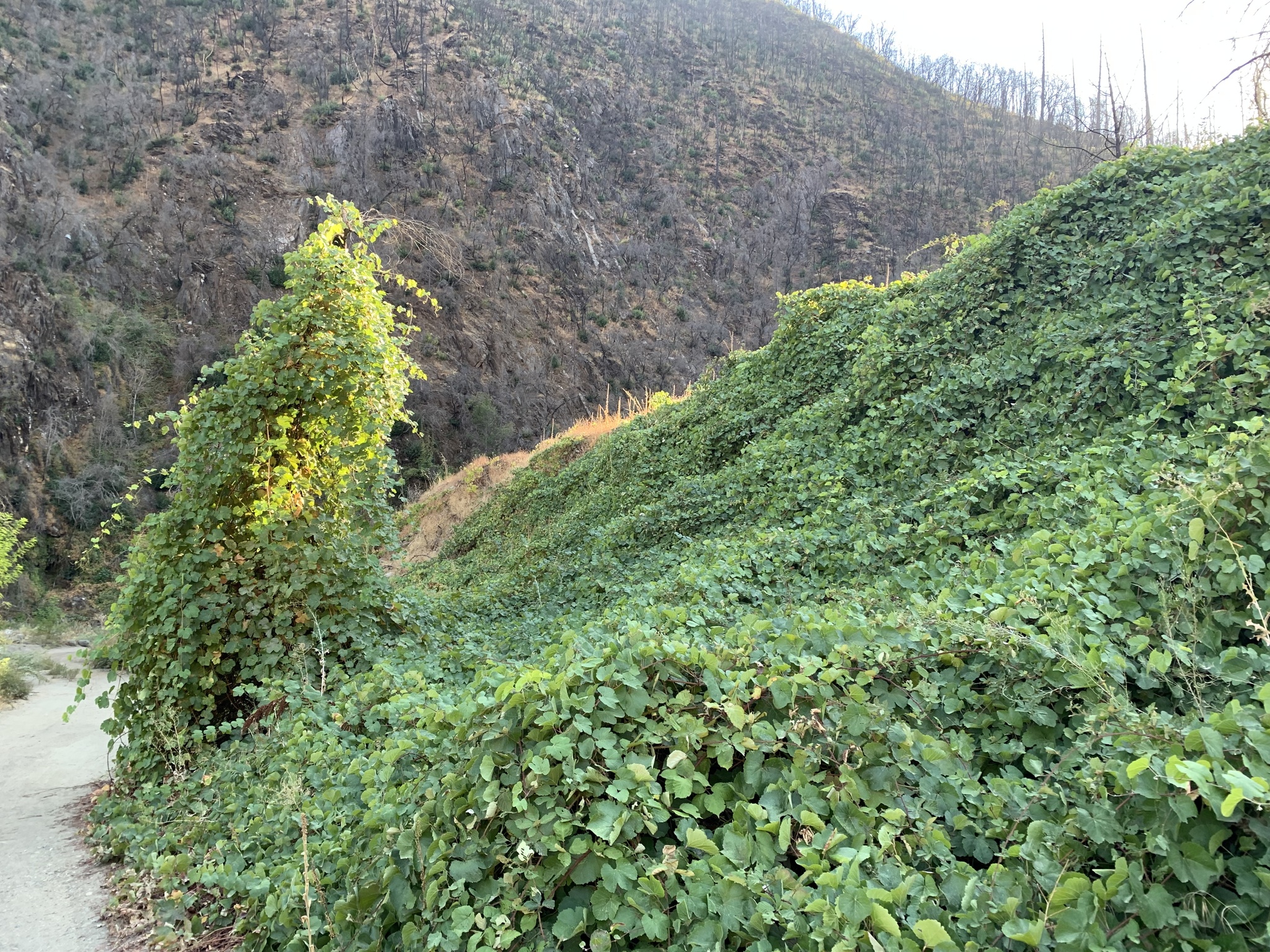
California wild grape is a conspicuous vine of riparian forests and woodlands. It is a minor to major component of valley oak (Quercus lobata) riparian, mixed-oak riparian, Fremont cottonwood (Populus fremontii), black cottonwood (P. trichocarpa), cottonwood-willow, mixed-hardwood riparian, red alder (Alnus rubra), and white alder (A. rhombifolia) communities [28]. It may dominate the lower and midstories and reach into the canopy, particularly in valley oak and Fremont cottonwood forests [10]. The following classifications name California wild grape as a dominant in community types:
- Terrestrial natural communities of California [10]
- The vascular plant communities of California [28]

California wild grape growing in Placer County, California.
Tree associates of California wild grape not listed in Distribution and Occurrence include California black walnut (Juglans hindsii), California sycamore (Platanus racemosa), interior live oak (Quercus wislizeni), California box elder (Acer negundo var. californicum), Oregon ash (Fraxinus latifolia), California bay (Umbellularia californica), and California buckeye (Aesculus californica) [3,8,10,15].
Common shrub associates are Mexican tea (Chenopodium ambrosoides), California blackberry (Rubus vitifolius), coyote bush (Baccharis pilularis var. consanguinea), California wild rose (Rosa californica), valley willow (Salix hindsiana), and arroyo willow (S. lasiolepis) [3,8,9]. Dutchman's pipe vine (Aristolochia californica), poison-oak (Toxicodendron diversilobum), and wild clematis (Clematis spp.) are vine associates [3,12].
Groundcover associates include Bermuda grass (Cynodon dactylon), holly fern (Polystichum lonchitis), and blue vervain (Verbena hastata) [3,15,18].
Botanical Description
California wild grape is a native, usually dioecious, deciduous liana. Stems are from 6.6 to 60 feet (2-20 m) long. When support such as trees or shrubs is available, California wild grape attaches to and climbs the support using branched tendrils located opposite its leaves. It has a sprawling and bushlike form when support is unavailable. California wild grape leaves are from 2.8 to 5.6 inches (7-14 cm) broad. The fruit is a pulpy berry. The seeds have a thick, hard testa; hard endosperm; and minute embryo [19,21,24].

California wild grape growing in Humboldt County, California (CC BY-NC-ND).
Raunkiaer Life Form (Raunkiaer 1934)
- Phanerophyte
Seasonal Development
California wild grape flowers from May to June [19]. Fruits ripen in September. Leaves are shed from mid-October to November (pers. obs.).
Regeneration Processes
California wild grape reproduces from seed [13]. Plants require outcrossing to effect pollination [23]. Seeds are presumably disseminated by frugivorous animals.
Successional Status
California wild grape is found in climax valley oak riparian forests. It is also named as a component of communities (such as Fremont cottonwood and Great Valley mixed-hardwood riparian forests) that undergo recurrent flooding [10].
Immediate Fire Effects
California wild grape is probably top-killed by fire [5,24].
Postfire Regeneration Strategy (Stickney 1989)
- Secondary colonizer - off-site seed
Fire Adaptations
Literature concerning California wild grape adaptations to fire is scant. Sampson and Jesperson [24] list California wild grape as a root crown sprouter. Its hard-coated seeds may be cracked by fire, but documented evidence linking fire with increased germination of California wild grape seed is lacking.
Plant Response to Fire
California wild grape sprouts from the root crown after fire [24]. It probably colonizes from animal-dispersed seed.
Fire Regimes
For fire regime information, search FEIS for this species by entering the species name on the Advanced Search page and selecting “Fire Regime” as the publication type.
Fire Management Considerations
California wild grape is probably a ladder fuel, carrying fire into the canopies of the trees upon which it climbs.
Federal Status
None
Other Status
No entry.
Importance to Wildlife and Livestock
Riparian vegetation provides important habitat for wildlife [15]. California wild grape is among the most valuable of the riparian plant species. As well as providing cover, it is an important animal food. The fruits are a fall staple for many animal species, including coyote, opossum, western spotted skunk, striped skunk, wood duck, band-tailed pigeon, California quail, mountain bluebird, and other passerines [2,16]. Black-tailed deer browse the leaves and young stems. Additionally, it is browsed by all classes of domestic livestock [24].
Palatability and Nutritional Value
California wild grape browse has been rated fair to poor for sheep, goats, and black-tailed deer and poor to useless for cattle and horses [24].
Cover Value
No entry.
Value for Rehabilitation or Restoration of Disturbed Sites
California wild grape is planted for riparian restoration [8]. It is easily started from cuttings [13,23] and shows favorable rates of establishment. Containerized cuttings transplanted onto the north banks of the Crescent Bypass and the South Fork of the Kings River showed less than 2 percent mortality after 2 years [20].
Other Uses
California wild grape is of great importance to wine industries throughout the world. This species was used to save the European wine industry between 1870 and 1900 when most wine grapes (Vitis vinifera) were killed by leaf- and root-attacking grape phylloxera aphids (Daktulosphaira vitifoliae). Since that time, nearly all commercial wine grapes grown anywhere in the world have been grafted onto rootstocks of resistant California wild grape cultivars.
The grapes of this species are palatable to humans. They are eaten raw or made into jelly.
Other Management Considerations
Trees such as valley oak and Fremont cottonwood often die after California wild grape climbs into their canopies [11,24].
California wild grape is a host of the western grapeleaf skeletonizer (Harrisina brillians). This moth can decimate commercial vineyards [25].
Table A1— Forest and range ecosystems, Bureau of Land Management (BLM) physiographic regions, Kuchler plant associations, Society for American Foresters (SAF) forest cover types, and Society for Rangeland Management (SRM) rangeland cover types in which this species occurs.
Forest and Range Ecosystems (Garrison et al. 1977)
- FRES20 Douglas-fir
- FRES21 Ponderosa pine
- FRES27 Redwood
- FRES28 Western hardwoods
- FRES34 Chaparral - mountain shrub
- FRES41 Wet grasslands
- FRES42 Annual grasslands
BLM Physiographic Regions (Bernard and Brown 1977)
- 1 Northern Pacific Border
- 3 Southern Pacific Border
- 4 Sierra Mountains
Kuchler Plant Associations (Kuchler 1964)
- K005 Mixed conifer forest
- K006 Redwood forest
- K029 California mixed evergreen forest
- K030 California oakwoods
- K048 California steppe
- K049 Tule marshes
SAF Cover Types (Eyre 1980)
- 221 Red alder
- 222 Black cottonwood - willow
- 232 Redwood
- 233 Oregon white oak
- 234 Douglas-fir - tanoak - Pacific madrone
- 243 Sierra Nevada mixed conifer
- 244 Pacific ponderosa pine - Douglas-fir
- 245 Pacific ponderosa pine
- 246 California black oak
- 249 Canyon live oak
- 250 Blue oak - gray pine
- 255 California coast live oak
SRM Rangeland Cover Types (Shiflet 1994)
- No entry
1. Airola, Daniell A.; Messick, Timothy C. 1987. Sliding toward extinction: the state of California's natural heritage, 1987. Report prepared at the request of the California Senate Committee on Natural Resources and Wildlife. [Location of publisher unknown]: [Publisher unknown]. 123 p. On file at: U.S. Department of Agriculture, Forest Service, Intermountain Research Station, Fire Sciences Laboratory, Missoula, MT. [19482]
2. Barrett, Reginald H. 1983. Food habits of coyotes, Canis latrans, in eastern Tehama County, California. California Fish and Game. 69(3): 184-186. [13786]
3. Belluomini, Linda; Trapp, Gene R. 1984. Ringtail distribution and abundance in the Central Valley of California. In: Warner, Richard E.; Hendrix, Kathleen M., eds. California riparian systems: Ecology, conservation, and productive management. Berkeley, CA: University of California Press: 906-914. [5880]
4. Bernard, Stephen R.; Brown, Kenneth F. 1977. Distribution of mammals, reptiles, and amphibians by BLM physiographic regions and A.W. Kuchler's associations for the eleven western states. Tech. Note 301. Denver, CO: U.S. Department of the Interior, Bureau of Land Management. 169 p. [434]
5. Conrad, C. Eugene. 1987. Common shrubs of chaparral and associated ecosystems of southern California. Gen. Tech. Rep. PSW-99. Berkeley, CA: U.S. Department of Agriculture, Forest Service, Pacific Southwest Forest and Range Experiment Station. 86 p. [4209]
6. Eyre, F. H., ed. 1980. Forest cover types of the United States and Canada. Washington, DC: Society of American Foresters. 148 p. [905]
7. Garrison, George A.; Bjugstad, Ardell J.; Duncan, Don A.; [and others]. 1977. Vegetation and environmental features of forest and range ecosystems. Agric. Handb. 475. Washington, DC: U.S. Department of Agriculture, Forest Service. 68 p. [998]
8. Goldner, Bernard H. 1984. Riparian restoration efforts associated with structurally modified flood control channels. In: Warner, Richard E.; Hendrix, Kathleen M., eds. California riparian systems: Ecology, conservation, and productive management: Proceedings of the conference; 1981 September 17-19; Davis, CA. Berkeley, CA: University of California Press: 445-451. [5852]
9. Hehnke, Merlin; Stone, Charles P. 1979. Value of riparian vegetation to avian populations along the Sacramento River Sy. In: Johnson, R. Roy; McCormick, J. Frank, technical coordinators. Strategies for protection and management of floodplain wetlands & other riparian ecosystems: Proc. of the symposium; 1978 December 11-13; Callaway Gardens, GA. General Technical Report WO-12. Washington, DC: U.S. Department of Agriculture, Forest Service: 228-235. [4363]
10. Holland, Robert F. 1986. Preliminary descriptions of the terrestrial natural communities of California. Sacramento, CA: California Department of Fish and Game. 156 p. [12756]
11. Jepson, Willis Linn. 1925. A manual of the flowering plants of California. Berkeley, CA: University of California Press. 1238. [19365]
12. Katibah, Edwin F. 1984. A brief history of riparian forests in the Central Valley of California. In: Warner, Richard E.; Hendrix, Kathleen M., eds. California riparian systems: Ecology, conservation, and productive management: Proceedings of the conference; 1981 September 17-19; Davis, CA. Berkeley, CA: University of California Press: 23-29. [5822]
13. Kruckeberg, A. R. 1982. Gardening with native plants of the Pacific Northwest. Seattle: University of Washington Press. 252 p. [9980]
14. Kuchler, A. W. 1964. Manual to accompany the map of potential vegetation of the conterminous United States. Special Publication No. 36. New York: American Geographical Society. 77 p. [1384]
15. Langley, Russell D. 1984. SOFAR: a small-town water diversion project on the South Fork, American River. In: Warner, Richard E.; Hendrix, Kathleen M., eds. California riparian systems: Ecology, conservation, and productive management: Proceedings of the conference; 1981 September 17-19; Davis, CA. Berkeley, CA: University of California Press: 505-514. [5855]
16. Martin, Alexander C.; Zim, Herbert S.; Nelson, Arnold L. 1951. American wildlife and plants. New York: McGraw-Hill Book Company, Inc. 500 p. [4021]
17. Mason, Herbert L. 1957. A flora of the marshes of California. Berkeley, CA: University of California Press. 878 p. [16905]
18. Motroni, Robert S. 1984. Seasonal variation of bird numbers in a riparian forest, Sacramento Valley, California. In: Warner, Richard E.; Hendrix, Kathleen M., eds. California riparian systems: Ecology, conservation, and productive management: Proceedings of a conference; 1981 September 17-19; Davis, CA. Berkeley, CA: University of California Press: 578-586. [5859]
19. Munz, Philip A. 1973. A California flora and supplement. Berkeley, CA: University of California Press. 1905 p. [6155]
20. Oldham, Jonathan A.; Valentine, Bradley E. 1990. Phase II of the crescent bypass riparian revegetation project. In: Hughes, H. Glenn; Bonnicksen, Thomas M., eds. Restoration '89: the new management challenge: Proceedings, 1st annual meeting of the Society for Ecological Restoration; 1989 January 16-20; Oakland, CA. Madison, WI: The University of Wisconsin Arboretum, Society for Ecological Restoration: 69-78. [14689]
21. Peck, Morton Eaton. 1961. A Manual of the Higher Plants of Oregon. 2d ed. Portland: Metropolitan Printing Company. 936 p. [20708]
22. Raunkiaer, C. 1934. The life forms of plants and statistical plant geography. Oxford: Clarendon Press. 632 p. [2843]
23. Robbins, James A.; Burger, David W. 1986. Propagating California wild grape. California Agriculture. 40(5/6): 9-10. [20514]
24. Sampson, Arthur W.; Jespersen, Beryl S. 1963. California range brushlands and browse plants. Berkeley, CA: University of California, Division of Agricultural Sciences, California Agricultural Experiment Station, Extension Service. 162 p. [3240]
25. Stern, V. M.; Federici, B. A. [n.d.]. Biological control of western grapeleaf skeletonizer, Harrisina brillian brillians Barnes and McDunnough, with a granulosis virus in California. In: Bostainian, N. J.; Wilson, L. T.; Dennehy, T. J, eds. Monitoring and Integrated Pest Management of Arthropod Pests of Sm Small Fruit Crops. Andover, Hampshire, UK: Intercept Ltd: 167-176. [20652]
26. Stickney, Peter F. 1989. Seral origin of species originating in northern Rocky Mountain forests. Unpublished draft on file at: U.S. Department of Agriculture, Forest Service, Intermountain Research Station, Fire Sciences Laboratory, Missoula, MT; RWU 4403 files. 10 p. [20090]
27. U.S. Department of Agriculture, Soil Conservation Service. 1982. National list of scientific plant names. Vol. 1. List of plant names. SCS-TP-159. Washington, DC. 416 p. [11573]
28. Thorne, Robert F. 1976. The vascular plant communities of California. In: Latting, June, ed. Symposium proceedings: plant communities of southern California; 1974 May 4; Fullerton, CA. Special Publication No. 2. Berkeley, CA: California Native Plant Society: 1-31. [3289]
29. Warner, Richard E. 1984. Structural, floristic, and condition inventory of central valley riparian systems. In: Warner, Richard E.; Hendrix, Kathleen M., eds. California riparian systems: Ecology, conservation, and productive management: Proceedings of a conference; 1981 September 17-19; Davis, CA. Berkeley, CA: University of California Press: 356-374. [5840]
30. Whitlow, Thomas H.; Bahre, Conrad J. 1984. Plant succession on Merced River dredge spoils. In: Warner, Richard E.; Hendrix, Kathleen M., eds. California riparian systems: Ecology, conservation, and productive management: Proceedings of the conference; 1981 September 17-19; Davis, CA. Berkeley, CA: University of California Press: 68-74. [5826]