


Zigadenus venenosus, meadow deathcamas
Hauser, A. Scott. 2006. Zigadenus venenosus, meadow deathcamas. In: Fire Effects Information System, [Online]. U.S. Department of Agriculture, Forest Service, Rocky Mountain Research Station, Fire Sciences Laboratory (Producer). Available: https://research.fs.usda.gov/feis/species-reviews/zigven
| Abbreviation | Common Name | Scientific Name | Classification | Status |
|---|---|---|---|---|
| Plants | ||||
| ZIGVEN | meadow deathcamas | Zigadenus venenosus | Life Form: Plants/Forb Kingdom: Plantae Class: Monocot Order: Liliales Family: Liliaceae Genus: Zigadenus | Fed. Protected: No Nativity: Native Invasiveness: Noninvasive |
Taxonomy
The currently accepted scientific name of meadow deathcamas is Zigadenus venenosus S. Wats. (Liliaceae) [22,29,30,35,40,42,50,51,52,58,59,114]. There are 2 accepted varieties:
- Zigadenus venenosus var. venenosus S. Wats. [22,51,58], meadow deathcamas
- Zigadenus venenosus var. gramineus Rybd. [13,22,51,58,66,114], grassy meadow deathcamas
In this review, "meadow deathcamas" refers to the species as a whole. Zigadenus venenosus var. venenosus is referred to as the "typical variety," and " grassy deathcamas" refers to Z. v. var. gramineus.
Synonyms
For Zigadenus venenosus S. Wats.
- Zygadenus venenosus S. Wats. [14,74,92,117]
For Zigadenus venenosus var. gramineus Rybd.
- Zygadenus gramineus Rybd. [46]
- Zigadenus venenosus var. gramineus (Rydb.) Walsh ex M.E. Peck [51]
Other Common Names
grassy deathcamas, deathcamas, death camas, hog potatoes
General Distribution
Meadow deathcamas is a native species. It is patchily distributed from British Columbia east to Saskatchewan and south to New Mexico and Baja California [22,29,30,40,42,50,51,52,58,59,114]. The typical variety occurs from British Columbia east to Alberta and south to Utah and California [22,51,58]. Grassy meadow deathcamas occurs from British Columbia east to Saskatchewan and south to Colorado [13,22,51,58,66,114]. Plants Database provides a distributional map of meadow deathcamas and its infrataxa.
States and Provinces
- United States: CA CO ID MT NE NV NM ND OR SD UT WA WY
- Canada: AB BC SK
- Mexico: B.C.N.
Site Characteristics
Meadow deathcamas occurs on coastal prairies [50,51], wet and drying meadows, along creeks [14,59,114], in open forests and forest edges [92], and on rocky bluffs, grassy hillsides, and sagebrush (Artemisia spp.) slopes [18,33,51,92]. Preferential site characteristics include rich, moist bottomlands and lower foothills [25].
Grassy meadow deathcamas commonly occurs on hills and in meadows, and to a lesser extent in open park areas and high bench lands [25].
Climate: Meadow deathcamas occurs in several climatic zones. In the Pawnee National Grasslands, Colorado, the climate is continental, with approximately 70% of annual precipitation falling between April and August [47]. Meadow deathcamas occurs in the hottest, driest zone found in British Columbia. The zone, a rough fescue-bluebunch wheatgrass (Festuca altaica-Pseudoroegneria spicata) community, encompasses the valley bottoms of the Thompson, Nicola, and Fraser river systems [70].
Extensive climatology data for Fort Lewis, Washington, where meadow deathcamas is common, are presented by Papanikolas [89].
Elevation: The overall elevational range of meadow deathcamas is 1,400 to 8,000 feet (420-2,400 m) [22,25,46,56,83,84,109,110]. The elevational range of grassy meadow deathcamas is 4,000 to 7,000 feet (1,200-2,100 m) [25].
Soil: Meadow deathcamas thrives on sandy and rocky soil [48,56,109].
A detailed analysis of soil in Fremont County, Wyoming, where grassy meadow deathcamas occurs, is presented in a review by Bayer [11].
Along the coast of British Columbia, meadow deathcamas occurs in kinnikinnick communities that indicate moderately to very dry soils, oneleaf foamflower communities that indicate nitrogen-medium soils, and Wallace's spikemoss communities that indicate very shallow soils [62].
Soil moisture: Soil moisture affects zygacine levels in deathcamas. Near Kamloops, British Columbia, soil moisture at 2.5 inches (6.5 cm) and 5.5 inches (14 cm) was significantly correlated with zygacine levels (r = -0.54 and r = -0.52, p<0.05). At 2 of 5 sites, a 45% average decrease in water was associated with a 40% increase in meadow deathcamas zygacine levels [72].
Plant Communities
Meadow deathcamas is not listed as a dominant or codominant species in published classifications. Common associates of meadow deathcamas that are not found in the lists above include the grass species Parry oatgrass (Danthonia parryi), timber oatgrass (D. intermedia), sedge (Carex spp.), and timothy (Phleum pratense); the forb species cinquefoil (Potentilla spp.), glacier lily (Erythronium grandiflorum), western yarrow (Achillea millefolium), pussytoes (Antennaria spp.), smooth aster (Symphyotrichum laevis), milk vetch (Astragalus spp.), arrowleaf balsamroot (Balsamorhiza sagittata), sticky purple geranium (Geranium viscosissimum), oneleaf foamflower (Tiarella trifoliata var. unifoliata), Wallace's spikemoss (Selaginella wallacei), alpine sweetvetch (Hedysarum alpinum), and lupine (Lupinus spp.); the shrub species rubber rabbitbrush (Chrysothamnus nauseosus), silverberry (Elaeagnus commutata), kinnikinnick (Arctostaphylos uva-ursi), western snowberry (Symphoricarpos occidentalis), willow (Salix spp.), and fringed sagebrush (Artemisia frigida); and the tree species balsam popular (P. balsamifera)[1,10,21,54,67,82,108,118].
Botanical Description
This description provides characteristics that may be relevant to fire ecology, and is not meant for identification. Keys for identification are available (e.g., [14,22,29,50,51,59,74,83,84,92,114,117]).

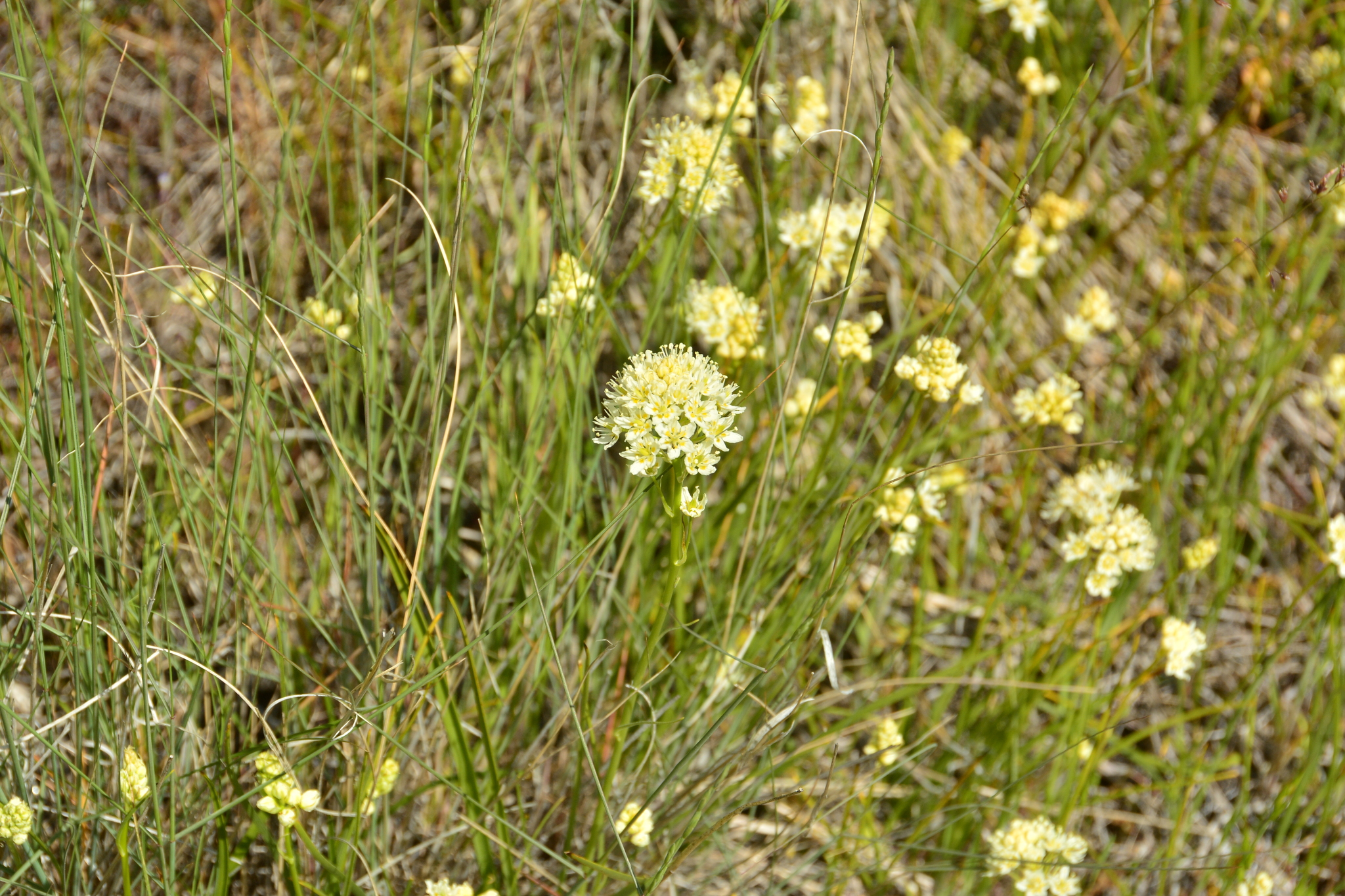
Meadow deathcamas.
Meadow deathcamas is a perennial [18,22,71,72], cool-season forb [56,61,71,88,109,110]. It grows from 6 to 28 inches (15-70 cm) in height [22,51,59,74,83,84,114]. Individual plants produce a single, erect, unbranched, sparingly leafed stem [88,92,104]. Meadow deathcamas leaves are grass-like, mostly basal, 4 to 12 inches (10-30 cm) long, and 2-10 mm wide [18,22,51,74,83,84,92,104,114]. The typical variety and grassy meadow deathcamas are primarily differentiated by a raceme or panicle inflorescence. The typical variety commonly bears several to many flowers on a 2 to 8 inch (5-20 cm) long terminal raceme [22,29,46,50,51,59,84,104,105]. Grassy meadow deathcamas usually has a terminal panicle [29,114]. Meadow deathcamas seeds are small, developing in a 3-cavitied capsule [22,29,74,88,104,105,114]. The bulbs are 0.5 to 1.5 inches (1-4 cm) in diameter [42,71,74,74,92] and occur 2 to 8 inches (5-20 cm) underground [87]. Roots are short and sparse, generally penetrating less than 6 inches (15 cm) into the soil from bulb depth [72].
Toxicity: Both varieties of meadow deathcamas are extremely toxic [20,61,65,72,73,100,105]. This is due to the presence of zygacine, a neurotoxic steroidal alkaloid [61,72,73,100]. Dried meadow deathcamas remains toxic for at least 20 years [100]. Research shows that meadow deathcamas does not exhibit diurnal fluctuations in zygacine [72,73]. For information on seasonal fluctuations, see Seasonal Development.
Raunkiaer Life Form
- Geophyte [95]
Seasonal Development
Meadow deathcamas is 1 of the 1st plants to begin growth in the spring. It reaches maturity and enters dormancy during early summer as soil moisture declines [56,61,88,110]. Seed dissemination is largely in July and August [25].
In the foothills meadow deathcamas generally flowers in April and May. At higher elevations meadow deathcamas flowers in late June and July [56,109,110]. The flowering periods of meadow deathcamas at several locations are presented below.
| State/Region | Flowering period |
|---|---|
| California | May to July [84] |
| Southern California | May to June [83] |
| Nebraska | May to July [105] |
| Nevada | April to July [59] |
| Great Plains | May to July [42,104] |
| Pacific Northwest | May to July [51] |
| Uintah Mountains, Utah | June to July [40] |
The seasonal development of meadow deathcamas in a western Montana mountain grassland ecosystem at 7,100 feet (2,160 m) was as follows [82]:
| Growth stage | Time period |
|---|---|
| Growth starts | April-May |
| Flowering begins | June |
| Flowering ends | June-July |
| Plants dried | June-August |
| Seed dissemination | August |
Zygacine levels were evaluated during 4 stages of meadow deathcamas growth at grassland and subalpine sites near Kamloops, British Columbia. Zygacine concentrations were slightly higher in meadow deathcamas plants growing at subalpine elevations, which were 1,300 to 1,600 feet (400-800 m) higher than grassland elevations, compared to plants on grassland. At both sites, zygacine concentrations were highest during bud stage [73].
| Site | Stage of growth | Zygacine level (% ± SD) |
|---|---|---|
| Grassland | Vegetative | 0.43 ± 0.03 |
| Bud | 0.46 ± 0.25 | |
| Bloom | 0.34 ± 0.08 | |
| Pod | 0.39 ± 0.12 | |
| Subalpine | Vegetative | 0.51 ± 0.11 |
| Bud | 0.53 ± 0.17 | |
| Bloom | 0.47 ± 0.15 | |
| Pod | 0.32 ± 0.20 |
Majak and others [72] studied zygacine levels in meadow deathcamas at various stage of growth near Kamloops and found that zygacine levels were significantly (p<0.05) higher during the vegetative state (0.50%) than during bloom (0.32%) and pod (0.32%) stages.
Regeneration Processes
Meadow deathcamas reproduces by seeds [87,88,104] and bulb offsets [63,79]. Currently (2006), there is no information available on meadow deathcamas pollination, seed production, seed dispersal, seed banking, germination, and seedling establishment or growth.
Breeding System
Meadow deathcamas has perfect flowers [30].
Vegetative Reproduction and Regeneration
Meadow deathcamas reproduces vegetatively via sprouting from mature bulbs [35,58] and bulb offsets [63,79].
Successional Status
Meadow deathcamas is adapted to disturbed sites [19,25,85,87], is shade intolerant [62], and occurs across the successional gradient [45]. It occurs in early, mid-, and late seral stages in the Craig Mountain Wildlife Area, Idaho. The area has a long history of disturbances including fire, fire exclusion, road building, agriculture, and domestic livestock grazing [45] (see Plant Response to Fire). On lands disturbed by off-road vehicles near Fort Lewis, Washington, meadow deathcamas occurs in secondary succession [19].
Immediate Fire Effects
Meadow deathcamas is top-killed by fire [54,113]. The bulbs survive fire [113].
Postfire Regeneration Strategy
- Geophyte, growing points deep in soil [101]
Fire Adaptations
Meadow deathcamas regenerates rapidly after fire from deep, underground bulbs [113]. It also reproduces by seeds [87,88,104], though currently (2006) the literature does not document this as a postfire regeneration strategy.
Plant Response to Fire
Meadow deathcamas is described as a fire "endurer" [119]. It regenerates via seeds [87,88,104], sprouting from bulbs [35,58], and from bulb offsets [63,79]. Understanding of meadow deathcamas' response to fire is limited and inconsistent, so further research is sorely needed. In the fire research described below, meadow deathcamas cover has decreased [15,31], increased [15,45,76], and remained constant [76,77] after burning.
Lightning-caused fires at China Garden Creek (September 2000) and Lower Corral Creek (October 2001), Idaho, had little effect on meadow deathcamas cover 1 and 2 years following fire. Prior to the 2000 and 2001 fires, no large fires had occurred in the areas since 1976. Vegetation sampling took place in 2001 (15 June-22 July) and 2002 (15 June-22 June) on burned and unburned sites. On unburned sites, meadow deathcamas cover increased from <0.025% in 2001 to 0.28% in 2002. On burned sites, meadow deathcamas cover remained relatively constant in 2001 (<0.025%) and 2002 (0.03%) [76].
A December 1997 wildfire on foothill rough fescue grasslands in southwest Alberta increased meadow deathcamas cover at postfire month 6 on burn perimeters and at postfire month 18 on burn perimeter and interior sites. Meadow deathcamas cover on burn interiors at postfire month 6 was slightly less than on unburned sites. The fire was "extremely hot", with head fire intensity ranging from 10,000 to 20,000 kW/m². The average rate of fire spread (~6 miles/hr) was 1 of the greatest documented for a grassland fire in Canada. In total, the fire burned 53,370 acres (21,600 ha). Conditions were favorable in the first 2 growing seasons following the fire, with precipitation 46% above average in 1998 and average in 1999. In postfire month 6 (June 1998), meadow deathcamas cover was 0.2% on unburned sites, 0.1% on burn interior sites, and 0.9% on burn perimeter sites. In postfire month 18 (June 1999), meadow deathcamas cover was greater on both burn perimeter (1.3%) and interior (0.6%) sites compared to unburned (0.1%) sites [15].
In a qualitative study in southeastern Alberta, meadow deathcamas composition (% biomass relative to the community total vegetation) decreased following an August 1994 wildfire in a lowland western wheatgrass-thickspike wheatgrass-needle-and-thread grass-porcupine grass (Pascopyrum smithii-Elymus lanceolatus-Hesperostipa comata-H. spartea) community. Vegetation analysis was conducted from 1995 to 1997 during late July to early August, the period of peak standing phytomass. Pooling data from all years, meadow deathcamas composition on burned and unburned sites was 0.6% and 1.4%, respectively [31].
From 17 August to 24 August 1996, a lightning-initiated fire burned 4,781 acres (1,935 ha) in Mesa Verde National Park, Colorado. While no prefire data were available, percent occurrence of meadow deathcamas (relative to the total sample points) in 2 burned Utah serviceberry (Amelanchier utahensis) communities in late August to September 1997 was 33% and 17%, respectively [37].
A 1973 wildfire that burned from 10 August to 23 September in the Selway-Bitterroot Wilderness of Idaho had no effect on meadow deathcamas. A "trace" cover of meadow deathcamas was measured on burned and unburned sites in June 1974 and 1976 [77].
Meadow deathcamas cover increased following an August 2000 fire in the Craig Mountain Wildlife Area, Idaho. The site is a bluebunch wheatgrass-Sandberg bluegrass (Poa secunda) habitat type occurring on the southern aspects of 2 watersheds, China Creek and Corral Creek. In total, the fire burned 74,510 acres (30,155 ha) over a 9-day period. The 45-day period prior to the fire had below-average precipitation, but precipitation was above average in September 2000. During the 1st postfire sampling year (2002), April and May precipitation was below average. The 2nd sampling season (2003) followed months of above-average precipitation. Research conducted prior to the fire found meadow deathcamas occurred on early, mid-, and late seral sites. Meadow deathcamas cover (%) on 7 burned plots from 1999 to 2003 is shown below [45]:
| Plot | Seral stage | 1999 | 2000 | 2002 | 2003 |
|---|---|---|---|---|---|
| 16 | Mid | 0.12 | 0.01 | 0.25 | 2.52 |
| 18 | Mid | 0 | 0.60 | 0.18 | 0.24 |
| 19 | Mid | 0 | 0 | 0.06 | 0.84 |
| 20 | Late | 0.24 | 0.96 | 0.48 | 3.18 |
| 21 | Mid | 0.12 | 0.12 | 0.90 | 5.70 |
| 22 | Early | 0.26 | 0.67 | 1.14 | 4.38 |
| 23 | Mid | 0.07 | 0.06 | 0.43 | 2.52 |
On ponderosa pine and Douglas-fir communities in the Blue Mountains of northeastern Oregon, meadow deathcamas cover and frequency in postfire year 4 were higher on thinned-and-burned sites than on thinned, prescribed burned, or unburned control sites. Meadow deathcamas was determined to be an indicator species for thinned-and-burned sites (P≤0.05). For further information on the effects of thinning and burning treatments on meadow deathcamas and 48 other species, see the Research Project Summary of Youngblood and others' [121] study.
Meadow deathcamas cover increased slightly during postfire year 2 on Lubrecht Experimental Forest, Montana. Prescription fires were conducted on thinned and unthinned sites in spring of 2002. Six units total were burned (3 thinned, 3 unthinned), each 22 acres (9 ha) in area. All fires were of low to moderate severity. For more information on this study, see Metlen's [78] Research Project Summary.
The Research Project Summary Changes in grassland vegetation following fire in northern Idaho provides further information on prescribed fire and postfire response of meadow deathcamas and other plant species.
Fire Regimes
In the communities and ecosystems where meadow deathcamas is found, its occurrence is minor. In the literature, meadow deathcamas is most commonly associated with foothill rough fescue communities, where the historic fire return interval is 5 to 10 years [15,118].
The following table provides fire return intervals for plant communities and ecosystems where meadow deathcamas is important. For additional fire regime information, search FEIS for this species by entering the species name on the Advanced Search page and selecting “Fire Regime” as the publication type.
| Community or Ecosystem | Dominant Species | Fire Return Interval Range (years) |
|---|---|---|
| silver fir-Douglas-fir | Abies amabilis-Pseudotsuga menziesii var. menziesii | >200 |
| California chaparral | Adenostoma and/or Arctostaphylos spp. | <35 to <100 [90] |
| grand fir | Abies grandis | 35-200 [3] |
| bluestem prairie | Andropogon gerardii var. gerardii-Schizachyrium scoparium | <10 |
| silver sagebrush steppe | Artemisia cana | 5-45 [49,93,118] |
| sagebrush steppe | Artemisia tridentata/Pseudoroegneria spicata | 20-70 [90] |
| basin big sagebrush | Artemisia tridentata var. tridentata | 12-43 [98] |
| mountain big sagebrush | Artemisia tridentata var. vaseyana | 15-40 [5,80] |
| Wyoming big sagebrush | Artemisia tridentata var. wyomingensis | 10-70 (mean=40) [112,120] |
| coastal sagebrush | Artemisia californica | <35 to <100 [90] |
| plains grasslands | Bouteloua spp. | <35 |
| blue grama-needle-and-thread grass-western wheatgrass | Bouteloua gracilis-Hesperostipa comata-Pascopyrum smithii | <35 [90,97,118] |
| blue grama-buffalo grass | Bouteloua gracilis-Buchloe dactyloides | <35 [90,118] |
| grama-galleta steppe | Bouteloua gracilis-Pleuraphis jamesii | <35 to <100 [90] |
| cheatgrass | Bromus tectorum | <10 [91,115] |
| California montane chaparral | Ceanothus and/or Arctostaphylos spp. | 50-100 |
| mountain-mahogany-Gambel oak scrub | Cercocarpus ledifolius-Quercus gambelii | <35 to <100 [90] |
| California steppe | Festuca-Danthonia spp. | <35 [90,102] |
| western juniper | Juniperus occidentalis | 20-70 |
| Rocky Mountain juniper | Juniperus scopulorum | <35 [90] |
| western larch | Larix occidentalis | 25-350 [4,9,24] |
| wheatgrass plains grasslands | Pascopyrum smithii | <5-47+ [90,93,118] |
| Engelmann spruce-subalpine fir | Picea engelmannii-Abies lasiocarpa | 35 to >200 [3] |
| pinyon-juniper | Pinus-Juniperus spp. | <35 [90] |
| Rocky Mountain bristlecone pine | P. aristata | 9-55 [27,28] |
| Rocky Mountain lodgepole pine* | Pinus contorta var. latifolia | 25-340 [8,9,106] |
| Sierra lodgepole pine* | Pinus contorta var. murrayana | 35-200 |
| Colorado pinyon | Pinus edulis | 10-400+ [36,41,60,90] |
| Jeffrey pine | Pinus jeffreyi | 5-30 |
| western white pine* | Pinus monticola | 50-200 |
| Pacific ponderosa pine* | Pinus ponderosa var. ponderosa | 1-47 [3] |
| interior ponderosa pine* | Pinus ponderosa var. scopulorum | 2-30 [3,7,68] |
| galleta-threeawn shrubsteppe | Pleuraphis jamesii-Aristida purpurea | <35 to <100 [90] |
| quaking aspen (west of the Great Plains) | Populus tremuloides | 7-120 [3,44,75] |
| mesquite | Prosopis glandulosa | <35 to <100 [34,90] |
| mountain grasslands | Pseudoroegneria spicata | 3-40 (mean=10) [2,3] |
| Rocky Mountain Douglas-fir* | Pseudotsuga menziesii var. glauca | 25-100 [3,5,6] |
| coastal Douglas-fir* | Pseudotsuga menziesii var. menziesii | 40-240 [3,81,96] |
| California mixed evergreen | Pseudotsuga menziesii var. menziesii-Lithocarpus densiflorus-Arbutus menziesii | <35 |
| California oakwoods | Quercus spp. | <35 [3] |
| coast live oak | Quercus agrifolia | 2-75 [43] |
| canyon live oak | Quercus chrysolepis | <35 to 200 |
| Oregon white oak | Quercus garryana | <35 [3] |
| California black oak | Quercus kelloggii | 5-30 [90] |
| interior live oak | Quercus wislizenii | <35 [3] |
| little bluestem-grama prairie | Schizachyrium scoparium-Bouteloua spp. | <35 [90] |
| redwood | Sequoia sempervirens | 5-200 [3,34,103] |
| western redcedar-western hemlock | Thuja plicata-Tsuga heterophylla | >200 |
| western hemlock-Sitka spruce | Tsuga heterophylla-Picea sitchensis | >200 |
| mountain hemlock* | Tsuga mertensiana | 35 to >200 [3] |
| *fire return interval varies widely; trends in variation are noted in the species review | ||
Fire Management Considerations
Meadow deathcamas may be reduced or eliminated by repeated annual burning from mid-spring to mid-summer. In early spring, carbohydrates stored in the bulbs are metabolized, producing new leaves. Since yearly burning destroys the photosynthetic surface responsible for new carbohydrate production, the plant may have insufficient carbohydrate stores need for growth the following year. This can result in plant death or the inability to reproduce for more than 1 year [107]. Since meadow deathcamas reaches maturity and enters dormancy during early summer, fire during other seasons likely has little effect [56,61,88,110].
Federal Status
None
Other Status
Information on state-level protected status of plants in the United States is available at Plants Database.
Importance to Wildlife and Livestock
Meadow deathcamas is 1 of the most toxic western range plants [25]. Livestock and wildlife are poisoned by the bulbs, stems, leaves, flowers, and seeds of meadow deathcamas [56,104,110]. Grassy meadow deathcamas is the more toxic of the 2 varieties [25]. Meadow deathcamas is particularly toxic to domestic sheep since they tend to select forbs, particularly in early spring before grasses have begun growing [25,56,61,71,72,73,87,88,104,109,110]. This is exacerbated by the fact that meadow deathcamas is 1 of the 1st grazing species to appear in the spring [61,71,104,109,110,116]. Fatal overdoses are most common in lambs [87]. A 100-pound (45 kg) domestic sheep may die if it eats 0.5 to 2 pounds (0.2-0.9 kg) of green meadow deathcamas foliage [56,87,110].
While meadow deathcamas is generally toxic to wildlife, descriptions of elk [94], small mammals [104], and mule deer [10] eating the forb are found in the literature.
Palatability and Nutritional Value
The palatability of meadow deathcamas for cattle, domestic sheep, and horses is "poor" [26,88]. Meadow deathcamas energy and protein value is rated as "poor" [26].
Cover Value
The cover value of meadow deathcamas is generally poor for upland game birds, waterfowl, small nongame birds, and small mammals [26].
Value for Rehabilitation or Restoration of Disturbed Sites
No information is available on this topic.
Other Uses
Meadow deathcamas is used as an ornamental [63]. The Blackfoot [71], Chehalis, Squaxin [92], and Native Americans of Mendocino County, California [18], used meadow deathcamas externally to cure boils and rheumatism and to alleviate pain caused by strains and bruises. The Chehalis and Squaxin used meadow deathcamas as a violent emetic [92].
Other Management Considerations
Herbicides: Meadow deathcamas can be controlled if sprayed early in the growing season with 2,4-D. After the flowering stalk appears, 2,4-D is ineffective [56,87,110,116]. Detailed effects of 2,4-D on meadow deathcamas at varying rates at in Albany County, Wyoming, are presented in a review by Humberg and others [53]. Meadow deathcamas is resistant to picloram, clopyralid, picloram + clopyralid, and metsulfuron methyl [17].
Fertilization: Nitrogen fertilization increases meadow deathcamas biomass. In a rough fescue-bluebunch wheatgrass community near Missoula, Montana, nitrogen was added at rates of 0, 50, 100, 150, and 200 kg/ha. At the 5 rates, meadow deathcamas biomass (g/m²) was approximately 0.75, 3.25, 0.75, 1.75, and 2.25, respectively [55].
Grazing response: Meadow deathcamas increases with overgrazing [69].
Herbage production: In mountain grasslands of western Montana, meadow deathcamas herbage production (air-dry) was 1 to 5 lbs./acre on southwestern exposures and 1 to 10 lbs./acre on northeastern exposures [82].
Livestock poisoning: Poisoning generally occurs in spring when more palatable vegetation is not available or on overgrazed ranges [88,109]. To reduce losses due to meadow deathcamas, livestock should be kept off infested ranges until adequate forage is available [87]. Death from meadow deathcamas seen in cattle [61,100], fowl, horses, and domestic sheep. Domestic sheep losses from 500 to 2,000 animals have been reported [61].
Symptoms of meadow deathcamas poisoning begin with excessive salivation, soon followed by nausea and vomiting. This is followed by muscular weakness, trembling, and eventual prostration. Pulse becomes fast and weak and heart action is weakened. Heart weakening is accompanied by a struggle for breath and frequent convulsions. If animals are severely poisoned, a comatose state may precede eventual death. The comatose state varies from several hours to 2 or more days. The preceding symptoms generally apply to domestic sheep, cattle, and horses. When cattle are poisoned salivation is usually less and nausea greater [61,109,110].
In feeding experiments involving domestic sheep, the 1st symptoms of meadow deathcamas poisoning occur within 2.5 hours after ingestion, and the average duration of symptoms is 29.25 hours. The minimum toxic dose and minimum lethal dose, expressed as a percentage of the animal's weight of green plant material, is 0.4% and 2.0%, respectively [61].
Human effects: Meadow deathcamas bulbs can cause severe illness in humans. Symptoms include gastrointestinal irritation and vasomotor collapse [56,57,61,87,110].
Table A1— Forest and range ecosystems, Bureau of Land Management (BLM) physiographic regions, Kuchler plant associations, Society for American Foresters (SAF) forest cover types, and Society for Rangeland Management (SRM) rangeland cover types in which this species occurs.
Forest and Range Ecosystems
- FRES20 Douglas-fir
- FRES21 Ponderosa pine
- FRES22 Western white pine
- FRES23 Fir-spruce
- FRES24 Hemlock-Sitka spruce
- FRES25 Larch
- FRES26 Lodgepole pine
- FRES27 Redwood
- FRES28 Western hardwoods
- FRES29 Sagebrush
- FRES34 Chaparral-mountain shrub
- FRES35 Pinyon-juniper
- FRES36 Mountain grasslands
- FRES37 Mountain meadows
- FRES38 Plains grasslands
- FRES39 Prairie
- FRES41 Wet grasslands
- FRES42 Annual grasslands [39]
BLM Physiographic Regions
- 1 Northern Pacific Border
- 2 Cascade Mountains
- 3 Southern Pacific Border
- 4 Sierra Mountains
- 5 Columbia Plateau
- 6 Upper Basin and Range
- 7 Lower Basin and Range
- 8 Northern Rocky Mountains
- 9 Middle Rocky Mountains
- 10 Wyoming Basin
- 11 Southern Rocky Mountains
- 12 Colorado Plateau
- 14 Great Plains
- 15 Black Hills Uplift
- 16 Upper Missouri Basin and Broken Lands [12]
Kuchler Plant Associations
- K001 Spruce-cedar-hemlock forest
- K002 Cedar-hemlock-Douglas-fir forest
- K003 Silver fir-Douglas-fir forest
- K004 Fir-hemlock forest
- K005 Mixed conifer forest
- K006 Redwood forest
- K007 Red fir forest
- K008 Lodgepole pine-subalpine forest
- K010 Ponderosa shrub forest
- K011 Western ponderosa forest
- K012 Douglas-fir forest
- K013 Cedar-hemlock-pine forest
- K014 Grand fir-Douglas-fir forest
- K015 Western spruce-fir forest
- K016 Eastern ponderosa forest
- K017 Black Hills pine forest
- K018 Pine-Douglas-fir forest
- K020 Spruce-fir-Douglas-fir forest
- K022 Great Basin pine forest
- K023 Juniper-pinyon woodland
- K024 Juniper steppe woodland
- K025 Alder-ash forest
- K026 Oregon oakwoods
- K028 Mosaic of K002 and K026
- K029 California mixed evergreen forest
- K030 California oakwoods
- K033 Chaparral
- K034 Montane chaparral
- K035 Coastal sagebrush
- K037 Mountain-mahogany-oak scrub
- K038 Great Basin sagebrush
- K047 Fescue-oatgrass
- K048 California steppe
- K050 Fescue-wheatgrass
- K051 Wheatgrass-bluegrass
- K053 Grama-galleta steppe
- K055 Sagebrush steppe
- K056 Wheatgrass-needlegrass shrubsteppe
- K057 Galleta-threeawn shrubsteppe
- K063 Foothills prairie
- K064 Grama-needlegrass-wheatgrass
- K065 Grama-buffalo grass
- K066 Wheatgrass-needlegrass
- K067 Wheatgrass-bluestem-needlegrass
- K069 Bluestem-grama prairie
- K070 Sandsage-bluestem prairie [64]
SAF Cover Types
- 205 Mountain hemlock
- 206 Engelmann spruce-subalpine fir
- 207 Red fir
- 209 Bristlecone pine
- 210 Interior Douglas-fir
- 211 White fir
- 212 Western larch
- 213 Grand fir
- 215 Western white pine
- 216 Blue spruce
- 217 Aspen
- 218 Lodgepole pine
- 220 Rocky Mountain juniper
- 221 Red alder
- 222 Black cottonwood-willow
- 223 Sitka spruce
- 224 Western hemlock
- 225 Western hemlock-Sitka spruce
- 226 Coastal true fir-hemlock
- 227 Western redcedar-western hemlock
- 228 Western redcedar
- 229 Pacific Douglas-fir
- 230 Douglas-fir-western hemlock
- 231 Port-Orford-cedar
- 232 Redwood
- 233 Oregon white oak
- 234 Douglas-fir-tanoak-Pacific madrone
- 237 Interior ponderosa pine
- 238 Western juniper
- 239 Pinyon-juniper
- 242 Mesquite
- 243 Sierra Nevada mixed conifer
- 244 Pacific ponderosa pine-Douglas-fir
- 245 Pacific ponderosa pine
- 246 California black oak
- 247 Jeffrey pine
- 248 Knobcone pine
- 249 Canyon live oak
- 250 Blue oak-foothills pine
- 255 California coast live oak
- 256 California mixed subalpine [32]
SRM Rangeland Cover Types
- 101 Bluebunch wheatgrass
- 102 Idaho fescue
- 104 Antelope bitterbrush-bluebunch wheatgrass
- 105 Antelope bitterbrush-Idaho fescue
- 106 Bluegrass scabland
- 107 Western juniper/big sagebrush/bluebunch wheatgrass
- 109 Ponderosa pine shrubland
- 110 Ponderosa pine-grassland
- 201 Blue oak woodland
- 202 Coast live oak woodland
- 203 Riparian woodland
- 204 North coastal shrub
- 205 Coastal sage shrub
- 206 Chamise chaparral
- 210 Bitterbrush
- 214 Coastal prairie
- 215 Valley grassland
- 216 Montane meadows
- 217 Wetlands
- 301 Bluebunch wheatgrass-blue grama
- 302 Bluebunch wheatgrass-Sandberg bluegrass
- 303 Bluebunch wheatgrass-western wheatgrass
- 304 Idaho fescue-bluebunch wheatgrass
- 306 Idaho fescue-slender wheatgrass
- 307 Idaho fescue-threadleaf sedge
- 310 Needle-and-thread-blue grama
- 311 Rough fescue-bluebunch wheatgrass
- 312 Rough fescue-Idaho fescue
- 314 Big sagebrush-bluebunch wheatgrass
- 315 Big sagebrush-Idaho fescue
- 316 Big sagebrush-rough fescue
- 317 Bitterbrush-bluebunch wheatgrass
- 318 Bitterbrush-Idaho fescue
- 319 Bitterbrush-rough fescue
- 323 Shrubby cinquefoil-rough fescue
- 324 Threetip sagebrush-Idaho fescue
- 401 Basin big sagebrush
- 402 Mountain big sagebrush
- 403 Wyoming big sagebrush
- 404 Threetip sagebrush
- 408 Other sagebrush types
- 409 Tall forb
- 411 Aspen woodland
- 412 Juniper-pinyon woodland
- 413 Gambel oak
- 419 Bittercherry
- 420 Snowbrush
- 421 Chokecherry-serviceberry-rose
- 422 Riparian
- 504 Juniper-pinyon pine woodland
- 601 Bluestem prairie
- 602 Bluestem-prairie sandreed
- 604 Bluestem-grama prairie
- 605 Sandsage prairie
- 607 Wheatgrass-needlegrass
- 608 Wheatgrass-grama-needlegrass
- 609 Wheatgrass-grama
- 610 Wheatgrass
- 612 Sagebrush-grass
- 613 Fescue grassland
- 704 Blue grama-western wheatgrass [99]
1. Aller, Alvin R. 1956. A taxonomic and ecological study of the flora of Monument Peak, Oregon. The American Midland Naturalist. 56(2): 454-472. [6385]
2. Arno, Stephen F. 1980. Forest fire history in the Northern Rockies. Journal of Forestry. 78(8): 460-465. [11990]
3. Arno, Stephen F. 2000. Fire in western forest ecosystems. In: Brown, James K.; Smith, Jane Kapler, eds. Wildland fire in ecosystems: Effects of fire on flora. Gen. Tech. Rep. RMRS-GTR-42-vol. 2. Ogden, UT: U.S. Department of Agriculture, Forest Service, Rocky Mountain Research Station: 97-120. [36984]
4. Arno, Stephen F.; Fischer, William C. 1995. Larix occidentalis--fire ecology and fire management. In: Schmidt, Wyman C.; McDonald, Kathy J., comps. Ecology and management of Larix forests: a look ahead: Proceedings of an international symposium; 1992 October 5-9; Whitefish, MT. Gen. Tech. Rep. GTR-INT-319. Ogden, UT: U.S. Department of Agriculture, Forest Service, Intermountain Research Station: 130-135. [25293]
5. Arno, Stephen F.; Gruell, George E. 1983. Fire history at the forest-grassland ecotone in southwestern Montana. Journal of Range Management. 36(3): 332-336. [342]
6. Arno, Stephen F.; Scott, Joe H.; Hartwell, Michael G. 1995. Age-class structure of old growth ponderosa pine/Douglas-fir stands and its relationship to fire history. Res. Pap. INT-RP-481. Ogden, UT: U.S. Department of Agriculture, Forest Service, Intermountain Research Station. 25 p. [25928]
7. Baisan, Christopher H.; Swetnam, Thomas W. 1990. Fire history on a desert mountain range: Rincon Mountain Wilderness, Arizona, U.S.A. Canadian Journal of Forest Research. 20: 1559-1569. [14986]
8. Barrett, Stephen W. 1993. Fire regimes on the Clearwater and Nez Perce National Forests north-central Idaho. Final Report: Order No. 43-0276-3-0112. Ogden, UT: U.S. Department of Agriculture, Forest Service, Intermountain Research Station, Fire Sciences Laboratory. Unpublished report on file with: U.S. Department of Agriculture, Forest Service, Rocky Mountain Research Station, Fire Sciences Laboratory, Missoula, MT. 21 p. [41883]
9. Barrett, Stephen W.; Arno, Stephen F.; Key, Carl H. 1991. Fire regimes of western larch - lodgepole pine forests in Glacier National Park, Montana. Canadian Journal of Forest Research. 21: 1711-1720. [17290]
10. Bartmann, Richard M. 1983. Composition and quality of mule deer diets on pinyon-juniper winter range, Colorado. Journal of Range Management. 36(4): 534-541. [35261]
11. Bayer, Randall J. 1992. Allozyme variation, genecology, and phytogeography of Antennaria arcuata (Asteraceae), a rare species from the Red Desert with small disjunct populations. American Journal of Botany. 79(8): 872-881. [19778]
12. Bernard, Stephen R.; Brown, Kenneth F. 1977. Distribution of mammals, reptiles, and amphibians by BLM physiographic regions and A.W. Kuchler's associations for the eleven western states. Tech. Note 301. Denver, CO: U.S. Department of the Interior, Bureau of Land Management. 169 p. [434]
13. Bingham, Richard T. 1987. Plants of the Seven Devils Mountains of Idaho--an annotated checklist. General Technical Report INT-219. Ogden, UT: U.S. Department of Agriculture, Forest Service, Intermountain Research Station. 146 p. [447]
14. Booth, W. E. 1950. Flora of Montana. Part I: Conifers and monocots. Bozeman, MT: The Research Foundation at Montana State College. 232 p. [48662]
15. Bork, Edward W.; Adams, Barry W.; Willms, Walter D. 2002. Resilience of foothills rough fescue, Festuca campestris, rangeland to wildfire. The Canadian Field-Naturalist. 116(1): 51-59. [46998]
16. Burkhardt, Wayne J.; Tisdale, E. W. 1976. Causes of juniper invasion in southwestern Idaho. Ecology. 57: 472-484. [565]
17. Carpenter, Jeffrey L. 1986. Responses of three plant communities to herbicide spraying and burning of spotted knapweed (Centaurea maculosa) in western Montana. Missoula, MT: University of Montana. 110 p. Thesis. [24496]
18. Chesnut, V. K. 1902. Plants used by the Indians of Mendocino County, California. Contributions from the U.S. National Herbarium. [Washington, DC]: U.S. Department of Agriculture, Division of Botany. 7(3): 295-408. [54917]
19. Clampitt, Christopher A. 1993. Effects of human disturbances on prairies and the regional endemic Aster curtus in western Washington. Northwest Science. 67(3): 163-169. [23038]
20. Compton, Brian D. 1993. The North Wakashan "wild carrots": clarification of some ethnobotanical ambiguity in Pacific Northwest Apiaceae. Economic Botany. 47(3): 297-303. [62948]
21. Cowan, Ian McTaggart. 1945. The ecological relationships of the food of the Columbian black-tailed deer, Odocoileus hemionus columbianus (Richardson), in the coast forest region of southern Vancouver Island, British Columbia. Ecological Monographs. 15(2): 110-139. [16006]
22. Cronquist, Arthur; Holmgren, Arthur H.; Holmgren, Noel H.; Reveal, James L.; Holmgren, Patricia K. 1977. Intermountain flora: Vascular plants of the Intermountain West, U.S.A. Vol. 6: The Monocotyledons. New York: Columbia University Press. 584 p. [719]
23. Dale, Nancy. 1986. Flowering plants: The Santa Monica Mountains, coastal and chaparral regions of southern California. Santa Barbara, CA: Capra Press. 239 p. In cooperation with: The California Native Plant Society. [7605]
24. Davis, Kathleen M. 1980. Fire history of a western larch/Douglas-fir forest type in northwestern Montana. In: Stokes, Marvin A.; Dieterich, John H., tech. coords. Proceedings of the fire history workshop; 1980 October 20-24; Tucson, AZ. Gen. Tech. Rep. RM-81. Fort Collins, CO: U.S. Department of Agriculture, Forest Service, Rocky Mountain Forest and Range Experiment Station: 69-74. [12813]
25. Dayton, William A. 1960. Notes on western range forbs: Equisetaceae through Fumariaceae. Agric. Handb. 161. Washington, DC: U.S. Department of Agriculture, Forest Service. 254 p. [767]
26. Dittberner, Phillip L.; Olson, Michael R. 1983. The Plant Information Network (PIN) data base: Colorado, Montana, North Dakota, Utah, and Wyoming. FWS/OBS-83/86. Washington, DC: U.S. Department of the Interior, Fish and Wildlife Service. 786 p. [806]
27. Donnegan, Joseph A. 1999. Climatic and human influences on fire regimes in Pike National Forest. Boulder, CO: University of Colorado. 122 p. Dissertation. [40456]
28. Donnegan, Joseph A.; Veblen, Thomas T.; Sibold, Jason S. 2001. Climatic and human influences on fire history in Pike National Forest, central Colorado. Canadian Journal of Forest Research. 31: 1526-1539. [43091]
29. Dorn, Robert D. 1977. Flora of the Black Hills. Cheyenne, WY: Robert D. Dorn and Jane L. Dorn. 377 p. [820]
30. Dorn, Robert D. 1984. Vascular plants of Montana. Cheyenne, WY: Mountain West Publishing. 276 p. [819]
31. Erichsen-Arychuk, Catherine; Bork, Edward W.; Bailey, Arthur W. 2002. Northern dry mixed prairie responses to summer wildfire and drought. Journal of Range Management. 55(2): 164-170. [40694]
32. Eyre, F. H., ed. 1980. Forest cover types of the United States and Canada. Washington, DC: Society of American Foresters. 148 p. [905]
33. Fahnestock, Jace T.; Larson, Diane L.; Plumb, Glenn E.; Detling, James K. 2003. Effects of ungulates and prairie dogs on seed banks and vegetation in a North American mixed-grass prairie. Plant Ecology. 167(2): 255-268. [60482]
34. Finney, Mark A.; Martin, Robert E. 1989. Fire history in a Sequoia sempervirens forest at Salt Point State Park, California. Canadian Journal of Forest Research. 19: 1451-1457. [9845]
35. Flora of North America Association. 2008. Flora of North America: The flora, [Online]. Flora of North America Association (Producer). Available: http://www.fna.org/FNA. [36990]
36. Floyd, M. Lisa; Romme, William H.; Hanna, David D. 2000. Fire history and vegetation pattern in Mesa Verde National Park, Colorado, USA. Ecological Applications. 10(6): 1666-1680. [37590]
37. Floyd-Hanna, Lisa; DaVega, Anne; Hanna, David; Romme, William H. 1997. Chapin 5 Fire vegetation monitoring and mitigation: First year report. [Mesa Verde, CO]: [U.S. Department of the Interior, National Park Service, Mesa Verde National Park]. Unpublished report on file at: U.S. Department of Agriculture, Forest Service, Rocky Mountain Research Station, Fire Sciences Laboratory, Missoula, MT. 7 p. [+ appendices]. [34181]
38. Floyd-Hanna, Lisa; Hanna, David; Romme, William H. 1998. Chapin 5 Fire vegetation monitoring and mitigation: Annual report, year 2. [Mesa Verde, CO]: [U.S. Department of the Interior, National Park Service, Mesa Verde National Park]. Unpublished report on file with: U.S. Department of Agriculture, Forest Service, Rocky Mountain Research Station, Fire Sciences Laboratory, Missoula, MT. 7 p. [+ appendices]. [34460]
39. Garrison, George A.; Bjugstad, Ardell J.; Duncan, Don A.; Lewis, Mont E.; Smith, Dixie R. 1977. Vegetation and environmental features of forest and range ecosystems. Agric. Handb. 475. Washington, DC: U.S. Department of Agriculture, Forest Service. 68 p. [998]
40. Goodrich, Sherel; Neese, Elizabeth. 1986. Uinta Basin flora. Ogden, UT: U.S. Department of Agriculture, Forest Service, Intermountain Region, Ashley National Forest; Vernal, UT: U.S. Department of the Interior, Bureau of Land Management, Vernal District. 320 p. [23307]
41. Gottfried, Gerald J.; Swetnam, Thomas W.; Allen, Craig D.; Betancourt, Julio L.; Chung-MacCoubrey, Alice L. 1995. Pinyon-juniper woodlands. In: Finch, Deborah M.; Tainter, Joseph A., eds. Ecology, diversity, and sustainability of the Middle Rio Grande Basin. Gen. Tech. Rep. RM-GTR-268. Fort Collins, CO: U.S. Department of Agriculture, Forest Service, Rocky Mountain Forest and Range Experiment Station: 95-132. [26188]
42. Great Plains Flora Association. 1986. Flora of the Great Plains. Lawrence, KS: University Press of Kansas. 1392 p. [1603]
43. Greenlee, Jason M.; Langenheim, Jean H. 1990. Historic fire regimes and their relation to vegetation patterns in the Monterey Bay area of California. The American Midland Naturalist. 124(2): 239-253. [15144]
44. Gruell, G. E.; Loope, L. L. 1974. Relationships among aspen, fire, and ungulate browsing in Jackson Hole, Wyoming. Fort Collins, CO: U.S. Department of Agriculture, Forest Service, Rocky Mountain Forest and Range Experiment Station. 33 p. In cooperation with: U.S. Department of the Interior, National Park Service, Rocky Mountain Region. [3862]
45. Gucker, Corey. 2004. Canyon grassland vegetation changes following the Maloney Creek wildfire. Moscow, ID: University of Idaho. 80 p. Thesis. [51512]
46. Harrington, H. D. 1964. Manual of the plants of Colorado. 2nd ed. Chicago, IL: The Swallow Press, Inc. 666 p. [6851]
47. Hazlett, Donald L. 1998. Vascular plant species of the Pawnee National Grassland. Gen. Tech. Rep. RMRS-GTR-17. Fort Collins, CO: U.S. Department of Agriculture, Forest Service, Rocky Mountain Research Station. 26 p. [29136]
48. Hazlett, Donald L.; Sawyer, Neil W. 1998. Distribution of alkaloid-rich plant species in shortgrass steppe vegetation. Conservation Biology. 12(6): 1260-1268. [49041]
49. Heyerdahl, Emily K.; Berry, Dawn; Agee, James K. 1994. Fire history database of the western United States. Final report. Interagency agreement: U.S. Environmental Protection Agency DW12934530; U.S. Department of Agriculture, Forest Service PNW-93-0300; University of Washington 61-2239. Seattle, WA: U.S. Department of Agriculture, Pacific Northwest Research Station; University of Washington, College of Forest Resources. 28 p. [+ appendices]. Unpublished report on file with: U.S. Department of Agriculture, Forest Service, Rocky Mountain Research Station, Fire Sciences Laboratory, Missoula, MT. [27979]
50. Hitchcock, C. Leo; Cronquist, Arthur. 1973. Flora of the Pacific Northwest. Seattle, WA: University of Washington Press. 730 p. [1168]
51. Hitchcock, C. Leo; Cronquist, Arthur; Ownbey, Marion. 1969. Vascular plants of the Pacific Northwest. Part 1: Vascular cryptogams, gymnosperms, and monocotyledons. Seattle, WA: University of Washington Press. 914 p. [1169]
52. Howitt, Beatrice F.; Howell, John Thomas. 1964. The vascular plants of Monterey County, California. Wasmann Journal of Biology. 22(1): 1-184. [22168]
53. Humberg, N. E.; Alley, H. P.; Vore, R. E. 1981. Rangeland and meadowland: Section II. University of Wyoming Agricultural Experiment Station Research Journal. 63: 29-51. [4907]
54. Humphrey, Harry B.; Weaver, John Ernst. 1915. Natural reforestation in the mountains of northern Idaho. Plant World. 18: 31-49. [12448]
55. Jacobs, James S.; Sheley, Roger L. 1999. Spotted knapweed, forb, and grass response to 2,4-D and N-fertilizer. Journal of Range Management. 52(5): 482-488. [62950]
56. James, L. F.; Keeler, R. F.; Johnson, A. E.; Williams, M. C.; Cronin, E. H.; Olsen, J. D. 1980. Plants poisonous to livestock in the western states. Agriculture Information Bulletin No. 415. Washington, DC: U.S. Department of Agriculture, Science and Education Administration. 90 p. [1243]
57. Johnston, A.; Smoliak, S. 1965. Plants of the prairie provinces: Poisonous or injurious to humans. Lethbridge, AB: Canadian Department of Agriculture, Research Station. 13 p. [38821]
58. Kartesz, John T. 1999. A synonymized checklist and atlas with biological attributes for the vascular flora of the United States, Canada, and Greenland. 1st ed. In: Kartesz, John T.; Meacham, Christopher A. Synthesis of the North American flora (Windows Version 1.0), [CD-ROM]. Chapel Hill, NC: North Carolina Botanical Garden (Producer). In cooperation with: The Nature Conservancy; U.S. Department of Agriculture, Natural Resources Conservation Service; U.S. Department of the Interior, Fish and Wildlife Service. [36715]
59. Kartesz, John Thomas. 1988. A flora of Nevada. Reno, NV: University of Nevada. 1729 p. [In 2 volumes]. Dissertation. [42426]
60. Keeley, Jon E. 1981. Reproductive cycles and fire regimes. In: Mooney, H. A.; Bonnicksen, T. M.; Christensen, N. L.; Lotan, J. E.; Reiners, W. A., tech. coords. Fire regimes and ecosystem properties: Proceedings of the conference; 1978 December 11-15; Honolulu, HI. Gen. Tech. Rep. WO-26. Washington, DC: U.S. Department of Agriculture, Forest Service: 231-277. [4395]
61. Kingsbury, John M. 1964. Poisonous plants of the United States and Canada. Englewood Cliffs, NJ: Prentice-Hall, Inc. 626 p. [122]
62. Klinka, K.; Krajina, V. J.; Ceska, A.; Scagel, A. M. 1989. Indicator plants of coastal British Columbia. Vancouver, BC: University of British Columbia Press. 288 p. [10703]
63. Kruckeberg, A. R. 1982. Gardening with native plants of the Pacific Northwest. Seattle, WA: University of Washington Press. 252 p. [9980]
64. Kuchler, A. W. 1964. Manual to accompany the map of potential vegetation of the conterminous United States. Special Publication No. 36. New York: American Geographical Society. 77 p. [1384]
65. Kupchan, S. Morris; Zimmerman, James H.; Afonso, Adriano. 1961. The alkaloids and taxonomy of Veratrum and related genera. Lloydia. 24(1): 1-26. [23815]
66. Lackschewitz, Klaus. 1986. Plants of west-central Montana--identification and ecology: annotated checklist. Gen. Tech. Rep. INT-217. Ogden, UT: U.S. Department of Agriculture, Forest Service, Intermountain Research Station. 128 p. [2955]
67. Larsen, J. A. 1923. Association of trees, shrubs, and other vegetation in the northern Idaho forests. Ecology. 4(1): 63-67. [60168]
68. Laven, R. D.; Omi, P. N.; Wyant, J. G.; Pinkerton, A. S. 1980. Interpretation of fire scar data from a ponderosa pine ecosystem in the central Rocky Mountains, Colorado. In: Stokes, Marvin A.; Dieterich, John H., tech. coords. Proceedings of the fire history workshop; 1980 October 20-24; Tucson, AZ. Gen. Tech. Rep. RM-81. Fort Collins, CO: U.S. Department of Agriculture, Forest Service, Rocky Mountain Forest and Range Experiment Station: 46-49. [7183]
69. Lewis, James K.; Van Dyne, George M.; Albee, Leslie R.; Whetzal, Frank W. 1956. Intensity of grazing: Its effect on livestock and forage production. Bulletin 459. Brookings, SD: South Dakota State College, Agricultural Experiment Station. 44 p. [11737]
70. Lloyd, D.; Angove, K.; Hope, G.; Thompson, C. 1990. A guide to site identification and interpretation for the Kamloops Forest Region: Part 1. Land Management Handbook No. 23. Victoria, BC: British Columbia Ministry of Forests, Research Branch. 191 p. [37061]
71. Long, R. 1981. Some Liliaceae of British Columbia. Davidsonia. 12(4): 85-88. [10669]
72. Majak, Walter; Van Ryswyk, A. L.; Hall, John W. 1999. Soil moisture influences low larkspur and death camas alkaloid levels. Journal of Range Management. 52(2): 127-131. [62945]
73. Makeiff, Darren; Majak, Walter; McDiarmid, Ruth E.; Reaney, Bourke; Benn, Michael H. 1997. Determination of zygacine in Zigadenus venenosus (death camas) by image analysis on thin layer chromatography. Journal of Agriculture and Food Chemistry. 45(4): 1209-1211. [62947]
74. Mason, Herbert L. 1957. A flora of the marshes of California. Berkeley, CA: University of California Press. 878 p. [16905]
75. Meinecke, E. P. 1929. Quaking aspen: A study in applied forest pathology. Tech. Bull. No. 155. Washington, DC: U.S. Department of Agriculture. 34 p. [26669]
76. Menke, Carolyn A.; Muir, Patricia S. 2004. Short-term influence of wildfire on canyon grassland plant communities and Spalding's catchfly, a threatened plant. Northwest Science. 78(3): 192-203. [60415]
77. Merrill, Evelyn H.; Mayland, Henry F.; Peek, James M. 1980. Effects of a fall wildfire on herbaceous vegetation on xeric sites in the Selway-Bitterroot Wilderness, Idaho. Journal of Range Management. 33(5): 363-367. [1642]
78. Metlen, Kerry L.; Dodson, Erich K.; Fiedler, Carl E. 2006. Research Project Summary--Vegetation response to restoration treatments in ponderosa pine/Douglas-fir forests. In: Fire Effects Information System, [Online]. U.S. Department of Agriculture, Forest Service, Rocky Mountain Research Station, Fire Sciences Laboratory (Producer). [64679]
79. Miller, Melanie. 2000. Fire autecology. In: Brown, James K.; Smith, Jane Kapler, eds. Wildland fire in ecosystems: Effects of fire on flora. Gen. Tech. Rep. RMRS-GTR-42-vol. 2. Ogden, UT: U.S. Department of Agriculture, Forest Service, Rocky Mountain Research Station: 9-34. [36981]
80. Miller, Richard F.; Rose, Jeffery A. 1995. Historic expansion of Juniperus occidentalis (western juniper) in southeastern Oregon. The Great Basin Naturalist. 55(1): 37-45. [25666]
81. Morrison, Peter H.; Swanson, Frederick J. 1990. Fire history and pattern in a Cascade Range landscape. Gen. Tech. Rep. PNW-GTR-254. Portland, OR: U.S. Department of Agriculture, Forest Service, Pacific Northwest Research Station. 77 p. [13074]
82. Mueggler, Walter F. 1983. Variation in production and seasonal development of mountain grasslands in western Montana. Research Paper INT-316. Ogden, UT: U.S. Department of Agriculture, Forest Service, Intermountain Forest and Range Experiment Station. 16 p. [1710]
83. Munz, Philip A. 1974. A flora of southern California. Berkeley, CA: University of California Press. 1086 p. [4924]
84. Munz, Philip A.; Keck, David D. 1973. A California flora and supplement. Berkeley, CA: University of California Press. 1905 p. [6155]
85. Nelle, Pamela J. ; Reese, Kerry P.; Connelly, John W. 2000. Long-term effects of fire on sage grouse habitat. Journal of Range Management. 53(6): 586-591. [37079]
86. Nyoka, Susan E.; Ferguson, Carol. 1999. Pollinators of Darlingtonia californica Torr., the California pitcher plant. Natural Areas Journal. 19: 386-391. [33072]
87. Pacific Northwest Extension Service. 1974. Death camas. PNW 104. Corvallis, OR: Pacific Northwest Extension Service. 2 p. [6899]
88. Panter, K. E.; James, L. F. 1989. Death camas--early grazing can be hazardous. Rangelands. 11(4): 147-149. [8053]
89. Papanikolas, Susan. 1997. The effects of shade and planting date on Oregon white oak (Quercus garryana) seedlings. Seattle, WA: University of Washington. 91 p. Thesis. [52443]
90. Paysen, Timothy E.; Ansley, R. James; Brown, James K.; Gottfried, Gerald J.; Haase, Sally M.; Harrington, Michael G.; Narog, Marcia G.; Sackett, Stephen S.; Wilson, Ruth C. 2000. Fire in western shrubland, woodland, and grassland ecosystems. In: Brown, James K.; Smith, Jane Kapler, eds. Wildland fire in ecosystems: Effects of fire on flora. Gen. Tech. Rep. RMRS-GTR-42-vol. 2. Ogden, UT: U.S. Department of Agriculture, Forest Service, Rocky Mountain Research Station: 121-159. [36978]
91. Peters, Erin F.; Bunting, Stephen C. 1994. Fire conditions pre- and postoccurrence of annual grasses on the Snake River Plain. In: Monsen, Stephen B.; Kitchen, Stanley G., comps. Proceedings--ecology and management of annual rangelands; 1992 May 18-22; Boise, ID. Gen. Tech. Rep. INT-GTR-313. Ogden, UT: U.S. Department of Agriculture, Forest Service, Intermountain Research Station: 31-36. [24249]
92. Pojar, Jim; MacKinnon, Andy, eds. 1994. Plants of the Pacific Northwest coast: Washington, Oregon, British Columbia and Alaska. Redmond, WA: Lone Pine Publishing. 526 p. [25159]
93. Quinnild, Clayton L.; Cosby, Hugh E. 1958. Relicts of climax vegetation on two mesas in western North Dakota. Ecology. 39(1): 29-32. [1925]
94. Ralphs, Robert M., tech. ed. 1981. Elk habitat relationships of central Idaho. Unpublished report compiled by an interagency working group. [Boise, ID]: [Idaho Department of Fish and Game]. 57 p. [16521]
95. Raunkiaer, C. 1934. The life forms of plants and statistical plant geography. Oxford: Clarendon Press. 632 p. [2843]
96. Ripple, William J. 1994. Historic spatial patterns of old forests in western Oregon. Journal of Forestry. 92(11): 45-49. [33881]
97. Rowe, J. S. 1969. Lightning fires in Saskatchewan grassland. The Canadian Field-Naturalist. 83: 317-324. [6266]
98. Sapsis, David B. 1990. Ecological effects of spring and fall prescribed burning on basin big sagebrush/Idaho fescue--bluebunch wheatgrass communities. Corvallis, OR: Oregon State University. 105 p. Thesis. [16579]
99. Shiflet, Thomas N., ed. 1994. Rangeland cover types of the United States. Denver, CO: Society for Range Management. 152 p. [23362]
100. Smith, R. A.; Lewis, D. 1991. Death camas poisoning in cattle. Veterinary and Human Toxicology. 33(6): 615-616. [62949]
101. Stickney, Peter F. 1989. Seral origin of species comprising secondary plant succession in Northern Rocky Mountain forests. FEIS workshop: Postfire regeneration. Unpublished draft on file at: U.S. Department of Agriculture, Forest Service, Intermountain Research Station, Fire Sciences Laboratory, Missoula, MT. 10 p. [20090]
102. Stromberg, Mark R.; Kephart, Paul; Yadon, Vern. 2001. Composition, invasibility, and diversity in coastal California grasslands. Madrono. 48(4): 236-252. [41371]
103. Stuart, John D. 1987. Fire history of an old-growth forest of Sequoia sempervirens (Taxodiaceae) forest in Humboldt Redwoods State Park, California. Madrono. 34(2): 128-141. [7277]
104. Stubbendieck, James; Coffin, Mitchell J.; Landholt, L. M. 2003. Weeds of the Great Plains. 3rd ed. Lincoln, NE: Nebraska Department of Agriculture, Bureau of Plant Industry. 605 p. In cooperation with: University of Nebraska, Lincoln. [50776]
105. Stubbendieck, James; Nichols, James T.; Butterfield, Charles H. 1989. Nebraska range and pasture forbs and shrubs (including succulent plants). Extension Circular 89-118. Lincoln, NE: University of Nebraska, Nebraska Cooperative Extension. 153 p. [10168]
106. Tande, Gerald F. 1979. Fire history and vegetation pattern of coniferous forests in Jasper National Park, Alberta. Canadian Journal of Botany. 57: 1912-1931. [18676]
107. Tepedino, V. J. 1982. Effects of defoliation on reproduction of a toxic range plant, Zigadenus paniculatus. The Great Basin Naturalist. 42(4): 524-528. [2312]
108. Tisdale, Edwin W. 1994. SRM 404: Threetip sagebrush. In: Shiflet, Thomas N., ed. Rangeland cover types of the United States. Denver, CO: Society for Range Management: 43-44. [43364]
109. U.S. Department of Agriculture, Agricultural Research Service, Animal Disease and Parasite Research Division. 1958. 16 plants poisonous to livestock in the western United States. Farmers' Bulletin No. 2106. Washington, DC: U.S. Department of Agriculture. 52 p. [41406]
110. U.S. Department of Agriculture, Agricultural Research Service. 1968. 22 plants poisonous to livestock in the Western states. Agriculture Information Bulletin No. 327. Washington, DC: U.S. Department of Agriculture, Agricultural Research Service, Animal Disease and Parasite Research Division and Crops Research Division. 64 p. [4275]
111. U.S. Department of Agriculture, Natural Resources Conservation Service. 2008. PLANTS Database, [Online]. Available: https://plants.usda.gov /. [34262]
112. Vincent, Dwain W. 1992. The sagebrush/grasslands of the upper Rio Puerco area, New Mexico. Rangelands. 14(5): 268-271. [19698]
113. Volland, Leonard A.; Dell, John D. 1981. Fire effects on Pacific Northwest forest and range vegetation. Portland, OR: U.S. Department of Agriculture, Forest Service, Pacific Northwest Region, Range Management and Aviation and Fire Management. 23 p. [2434]
114. Welsh, Stanley L.; Atwood, N. Duane; Goodrich, Sherel; Higgins, Larry C., eds. 1987. A Utah flora. The Great Basin Naturalist Memoir No. 9. Provo, UT: Brigham Young University. 894 p. [2944]
115. Whisenant, Steven G. 1990. Postfire population dynamics of Bromus japonicus. The American Midland Naturalist. 123: 301-308. [11150]
116. Whitson, Thomas D. 1987. Weeds in Wyoming causing livestock poisoning. In: Fisser, Herbert G., ed. Wyoming shrublands: Proceedings, 16th Wyoming shrub ecology workshop; 1987 May 26-27; Sundance, WY. Laramie, WY: University of Wyoming, Department of Range Management: 55-57. [13922]
117. Wiggins, Ira L. 1980. Flora of Baja California. Stanford, CA: Stanford University Press. 1025 p. [21993]
118. Wright, Henry A.; Bailey, Arthur W. 1982. Fire ecology: United States and southern Canada. New York: John Wiley & Sons. 501 p. [2620]
119. Wrobleski, David W. 1999. Effects of prescribed fire on Wyoming big sagebrush communities: implications for ecological restoration of sage grouse habitat. Corvallis, OR: Oregon State University. 76 p. Thesis. [30180]
120. Young, James A.; Evans, Raymond A. 1981. Demography and fire history of a western juniper stand. Journal of Range Management. 34(6): 501-505. [2659]
121. Youngblood, Andrew; Metlen, Kerry L.; Coe, Kent. 2006. Changes in stand structure and composition after restoration treatments in low elevation dry forests of northeastern Oregon. Forest Ecology and Management. 234(1-3): 143-163. [64992]