


Stanislaus-Tuolumne Experimental Forest
The Stanislaus-Tuolumne Experimental Forest covers 690 ha in the central Sierra Nevada, near Pinecrest, California. It was selected as typical of mixed conifer stands of the Sierra Nevada, specifically, those of high site-quality on mid-elevation west slopes. The Stanislaus-Tuolumne was formally created in December of 1943, though research in the area had been ongoing since the 1920’s. The effort to create the Stanislaus-Tuolumne was driven by Duncan Dunning, who had been pushing for formal designation of an experimental forest on the Stanislaus National Forest since the early 1930's. The forest consists of two tracts: the 156 ha Stanislaus Tract on the South Fork of the Stanislaus River and the 534 ha Tuolumne Tract on the lower slopes of Dodge Ridge, just south of the North Fork of the Tuolumne River. Elevations range from 1,590 to 1,950 m.
Ecology
Climate

Tuolumne tract of the Stanislaus-Tuolumne Experimental forest in the foreground, with Pinecrest Lake in the background.
The climate is characterized by warm dry summers and cold wet winters. Annual precipitation averages 940 mm, more than half falling as snow between December 1 and March 31. In exceptional winters, snow may accumulate to depths over 3 m. Some drifts persist until mid-May. Little precipitation falls from June through September. Air temperatures during the year usually range from -23 to 35 °C. Average monthly minimum and maximum air temperatures range from -7 to 7 °C for January to 6 to 27 °C for July. The growing season lasts about 112 days.
Soils
Moderately deep, sandy to fine sandy loam soils of the Holland series are widespread. Soils are residual, derived from granite or diorite. Shallow soils from lava caps are found on some higher slopes and ridges, but overall site quality is high.
Vegetation
Sierra Nevada mixed conifer (SAF 243) covers 629 ha, though it can be considered a variant because Douglas-fir is largely absent and Jeffrey pine is present. The red fir forest cover type (SAF 207) covers 61 ha.
Facilities Information
The Stanislaus-Tuolumne's two tracts are located 51 km east of Sonora, Tuolumne County. The forest can be reached via State Route 108, an all-weather road. The road network within the forest is unpaved except for Old Strawberry Road and Crabtree Road. Only the Old Strawberry Road and the small section of State Route 108 that crosses a corner of the Stanislaus tract are maintained during the winter. There are no facilities maintained by PSW as all buildings were transferred to the Summit Ranger District in the mid-1960s.
Visitor Information
Maps
Lat. 38°10.4´ N, long. 120°0.0´ W
Google Map
Stanislaus-Tuolumne Experimental Forest Google Map
Topographic Map

Topographic map with outlines indicating the span of the Stanislaus-Tuolumne Experimental Forest
Contact
| Address: | USDA Forest Service, Pacific Southwest Research Station 3644 Avtech Parkway Redding, CA 96002 |
| Email: | eric.e.knapp@usda.gov |
Research, Past and Present

Early research focused on the development of harvesting methods for (old-growth stands) that would provide for regeneration of sugar pine, Jeffrey pine, and ponderosa pine. Cone and seed production of pine and fir trees were monitored for 28 years. These data were used in the definitive work on seed and cone production. Later, the "unit area control" procedure was tested at the forest. "Site factor" stations were established in the early 1930s to monitor conditions related to seedling establishment. Studies of dwarf mistletoe were conducted here in the 1960s.
In 2006 research activity on the Experimental Forest again increased with the discovery of data associated with several historic “Methods of Cutting” plots. In 1929, all trees had been mapped and understory vegetation was quantified in three approximately 4 ha plots. The plots were then logged using different methods. Leave trees were individually tagged many of these tags remain today. All trees were remapped in 2007 and 2008, making the plots among the oldest in the USFS system. A “variable density thinning” study, comparing thinning to a variable spatial structure (with tree groups and gaps, similar to the historic stand structure), thinning to an even crown spacing, and an un-thinned control, all with or without prescribed fire, was initiated on 240 acres in 2009. Another study comparing different thinning and prescribed fire treatments for alleviating mortality of large pines was installed on 135 acres in 2009.
Research Opportunities
The Stainslaus-Tuolumne is the site of studies related to mixed conifer stands, though on a small scale, because the area is limited. The stands here are remarkable because of the component of large sugar pine trees found throughout much of the forest.
Long-term Monitoring and Data
Climatological measurements on the Stanislaus-Tuolumne include air and soil temperatures, relative humidity, barometric pressure, wind velocity, cloudiness, precipitation and soil moisture. Beginning in 1932 and 1933, records were kept for 30 years at one site, 19 years at another, and 11 years at three other sites. Trees in the Tuolumne Tract have been inventoried by stand condition classes within 1-ha divisions. The Stanislaus National Forest has mapped the soils to the family level. This soil survey supersedes a more detailed survey conducted by the University of California-Berkeley in 1942.
Historical Weather Data
Western Regional Climate Center - Pinecrest 2 RAWS
Publication
Stark, N. 1963. Thirty-year summary of climatological measurements from the central Sierra Nevada. Res. Note PSW-36. Berkeley, CA: U.S. Department of Agriculture, Forest Service, Pacific Southwest Forest and Range Experiment Station. 15 p. (See Resources Documents.)
Key Personnel
Manager
-
Person

Eric E. Knapp, PhD
Research Ecologisthttps://research.fs.usda.gov/about/people/eric.e.knapp
Collaborators
Staff members of the Summit Ranger District, Stanislaus National Forest, have and continue to work with scientists at the USDA Forest Service's Pacific Southwest (PSW) Research Station on questions of mutual interest. PSW scientists are also collaborating with faculty at University of California Berkeley and University of California Merced on several new research projects.
Documents
-
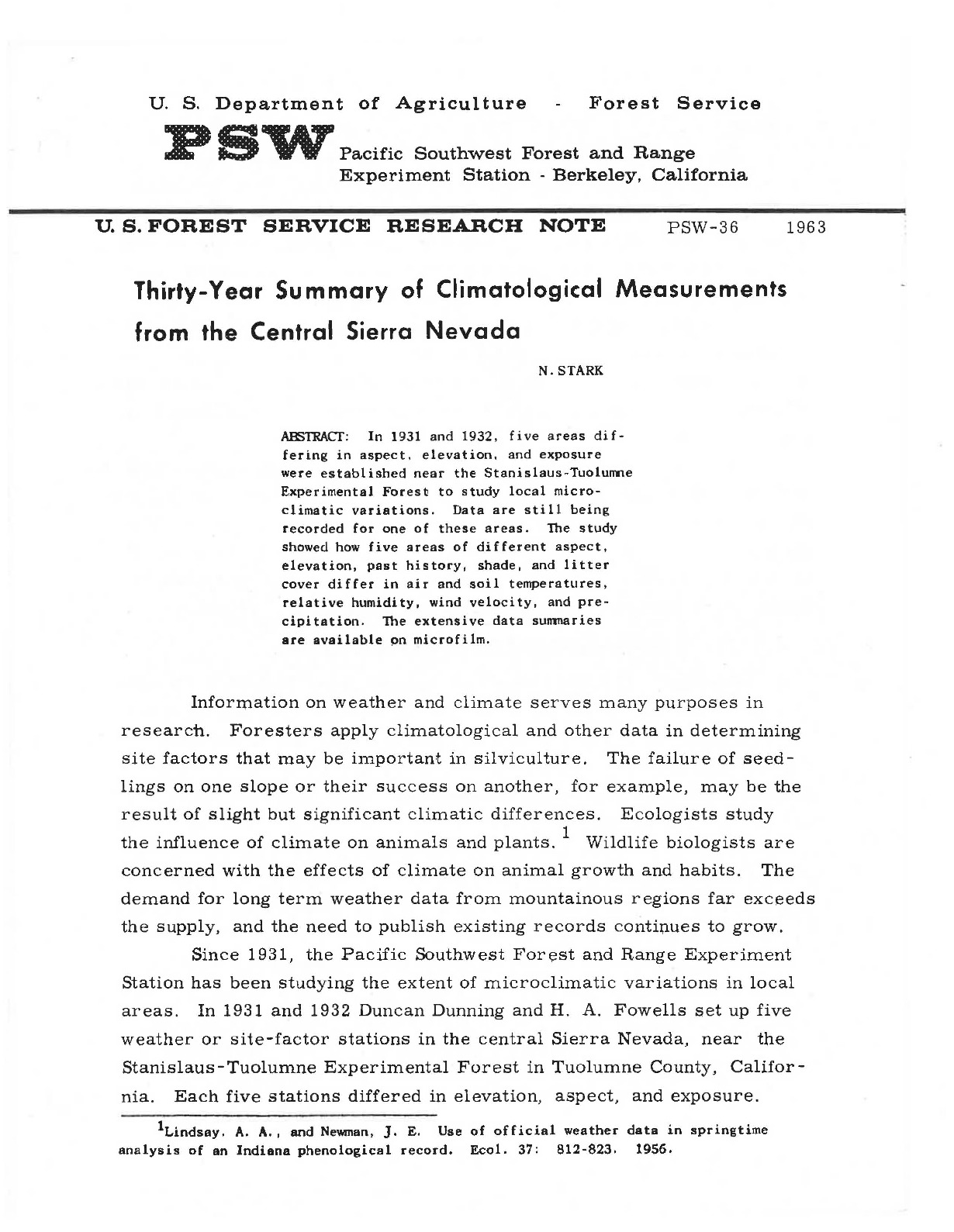 https://research.fs.usda.gov/sites/default/files/2023-03/psw_rn036.pdfFile Type: pdf
File Size: 6.47MB -
 https://research.fs.usda.gov/sites/default/files/2023-03/psw-stanislaus_history_addend.pdfFile Type: pdf
File Size: 166KB -
 https://research.fs.usda.gov/sites/default/files/2023-03/psw-summaryfromnationalregisterofhistoricplaces.pdfFile Type: pdf
File Size: 247KB -
 https://research.fs.usda.gov/sites/default/files/2023-03/psw-stanislaus_history.pdfFile Type: pdf
File Size: 2.00MB -
 https://research.fs.usda.gov/sites/default/files/2023-03/psw_1968_stark001.pdfFile Type: pdf
File Size: 715KB -
 https://research.fs.usda.gov/sites/default/files/2023-03/psw-cfres_1955_kittredge001.pdfFile Type: pdf
File Size: 237KB -
 https://research.fs.usda.gov/sites/default/files/2023-03/psw_1949_dunning001.pdfFile Type: pdf
File Size: 3.50MB -
 https://research.fs.usda.gov/sites/default/files/2023-03/psw-usda_bull426.pdfFile Type: pdf
File Size: 10.62MB
Projects
-
Project
 https://research.fs.usda.gov/psw/projects/variable-density
-
Project
 https://research.fs.usda.gov/psw/projects/methods-cutting
External Publications
-
Knapp, Eric E.; Carlson, Robert L. 2021. Stanislaus-Tuolumne Experimental Forest ‘Methods of Cutting’ study plots 8-11: 88+ years of forest composition. Fort Collins, CO: Forest Service Research Data Archive. https://doi.org/10.2737/RDS-2021-0061
-
Zheng, Z.; Ma, Q., Qian, K.; Bales, R.C. 2018. Canopy effects on snow accumulation: observations from Lidar, canonical-view photos, and continuous ground measurements from sensor networks. Remote Sensing. 10: 1769; http://dx.doi.org/10.3390/rs10111769
-
Roche, J.W.; Goulden, M.L.; Bales, R.C. 2018. Estimating evapotranspiration change due to forest treatment and fire at the basin scale in the Sierra Nevada, California. Ecohydrology. 11(7): e1978. https://doi.org/10.1002/eco.1978
-
Zeibig-Kichas, N.E.; Ardis, C.W.; Berrill, J.-P.; King, J.P. 2016. Bark thickness equations for mixed-conifer forest type in Klamath and Sierra Nevada Mountains of California. International Journal of Forestry Research. 2016: 1864039. http://dx.doi.org/10.1155/2016/1864039
-
Hull, R.J.; Leonard, O.A. 1964. Physiological aspects of parasitism in mistletoes (Arceuthobium and Phoradendron). II. The photosynthetic capacity of mistletoe. Plant Physiol. 39: 1008-1017. https://doi.org/10.1104/pp.39.6.1008
-
Hull, R.J.; Leonard, O.A. 1964. Physiological aspects of parasitism in mistletoes (Arceuthobium and Phoradendron). I. The carbohydrate nutrition of mistletoe. Plant Physiol. 39: 996-1007. https://doi.org/10.1104/pp.39.6.996
-
Kittredge, J. 1953. Influence of forests on snow in the ponderosa-sugar pine-fir zone of the central Sierra Nevada. Hilgardia. 22: 1-96. https://doi.org/10.3733/hilg.v22n01p001
Treesearch Publications
- Alan H. Taylor, Jan Oliver Wallgrün, Eric E. Knapp, Alexander Klippel, José J. Sánchez. 2025. Being there: effectiveness of a 360-degree virtual tour for increasing understanding of forest treatments for fire hazard reduction in California, USA
- Emily G. Brodie, Eric E. Knapp, Andrew M. Latimer, Hugh D. Safford, Marissa Vossmer, Sarah M. Bisbing. 2023. The century-long shadow of fire exclusion: Historical data reveal early and lasting effects of fire regime change on contemporary forest composition
- Jeffrey M. Kane, Alexis A. Bernal, Eric E. Knapp, Harold Zald. 2023. Tree resistance to drought and bark beetle-associated mortality following thinning and prescribed fire treatments
- Jan Oliver Wallgrün, Eric E. Knapp, Alan Taylor, Alexander Klippel, Jiayan Zhao, Pejman Sajjadi. 2021. Place-based learning through a proxy - variations in the perceived benefits of a virtual tour
- A. W. Slack, J. M. Kane, Eric E. Knapp. 2021. Growth and defense inform large sugar pine (Pinus lambertiana) mortality in a fire‐excluded forest of the central Sierra Nevada
- Justin P. Ziegler, Chad M. Hoffman, Brandon M. Collins, Eric E. Knapp, William E. Mell. 2021. Pyric tree spatial patterning interactions in historical and contemporary mixed conifer forests, California, USA
- Eric E. Knapp, Alexis A. Bernal, Jeffrey M. Kane, Christopher J. Fettig, Malcolm P. North. 2021. Variable thinning and prescribed fire influence tree mortality and growth during and after a severe drought
- Lauren S. Pile, Robert Deal, Daniel C. Dey, David Gwaze, John M. Kabrick, Brian J. J. Palik, Thomas M. Schuler. 2020. The 2019 National Silviculture Workshop: A focus on forest management-research partnerships
- Andrew Slack, Jeffrey Kane, Eric E. Knapp, Rosemary Sherriff. 2017. Contrasting impacts of climate and competition on large sugar pine growth and defense in a fire-excluded forest of the Central Sierra Nevada
- Eric E. Knapp, Jamie Lydersen, Malcolm P. North, Brandon M. Collins. 2017. Efficacy of variable density thinning and prescribed fire for restoring forest heterogeneity to mixed-conifer forest in the central Sierra Nevada, CA
- R. Sollmann, Angela M. White, Gina L. Tarbill, Patricia N. Manley, Eric E. Knapp. 2016. Landscape heterogeneity compensates for fuel reduction treatment effects on Northern flying squirrel populations
- Eric E. Knapp. 2015. Long-term dead wood changes in a Sierra Nevada mixed conifer forest: habitat and fire hazard implications
- Jamie Lydersen, Brandon M. Collins, Eric E. Knapp, Gary B. Roller, Scott Stephens. 2015. Relating fuel loads to overstorey structure and composition in a fire-excluded Sierra Nevada mixed conifer forest
- Eric E. Knapp, Carl N. Skinner, Malcolm P. North, Becky Estes. 2013. Long-term overstory and understory change following logging and fire exclusion in a Sierra Nevada mixed-conifer forest
- Jamie Lydersen, Malcolm P. North, Eric E. Knapp, Brandon M. Collins. 2013. Quantifying spatial patterns of tree groups and gaps in mixed-conifer forests: reference conditions and long-term changes following fire suppression and logging
- Anthony Godfrey. 2013. The search for forest facts: a history of the Pacific Southwest Forest and Range Experiment Station, 1926–2000
- Eric E. Knapp, Malcolm P. North, M. Benech, Becky Estes. 2012. Chapter 12: The variable-density thinning study at Stanislaus-Tuolumne Experimental Forest
- Noreen Parks, Eric E. Knapp. 2009. Viewing forests through a historical lens
- Mary Beth Adams, Linda Loughry, Linda Plaugher. 2008. Experimental Forests and Ranges of the USDA Forest Service
- John R. Parmeter Jr., Robert F. Scharpf. 1989. Dwarf mistletoe in red and white firs in California–23 to 28 years after inoculation
- George T. Ferrell. 1983. Growth classification systems for red fir and white fir in northern California
- Robert E Scharpf, J. R. Jr. Parmeter. 1982. Population dynamics of dwarf mistletoe on young true firs in the central Sierra Nevada, California
- George T. Ferrell. 1980. Risk-rating systems for mature red fir and white fir in northern California
- Robert F. Scharpf, John R. Parmeter Jr. 1976. Population buildup and vertical spread of dwarf mistletoe on young red and white firs in California
- Willis W. Wagener, Harold R. Offord. 1972. Logging slash: its breakdown and decay at two forests in northern California
- R.S. Smith. 1970. Borax to control Fomes annosus infection of white fir stumps
- Robert F. Scharpf. 1970. Seed viability, germination, and radicle growth of dwarf mistletoe in California
- William W. Oliver. 1970. Snow bending of sugar pine and ponderosa seedlings ... injury not permanent.
- R.F. Scharpf. 1969. Cytospora abietis associated with dwarf mistletoe on true firs in California
- Robert F. Scharpf. 1969. Dwarf Mistletoe on Red Fir . . . infection and control in understory stands
- T.A. Tousson, W. Menzinger, R.S. Smith. 1969. Role of conifer litter in ecology of Fusarium: stimulation of germination in soil in conifer forest soils
- R.F. Scharpf, J.R. Parmeter. 1967. The biology and pathology of dwarfmistletoe, Arceuthobium campylopodum F. abietinum, parasitizing true firs (Abies spp.) in California
- Richard S. Smith. 1967. Decline of the Fusarium oxysporum in the roots of Pinus lambertiana seedlings transplanted into forest soils
- Richard S. Smith, Robert V. Bega, Jerry Tarry. 1966. Additional hosts of Fomes annosus in California
- Robert F. Scharpf, J.R. Parmeter. 1966. Determining the age of dwarfmistletoe infections on red fir
- H. A. Fowells, N. B Stark. 1965. Natural regeneration in relation to environment in the mixed conifer forest type of California
- N. Stark. 1965. Natural regeneration of Sierra Nevada mixed conifers after logging
- R.F. Scharpf. 1964. Cultural variation and pathogenicity of the Colletotrichum blight fungus of dwarf mistletoe
- F.J. Baron, N. Stark, G.H. Schubert. 1964. Effects of season and rate of application of 2, 4-D and 2, 4, 5-T on pine seedlings and mountain whitethorn in California
- Clarence R. Quick. 1964. Experimental herbicidal control of Dwarfmistletoe on some California conifers
- N. Stark. 1964. Field test of hybrid pines in central California
- J.R. Jr. Parmeter, R.F. Scharpf. 1963. Dwarf mistletoe on red fir and white fir in California
- J.R. Parmeter, R.F. Scharpf. 1963. Some characteristics of dwarf mistletoe populations on red fir
- W.W. Wagener. 1961. Past fire incidence in Sierra Nevada forests
- David C. Maul. 1958. Silvical characteristics of white fir
- G.H. Schubert. 1957. Silvical characteristics of incense-cedar
- Willis W. Wagener. 1957. The limitations of two leafy mistletoes of the genus Phoradendron by low temperatures
- William E. Hallin. 1957. Silvical characteristics of Jeffrey pine
- Gilbert H. Schubert. 1956. Early survival and growth of sugar pine and white fir in clear-cut openings
- Gilbert H. Schubert. 1956. Effect of fertilizer on cone production of sugar pine
- Clarence R. Quick. 1956. Viable seeds from the duff and soil of sugar pine forests
- H.A Fowells, G.H. Schubert. 1956. Seed crops of forest trees in the pine region of California
- Donald T. Gordon. 1956. Slash disposal and seedbed preparation by tractor
- Gilbert H. Schubert. 1955. Effect of storage temperature on viability of sugar, Jeffrey, and ponderosa pine seed
- Gilbert H. Schubert. 1955. Freezing injury to sugar pine cones
- G.H. Schubert. 1955. Freezing injury to young sugar pine
- Gilbert H. Schubert. 1955. Recent trials with 2,4-D and 2,4,5-T to kill brush in the Sierra Nevada in California
- H.A. Fowells, G.H. Schubert. 1955. Planting trials with transpiration retardants in California
- James L. Averell, John C. Crowell, Clarence R. Quick, Gilbert H. Schubert. 1955. Sugar pine management—an annotated bibliography
- Clarence R. Quick. 1954. Ecology of the Sierra Nevada gooseberry in relation to blister rust control
- William E. Hallin. 1954. Unit area control--its development and application
- Gilbert H. Schubert. 1953. A trial of three chemicals as rodent repellents in direct seeding
- D. F. Roy. 1953. Effects of ground cover and class of planting stock on survival of transplants in the eastside pine type of California
- D. F. Roy, G. H. Schubert. 1953. K-screen seed spots
- Gilbert H. Schubert. 1953. Ponderosa pine cone cutting by squirrels
- Donald T. Gordon, Richard D. Cosens. 1952. Slash disposal and site preparation in converting old-growth sugar pine-fir forests to regulated stands
- Richard D. Cosens. 1952. Epicormic branching on pruned white fir
- Richard D. Cosens. 1952. Reducing logging damage
- William E. Hallin. 1951. Unit area control in California forests
- G.H. Schubert, H.A. Fowells. 1951. Recent direct seeding trials in the pine region
- H.A. Fowells, G.H. Schubert. 1951. Natural reproduction in certain cutover pine-fir stands in California
- H.A. Fowells. 1950. Some observations on the seedfall of sugar pine
- Richard D. Cosens, David Tackle. 1950. Costs of rodent control in pine regeneration in California
- V.A. Clements, C.W. Stevens, D.F. Roy. 1949. Form-class volume tables for ponderosa pine, Douglas-fir and white fir in California
- V.A. Clements, C.W. Stevens, D.F. Roy. 1949. Form-class volume tables for sugar pine and red fir in California
- H.A. Fowells. 1949. An index of ripeness for sugar pine seed
- H.A. Fowells. 1948. The temperature profile in a forest
- Duncan Dunning. 1945. Diameter class volume tables for California old-growth timber
- H.A. Fowells. 1944. Site preparation as an aid to sugar pine regeneration
- Duncan Dunning. 1942. A site classification for the mixed-conifer selection forests of the Sierra Nevada
- A.A. Hasel. 1942. Sampling error of cruises in the California pine region
- A.A. Hasel. 1941. Estimation of vegetation-type areas by linear measurement
- H.A. Fowells. 1941. The period of seasonal growth of ponderosa pine and associated species
- H.A. Fowells. 1940. Cutworm damage to seedlings in California pine stands
- H.A. Fowells, R.K. Arnold. 1939. Hardware cloth seed-spot screens reduce high surface soil temperature
- A.A. Hasel, E. Wohletz, W. B. Tallmon. 1934. Methods of cutting
- L. H. Reineke. 1933. Perfecting a stand-density index for even-aged forest
- D. Dunning, L.H. Reineke. 1933. Preliminary yield tables for second-growth stands in the California pine region
- M. R. Brundage, M. E. Krueger, Duncan Dunning. 1933. The economic significance of tree size in western Sierra Nevada lumbering
- M.E. Krueger. 1929. Factors affecting the cost of tractor logging in the California Pine Region
- Duncan Dunning. 1928. An instrument for measuring increment cores
- Duncan Dunning. 1928. A tree classification for the selection forests of the Sierra Nevada
- S.B. Show, W.B. Greeley. 1926. Timber growing and logging practice in the California pine region
- D. Dunning. 1923. Some results of cutting in the Sierra Forests of California
- J.S. Boyce. 1920. The dry-rot of incense cedar