


Cedar Cub site in the Experimental Network for Assisted Migration and Establishment Silviculture (ENAMES)
The Cedar Cub site, part of the Experimental Network for Assisted Migration and Establishment Silviculture (ENAMES) study, has been established in the Okanogan-Wenatchee National Forest to test assisted population migration of Douglas-fir using four seed sources that match historical and predicted future climates at the site, as well as the effects of planting density on reforestation success. The site burned in 2021 and will be planted in the spring of 2024.

McKenzie site 3D map showing experimental plots color-coded by the climate scenario each seed source is adapted to. Map by Laura Gonzalez Mantecon.
Land manager: USDA Forest Service.
Location: Okanogan-Wenatchee National Forest, Chelan Ranger District.
Nearest town: Winthrop, WA.
Species: Ponderosa pine (Pinus ponderosa).
Site history: This site was a second growth stand of largely ponderosa pine and Douglas-fir, with a small aspen component in riparian areas, before it burned in the 2021 Cedar Creek Fire. There is no record of any past specific vegetation management in this area, but it was being considered for commercial timber harvest and/or small tree thinning before the fire. This area is used for recreation all times of the year by mountain bikers, horse riders, skiers, hunters, and more, and it is a high-value area for the Methow Valley Community.
Site characteristics: The site is at an elevation of 4,100 ft and faces southeast-south-southwest, with a moderate slope of 12 to 20°. The site is fairly rocky, and the soils are shallow to deep ashy loams formed in colluvium, residuum and glacial till from schist, gneiss, rhyodacite, and quartz latite, with minor amounts of volcanic ash and loess. The mean annual temperature is 43 °F (coldest month: 23 °F, warmest month: 63 °F) and the mean annual precipitation is 570 mm (231 mm of which is snow).
Planting date: Spring 2024.
Contact person:
Eireann Pederson, District Silviculturist, Okanogan-Wenatchee National Forest-Chelan Ranger District.
Robert Slesak, Research Forester, USDA Forest Service, Pacific Northwest Research Station.

Pre-planting site conditions at the Cedar Cub site. Photo by Broderick DeAngelis.
Management objectives and other considerations: This site is in the Okanogan-Wenatchee National Forest Management Area 5, where the goal is to “provide opportunities for recreation and viewing scenery in a roaded natural setting with a visual quality objective of retention or partial retention.” The desired future condition is as follows: “Recreation opportunities will be maintained and enhanced within this roaded recreation area by maintaining a predominately natural appearing landscape. Even-aged stands, and stands representing different age classes, species mix, and with variable structure, will be found across the Forest.”
Site preparation: None.
Pre-planting site conditions: Since the fire burned with high intensity in this area, there is a large amount of standing dead trees and no live ones. There are scattered downed trees throughout the site, but the ground is largely clear of woody debris. Ground cover is largely herbaceous, with dense pockets of Canada thistle and a very small amount of natural ponderosa pine regeneration.
Assisted migration treatments: The team used the Seedlot Selection Tool to choose four planted seed sources (see table below).
Climate period
| Seed origin | Seed source elevation (ft) | Mean cold month temperature (°C) | Summer heat-moisture index |
Historical/local (1961-1990) | Okanogan National Forest | 3,000-4,000 | -6.1 |
|
Early-century (2011-2040) | Wenatchee National Forest | <4,000 | -3.0 |
|
Mid-century (2041-2070) | Gifford Pinchot National Forest | 2,000-2,500 | -1.3 |
|
Late-century (2017-2100) | Deschutes National Forest | 3,500-4,000 | -0.9 |
|

Seed source locations matching historical and predicted future climates for the Cedar Cub site. Map by Laura Gonzalez Mantecon.
Silvicultural treatments: Three different planting densities (see below).
Seedling stock type: Styro 10 (large containerized seedlings).
Planting density: Operational crews will plant 150, 200, and 250 trees per ac.
Monitoring: The site will be monitored to track and compare seedling survival among seed sources and silvicultural treatments. Measurements are planned for 1, 5, 10, and 15 years after planting.
The site may also serve as a demonstration plot for managers to visit and visually compare seed source performance.

Figure 1. Seedling survival for the different seed sources one year post-planting at the Cedar Cub site.

Figure 2. Seedling diameter by seed source one year post-planting at the Cedar Cub site.

Figure 3. Seedling growth by seed source one year post-planting at the Cedar Cub site.
Map
-
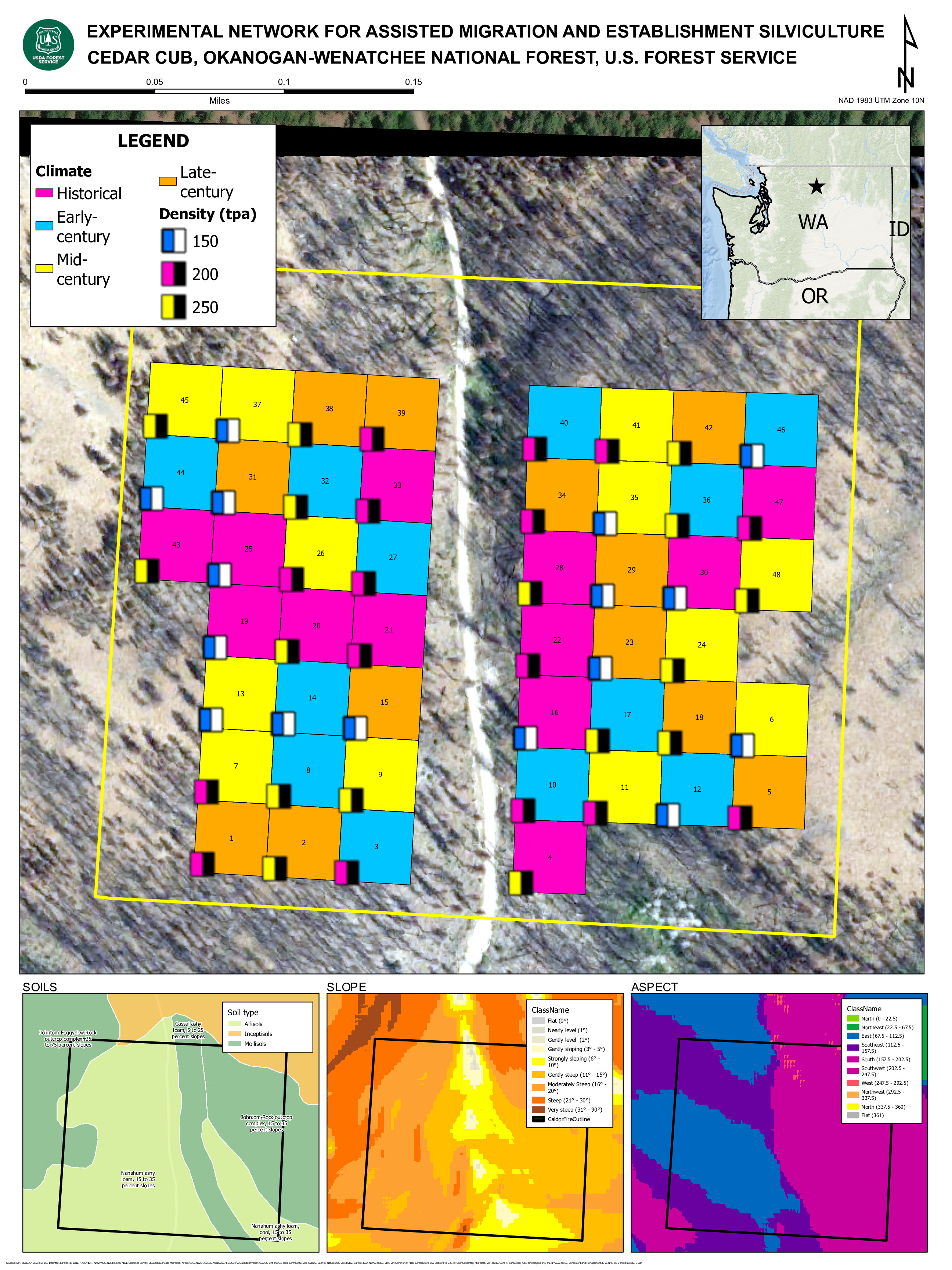 https://research.fs.usda.gov/sites/default/files/2023-10/pnw-cedarcublayout.pdfFile Type: pdf
File Size: 8.34MB
Project
-
Project
 https://research.fs.usda.gov/pnw/projects/enames