


Huck site in the Experimental Network for Assisted Migration and Establishment Silviculture (ENAMES)
The Huck site, part of the Experimental Network for Assisted Migration and Establishment Silviculture (ENAMES) study, has been established in the Fremont-Winema National Forest to test assisted population migration of ponderosa pine using four seed sources that match historical and predicted future climates at the site, as well as the effect of seedling stock type on survival and growth. The site burned during the 2021 Bootleg Fire and will be planted in 2026.

Huck during plot layout process. Photo by Mekeilah Aguilar.
Land manager: USDA Forest Service.
Location: Fremont-Winema National Forest, Bly Ranger District.
Nearest town: Beatty, OR.
Species: Ponderosa pine (Pinus ponderosa).
Site history: The site was originally a Ponderosa Pine-bitterbrush-needlegrass and White fir-ceanothus-manzanita stand part of the Huck Sale Area, which was awarded in 2021. However, the site burned in the Bootleg Fire in the summer of 2021, and it was not cut until late October or November after the hazard tree and site preparation post-fire prescriptions.
Site characteristics: The site is rather flat and at an elevation of 5,200 ft. The mean annual temperature is 27 °F (coldest month: 9 °F; warmest month: 44 °F) and mean annual precipitation is 1405 mm (979 mm of which is snow).
Contact person:
Kari O’Leary, Vegetation Manager; USDA Forest Service, Fremont-Winema National Forest.
Robert Slesak, Research Forester, USDA Forest Service, Pacific Northwest Research Station.

Huck site 3D map showing experimental plots color-coded by the climate scenario each seed source is adapted to. Map by Laura Gonzalez Mantecon.

Pre-planting site conditions at the Huck site. Photo by Allison Philips.
Management objectives and other considerations: The site falls within Management Area 5 – Timber Production in the Winema National Forest Land and Resource Management Plan. There are wildlife habitat retention areas nearby as well.
Site preparation: Salvage harvest.
Pre-planting site conditions: The area was logged using normal ground-based logging methods, so slash is minimal, as needed for erosion control. The burn was so severe that only snags over 21 inches were left after the fire and salvage timber contract. Most of the area burned with high tree mortality, so natural regeneration will likely be low.
Experimental design: A randomized complete block with four replications per treatment applied to 0.5-acre plots.
Assisted migration treatments: The team used the Seedlot Selection Tool to choose four planted seed sources (see table below.)
Climate period
| Seed origin | Seed source elevation (ft) | Mean cold month temperature (°C) | Summer heat-moisture index |
Historical/local (1961-1990) | Fremont-Winema NF | 5000-6000 | -2.6 | 145.05 |
Early-century (2011-2040) | CA Seed Zone 741 Klamath/Shasta NF | 5000-5500 | -0.5 | 154.6 |
Mid-century (2041-2070) | CA Seed Zone 523 Lassen/Plumas NF | 4500-5000 | 0.5 | 192.25 |
Late-century (2071-2100) | CA Seed Zone 531 | 5000-5500 | 2.45 | 238.35 |

Seed source locations matching historical and predicted future climates for the Huck site. Map by Scout Dahms-May.
Silvicultural treatments: Two different seedling stock types (see below.)
Planting density: Operational contract crews will plant 222 trees per ac.
Seedling stock type: 2-0 bareroot and 1-0 containerized seedlings.
Monitoring: The site will be monitored to track and compare seedling survival among seed sources and silvicultural treatments. Measurements are planned for 1, 5, 10, and 15 years after planting.
The site may also serve as a demonstration plot for managers to visit and visually compare seed source performance.
To be available soon.
Map
-
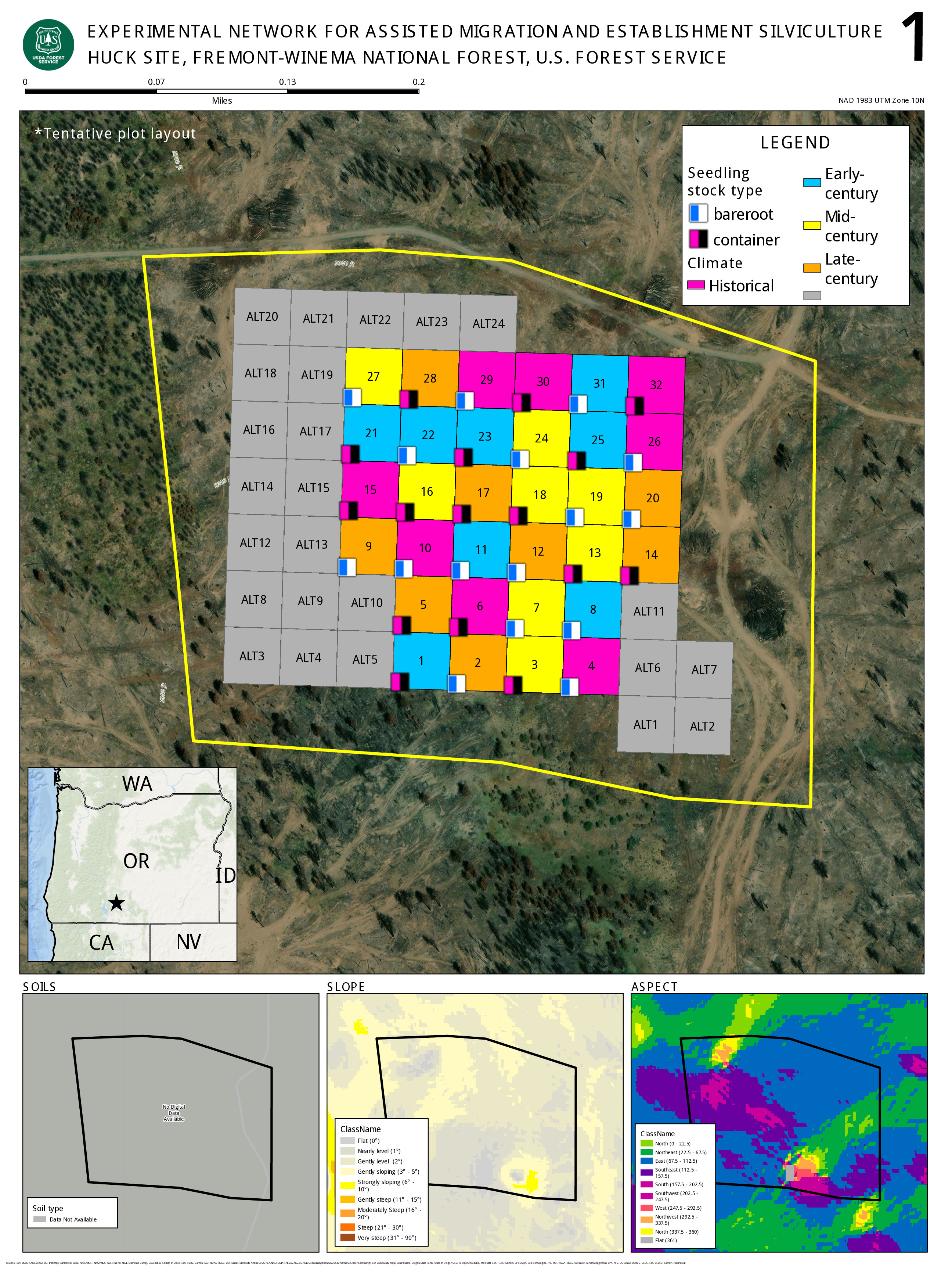 https://research.fs.usda.gov/sites/default/files/2023-10/pnw-hucklayout.pdfFile Type: pdf
File Size: 4.07MB
Project
-
Project
 https://research.fs.usda.gov/pnw/projects/enames