


White River site in the Experimental Network for Assisted Migration and Establishment Silviculture (ENAMES)
The White River site, part of the Experimental Network for Assisted Migration and Establishment Silviculture (ENAMES) study, has been established to test assisted population migration of Douglas-fir using four seed sources that match historical and predicted future climates at the site, as well as the effects of planting density on reforestation success. The site burned during the 2020 White River Fire and was planted in the spring of 2023.

White River site 3D map showing experimental plots color-coded by the climate scenario each seed source is adapted to. Map by Laura Gonzalez Mantecon.
Land manager: USDA Forest Service.
Location: Mount Hood National Forest, Barlow Ranger District.
Nearest town: Maupin, OR.
Species: Ponderosa pine (Pinus ponderosa.)
Site characteristics: The site sits on a ~10- to 25-percent north-northwest slope at 3,100 ft of elevation. Soils are deep, coarse, silt loams derived from glacial till mixed with volcanic ash. Mean annual temperature is 45 °F (coldest month: 29 °F; warmest month: 62 °F), and mean annual precipitation is 756 mm (150 mm of which is snow.)
Site history: Part of the unit was clearcut in 1979 and planted in 1984 with ponderosa pine at 8- by 8-ft spacing (440 trees per ac.) Overstory densities indicate a commercial thin around the same time in the areas that were not clearcut. No stand improvement treatments have occurred since then. The site burned at high severity with nearly 100-percent tree mortality in the 2020 White River Fire.
Planting date: Spring 2023.
Contact person:
Lisa Garrigues, Silviculture Forester, USDA Forest Service, Mount Hood National Forest-Barlow Ranger District.
Robert Slesak, Research Forester, USDA Forest Service, Pacific Northwest Research Station.

Pre-planting site conditions at the White River site. Photo by Michelle Agne.
Management objectives and other considerations: The east side of Mount Hood National Forest is showing signs of drought-related stress. This has affected our planting program because survival rates depend on moisture availability during planting activities and the first growing season. This research aims to enhance fuels management; mitigate fire risk; and reduce tree mortality due to drought, insect, and disease stress. To meet these objectives, treatments often focus on reducing tree densities and competition to promote overall growth and vigor.
Our current planting prescriptions typically consist of two to three species (ponderosa pine, western larch, and western white pine) at densities of ~200 trees per ac. This is a lower density than prior plantation management. Planting at this density allows us to meet forest standards, while considering survival rates of seedlings and natural variance in planting densities due to topography, soils, and planting site conditions. Natural regeneration is typically expected as well, largely dominated by grand fir and Douglas-fir.

A recently planted seedling at the White River site. Photo by Broderick DeAngelis.
Testing different densities will provide valuable data regarding survival and competition within young stands facing drought-related stress.
Site preparation: None.
Pre-planting site conditions: The site experienced nearly 100-percent tree mortality in the overstory. Snags are a mix of small-diameter ponderosa pine (12 to 15 inches diameter at breast height) and larger Douglas-fir. At the time of planting, some trees were down due to breakage. Slash recruitment is expected to increase as overstory snags decay and fall. Surrounding areas experienced moderate to high tree mortality; some recruitment of Douglas-fir and ponderosa pine is expected. Little to no natural regeneration of conifer species has been noted to date. Some herbaceous plant regeneration has occurred, largely blackberry and thistle.
Experimental design: The experimental design in this site is a randomized complete block with four replications per treatment applied to 0.5-acre plots.
Assisted migration treatments: The team used the Seedlot Selection Tool to choose four planted seed sources (see table below.)
Climate period
| Seed origin | Seed source elevation (ft) | Mean cold month temperature (°C) | Summer heat-moisture index |
Historical/local (1961-1990) | Mount Hood National Forest | 2,000-3,000 | -1.12 | 220.3 |
Early-century (2011-2040) | Deschutes National Forest | 3,500-4,000 | -0.9 | 148.1 |
Mid-century (2041-2070) | Umpqua National Forest | 3,500-4,500 | 1.25 | 68.9 |
Late-century (2017-2100) | Rogue River National Forest | 2,000-3,000 | 2.51 | 170.3 |

Seed source locations matching historical and predicted future climates for the site. Map by Laura Gonzalez Mantecon.
Silvicultural treatments: Three different planting densities (see below).
Planting density: Operational contract crews planted 150, 200, and 250 trees per ac.
Seedling stock type: Containerized (Styro 7.9, 91/130).
Monitoring: The site will be monitored to track and compare seedling survival and growth among seed sources. The team will take initial measurements in the first year after planting, with follow-up measurements planned for 5, 10, and 15 years after planting.
The site may also serve as a demonstration plot for managers to visit and visually compare seed source performance.

Figure 1. Seedling survival for the different seed sources one year post-planting at the White River site.

Figure 2. Seedling diameter by seed source one year post-planting at the White River site.

Figure 3. Seedling growth by seed source one year post-planting at the White River site.
Map
-
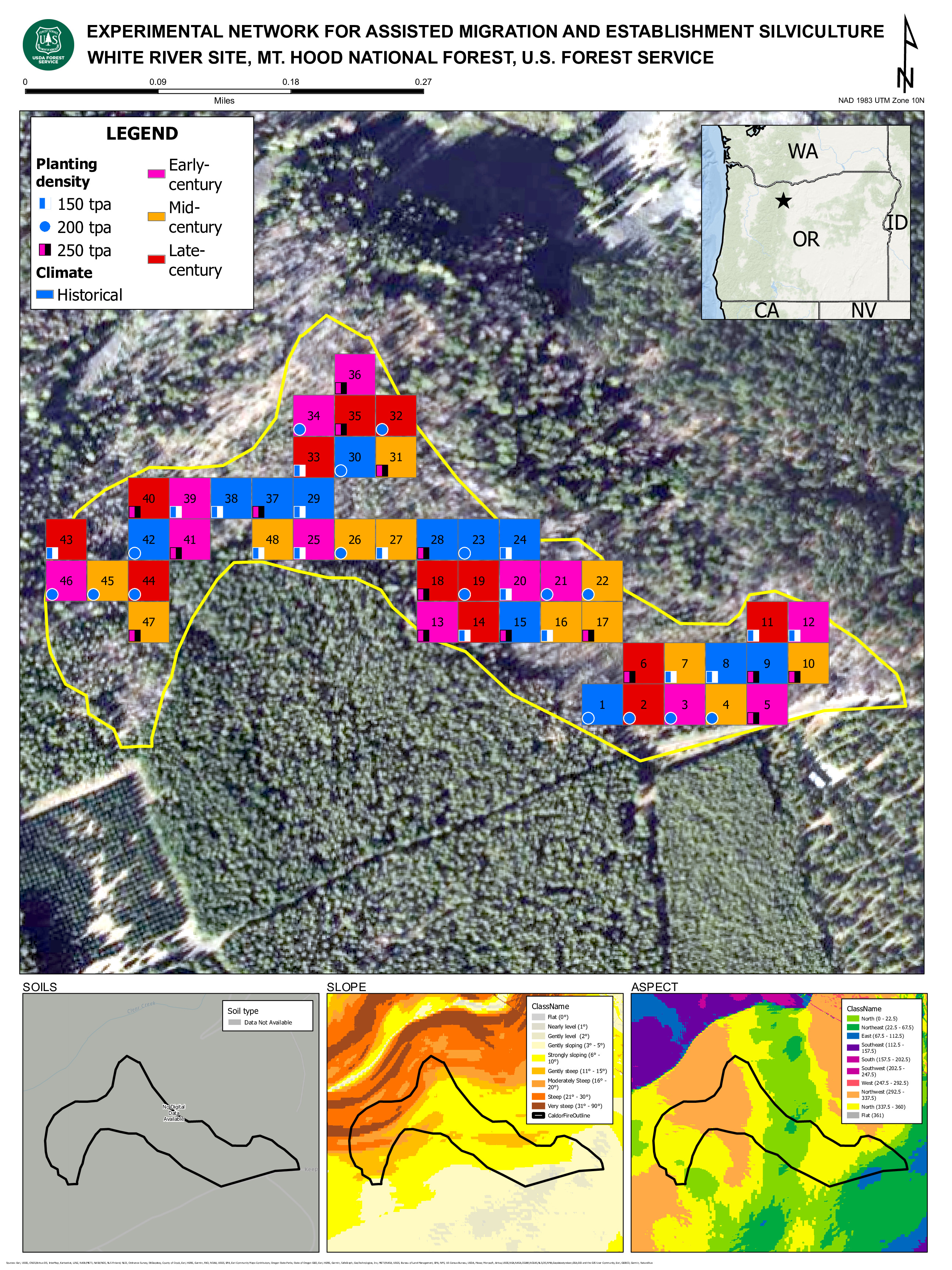 https://research.fs.usda.gov/sites/default/files/2023-10/whiteriverlayout.pdfFile Type: pdf
File Size: 7.33MB
Project
-
Project
 https://research.fs.usda.gov/pnw/projects/enames