


Winterfelled site in the Experimental Network for Assisted Migration and Establishment Silviculture (ENAMES)
The Winterfelled site, part of the Experimental Network for Assisted Migration and Establishment Silviculture (ENAMES) study, has been established in Oregon Department of Forestry’s land in NW Oregon to test assisted population migration of Douglas-fir using four seed sources that match historical and predicted future climates at the site, as well as the effect of herbicide application on seedling survival and growth. The site was harvested in 2022 and will be planted in 2024.

Winterfelled site 3D map showing experimental plots color-coded by the climate scenario each seed source is adapted to. Map by Laura Gonzalez Mantecon.
Land manager: Oregon Department of Forestry.
Nearest town: Mill City, OR.
Species: Douglas-fir (Pseudotsuga menziesii.)
Site history: This site was a predominantly Douglas-fir stand that was harvested in 2022.
Site characteristics: The site is at an elevation of 2,400 ft and faces south, with a gentle slope of 10–25°. The soils are deep, well-drained gravelly loams formed in colluvium and residuum from tuffaceous sandstone, siltstone, and basalt. The mean annual temperature is 38 °F (coldest month: 30 °F; warmest month: 52 °F) and mean annual precipitation is 3704 mm (1346 mm of which is snow).
Planting date: Spring 2024.
Contact person:
John Walter, Young Stand Silvicultural Specialist, Oregon Department of Forestry.
Robert Slesak, Research Forester, USDA Forest Service, Pacific Northwest Research Station.

Pre-planting site conditions at the Winterfelled site. Photo by Broderick DeAngelis.
Management objectives and other considerations: This site is managed primarily for timber production.
Site preparation: TBA.
Pre-planting site conditions: Stumps and scattered burn piles cover the site, as well as some herbaceous understory regeneration that includes ferns. There is no remaining overstory.
Experimental design: A randomized complete block with four replications per treatment applied to 0.5-ac plots.
Assisted migration treatments: The team used the Seedlot Selection Tool to choose four planted seed sources (see table below). The seed was sourced from Bureau of Land Management (BLM) seed lots.
Climate period
| Seed origin | Seed source elevation (ft) | Mean cold month temperature (°C) | Summer heat-moisture index |
Historical/local (1961-1990) | BLM - Molalla area | 2,700–4,000 | 0.87 | 34.2 |
Early-century (2011-2040) | BLM - McKenzie area | 2,700-4,000 | 2.85 | 67.1 |
Mid-century (2041-2070) | BLM - McKenzie area | 800–2,700 | 3.50 | 74.4 |
Late-century (2017-2100) | BLM - Coquille 16 area | <1,600 | 6.36 | 80.6 |

Seed source locations matching historical and predicted future climates for the Winterfelled site. Map by Laura Gonzalez Mantecon.
Silvicultural treatments: Three herbicide application treatments: No spray, one application, two applications.
Planting density: Operational contract crews will plant 300 trees per ac.
Seedling stock type: Containerized stock (Styro 515).
Monitoring: The site will be monitored to track and compare seedling survival among seed sources and silvicultural treatments. Measurements are planned for 1, 5, 10, and 15 years after planting.
The site may also serve as a demonstration plot for managers to visit and visually compare seed source performance.

View from the Winterfelled site. Photo by Broderick DeAngelis.

Figure 1. Seedling survival for the different seed sources one year post-planting at the Winterfelled site.

Figure 2. Seedling diameter by seed source one year post-planting at the Winterfelled site.

Figure 3. Seedling growth by seed source one year post-planting at the Winterfelled site.
Map
-
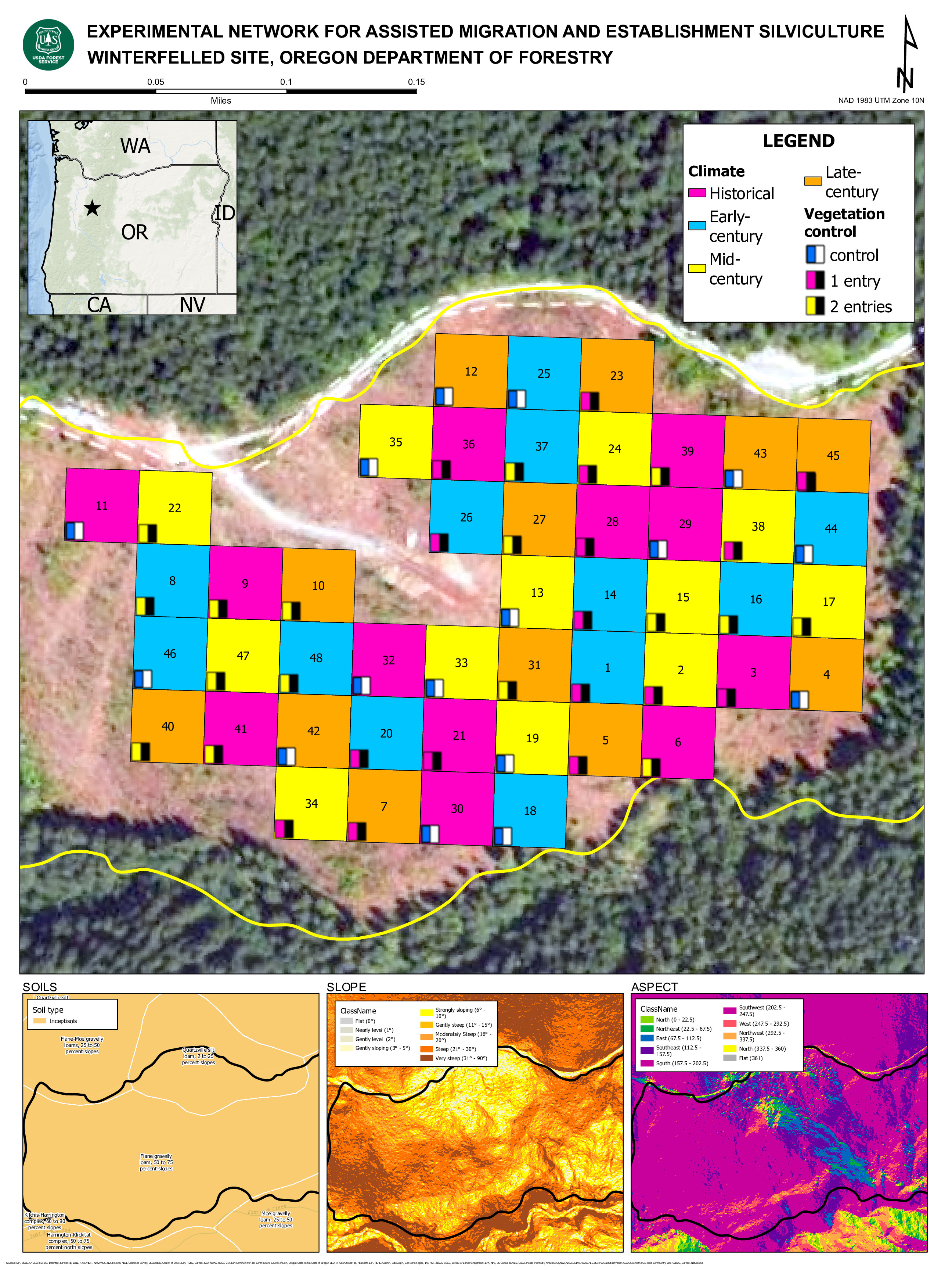 https://research.fs.usda.gov/sites/default/files/2023-10/pnw-winterfelledlayout.pdfFile Type: pdf
File Size: 6.63MB
Project
-
Project
 https://research.fs.usda.gov/pnw/projects/enames